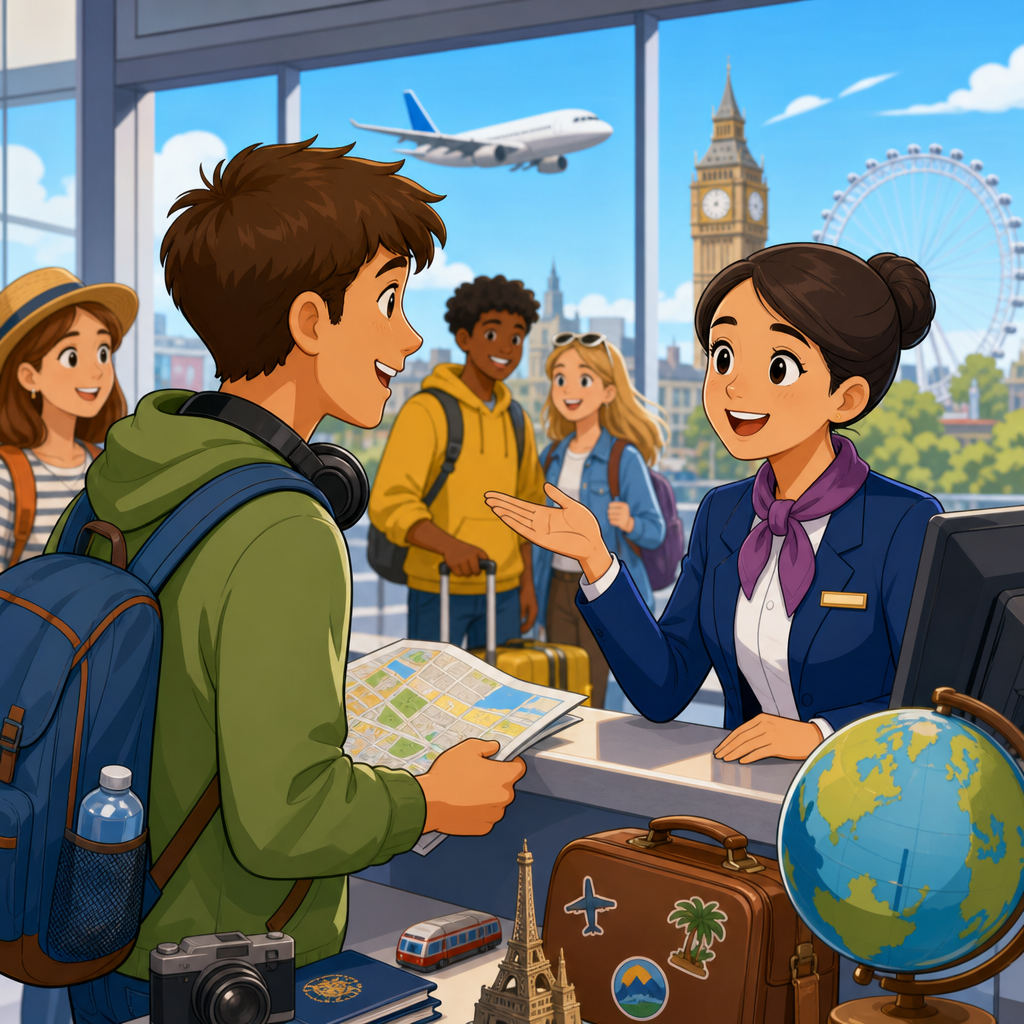
Travel English helps ESL learners handle the real conversations that happen before, during, and after a trip. It includes the words, phrases, questions, and listening skills needed in airports, hotels, restaurants, train stations, shops, and emergencies. A complete travel English phrasebook is more than a list of translations. It is a practical guide to communication under time pressure, often with background noise, unfamiliar accents, and limited chances to ask someone to repeat. I have taught travel-focused English to adult learners preparing for holidays, study tours, business trips, and immigration interviews, and the same pattern appears every time: students do not need perfect grammar first. They need useful phrases they can say clearly and understand quickly.
English for travel matters because tourism, transportation, and hospitality often rely on simple international English, even in countries where English is not the main language. A traveler may need to check in for a flight in Seoul, ask for directions in Rome, report a lost bag in Dubai, or order food in Prague, all in English. The goal is not to sound advanced. The goal is to solve problems politely and efficiently. That means learning high-frequency travel vocabulary, functional sentence patterns, and survival strategies such as confirming details, spelling names, checking prices, and asking for help. This hub article covers the full travel journey so learners can build confidence and move into more detailed lessons from a strong foundation.
Before memorizing phrases, it helps to understand how travel English works. Most useful expressions fall into a few functions: requesting, confirming, refusing, apologizing, thanking, and clarifying. For example, “Could you tell me where gate 22 is?” is a request. “So the train leaves at 6:40, right?” is confirmation. “I’m sorry, I don’t understand. Could you say that again more slowly?” is clarification. These functions appear in every travel setting. If learners master them, they can adapt one phrase pattern to many situations. That is why this guide emphasizes practical sentence frames, not isolated vocabulary only.
Pronunciation is also central to travel communication. In class, I often see learners know the correct words but still struggle because stress, numbers, dates, and letters are hard to catch in fast speech. Saying “thirteen” and “thirty” clearly can prevent expensive mistakes. Understanding “fifteen A” versus “fifty eight” can matter at a boarding gate. Travel English therefore includes listening for key information: times, platform numbers, room numbers, passports, receipts, reservations, addresses, and names. Learners should practice with realistic dialogues and repeat phrases aloud, because travel is spoken language in action, not a written test.
Core travel phrases every ESL learner should know
The most useful travel phrases are short, polite, and flexible. Start with greetings and basic needs: “Hello,” “Excuse me,” “Please,” “Thank you,” and “Sorry.” Then add action phrases: “I need help,” “I have a reservation,” “I’m looking for…,” “How much is this?,” “Where is…?,” and “Can you show me on the map?” These expressions work in nearly every travel scenario. Learners should also know how to give personal information: “My name is…,” “Here is my passport,” “My flight number is…,” and “I’m staying for five days.” When students can combine these phrases with clear nouns like ticket, gate, station, hotel, receipt, bathroom, menu, and pharmacy, they become much more independent.
Questions are especially important because travel requires constant information gathering. The most valuable forms are “Where is…?,” “When does it leave?,” “What time does it open?,” “How long does it take?,” “Which platform is it?,” and “Is this the right line?” At a practical level, yes-or-no questions can be easier under stress than open questions. Instead of asking “Can you explain the bus system?” a learner can ask “Does this bus go to the city center?” That usually produces a faster, clearer answer. Direct, simple questions reduce misunderstanding and are easier for both speaker and listener, especially when one or both are using English as an additional language.
Politeness should be simple and natural, not overly formal. In travel contexts, “Could you…?” and “Can I…?” are usually enough. “Could you help me, please?” sounds respectful. “Can I pay by card?” is clear and common. Learners sometimes memorize long textbook sentences they never actually use. Shorter language often works better. For example, “One ticket to Oxford, please,” is perfectly acceptable at a train station. “A table for two, please,” is standard at a restaurant. “Late check-out, if possible,” is useful at a hotel front desk. The key is confident delivery, accurate details, and the ability to follow up if the first answer is unclear.
Airport and flight English from check-in to arrival
Airports create some of the most stressful travel conversations, so learners benefit from knowing the sequence. At check-in, common phrases include “I’d like to check in,” “Here is my passport,” “I have one bag to check,” and “Can I have an aisle seat?” Staff may ask, “Did you pack your bags yourself?” “Do you have any liquids?” or “Would you like a window or aisle?” Security language includes tray, laptop, boarding pass, belt, metal objects, and gate. At the gate, learners may hear “final call,” “boarding begins,” “delayed,” “cancelled,” or “now boarding rows 20 to 30.” These are not academic words; they are decision words, and missing them can disrupt an entire trip.
Arrival English matters just as much. After landing, travelers may need to understand signs and questions at immigration, baggage claim, and customs. Useful phrases include “I’m here on holiday,” “I’m here for business,” “I’m staying at this hotel,” and “Nothing to declare.” If a bag does not arrive, the learner should be ready to say, “My suitcase is missing,” “This is my baggage tag,” “It is black with a red ribbon,” and “When will it be delivered?” A clear physical description is often more helpful than perfect grammar. In real service encounters, staff respond to useful information: color, size, brand, flight number, and contact details.
One common difficulty is numbers. Flight times, terminal numbers, baggage belts, and passport dates are easy to confuse. I advise learners to repeat critical details back: “Gate 14, correct?” “Boarding at 7:25?” “Carousel 6?” This confirmation habit prevents mistakes and shows active listening. If pronunciation is a challenge, spelling is another survival tool. Knowing the international spelling alphabet used in aviation can help, but even basic letter clarity is useful when giving names or email addresses. Travelers do not need elegant conversation at the airport. They need accurate exchanges, calm repetition, and the confidence to ask staff to slow down.
Hotel, accommodation, and check-in conversations
Hotel English centers on reservations, requests, and problem solving. At check-in, a traveler often says, “I have a reservation under the name…,” “I booked for three nights,” or “Is breakfast included?” Front desk staff may ask for identification, a credit card, or a booking confirmation. Important terms include single room, double room, twin room, non-smoking, key card, deposit, and late check-out. Learners should also know how to ask about essentials: “What time is breakfast?” “Is there Wi-Fi in the room?” “Could I have the password?” “How do I get to my room?” These phrases cover most first-day accommodation needs.
Problems in accommodation require more precise language. If something is wrong, learners should be able to say, “The air conditioning isn’t working,” “There’s no hot water,” “The room is too noisy,” “I asked for a double room,” or “Could someone help with my luggage?” Specificity gets faster results. Saying “There is a problem” is less useful than naming the exact issue. In serviced apartments or hostels, additional words may be needed, such as shared bathroom, locker, towel, cleaning service, and self check-in. Because accommodation styles vary widely, learners benefit from recognizing booking language before arrival, not only speaking at the front desk.
Travelers also need tact. Complaints should be firm but polite: “I’m sorry, but the room hasn’t been cleaned,” or “Excuse me, I think there’s been a mistake with the bill.” This tone is effective in hotels worldwide. Good travel English does not mean speaking aggressively. It means being clear enough to solve a problem without creating a new one. When I coach learners for independent travel, we practice three steps: state the problem, give the key detail, and ask for the solution. For example: “The shower isn’t working. Room 508. Could you send someone up, please?” That structure works reliably.
Transport, directions, and getting around a new city
Once outside the airport or hotel, learners often need English for buses, trains, taxis, rideshare services, and walking directions. The core phrases are simple: “How do I get to the city center?” “Does this train stop at King’s Cross?” “Where can I buy a ticket?” “Is this seat taken?” and “Could you let me know when we get there?” In taxis, travelers commonly say, “Please take me to this address,” while showing the address on a phone. That is a smart strategy because pronunciation of street names can be difficult for both sides. Travelers should always confirm the destination before the ride begins.
Understanding directions requires key location words: left, right, straight ahead, across from, next to, between, near, far, corner, block, entrance, exit, platform, line, transfer, and last stop. These words appear in stations, on maps, and in spoken instructions. Learners should also know that native and non-native speakers often shorten directions: “Two stops,” “Change at Central,” or “It’s about ten minutes on foot.” Short answers are normal, not rude. In dense transport systems such as London, Singapore, or Tokyo, signage supports spoken English, so learners should combine listening with map reading and station names.
| Situation | Useful phrase | Why it works |
|---|---|---|
| Buying a ticket | One return ticket to Bristol, please. | Gives destination and ticket type quickly. |
| Checking direction | Does this bus go to the museum? | Gets a clear yes or no answer. |
| Taxi ride | Please take me to this address. | Avoids pronunciation confusion. |
| Asking distance | How long does it take on foot? | Helps decide whether to walk. |
| Missing a stop | I think I missed my stop. What should I do? | Requests immediate practical help. |
Real-world travel also includes delays, changes, and uncertainty. Learners should prepare for phrases such as “The train has been cancelled,” “There’s a replacement bus service,” or “Expect a 20-minute delay.” In those moments, the best response is to ask for the next action: “What’s the best way to get there now?” This is more useful than repeating frustration. Strong travel English supports mobility by helping learners adapt when plans fail. That is why transport vocabulary is a core part of any serious English for travel course.
Restaurants, shopping, and everyday travel interactions
Food and shopping are where many learners want more confidence because these interactions happen daily and often feel personal. In restaurants, useful phrases include “A table for one, please,” “Could I see the menu?” “What do you recommend?” “I’m allergic to nuts,” “Could I have this without cheese?” and “Could we have the bill, please?” Allergy language is especially important. Learners should memorize exact terms for common risks such as nuts, shellfish, dairy, eggs, and gluten. Staff cannot act on vague statements. Clear food English protects health and avoids embarrassing mistakes.
Shopping English is equally practical. Travelers need phrases such as “How much is this?” “Do you have this in a larger size?” “Can I try it on?” “I’m just looking, thanks,” and “Can I pay by card?” In markets, learners may also hear bargaining language, but in many shops prices are fixed, so polite directness is enough. They should understand receipt, cash, refund, exchange, fitting room, and out of stock. Many everyday tasks also overlap with travel needs: buying a SIM card, asking for a charger, finding a pharmacy, or mailing a postcard. These are small interactions, but they shape the comfort of the whole trip.
Social English matters too. A traveler may need to make small talk with hosts, guides, other travelers, or service staff. Useful friendly phrases include “Where are you from?” “Is this your first time here?” “Do you have any local recommendations?” and “The food is excellent.” These expressions open conversation without being intrusive. At the same time, learners should know how to set boundaries politely: “No, thank you,” “I’m fine, thanks,” or “I’d prefer something quieter.” Travel is not only about transactions. It is also about relationships, impressions, and feeling capable in unfamiliar places.
Emergency English, study habits, and how to keep improving
Every travel phrasebook must cover emergencies. Learners should know how to say, “I need a doctor,” “Call the police,” “I’ve lost my passport,” “My wallet has been stolen,” “I need a pharmacy,” and “I’m allergic to penicillin.” These phrases should be practiced until they come out automatically. It also helps to know the local address of the hotel, emergency numbers, and how to describe pain: headache, fever, stomachache, dizziness, and trouble breathing. In serious situations, simple and direct language is best. Staff, police, and medical workers need facts, not long explanations.
Improvement comes fastest when learners practice by scenario, not by alphabetical vocabulary lists. Build mini-dialogues for airports, hotels, restaurants, trains, and emergencies. Record yourself saying them. Practice numbers, dates, and spelling daily. Use tools such as Google Translate conversation mode carefully for backup, but do not depend on them for everything because internet access, background noise, and translation errors can cause problems. Better tools for long-term learning include Anki for spaced repetition, YouGlish for hearing phrases in real speech, and role-play with a tutor or study partner. The best phrasebook is one you can actually use under pressure.
A complete travel English phrasebook gives ESL learners a practical system for moving through the world with less stress. The essential skills are clear requests, accurate confirmation, polite problem solving, and enough vocabulary to manage transport, accommodation, food, shopping, and emergencies. Learners do not need advanced grammar to travel successfully. They need high-frequency phrases they can pronounce clearly and understand in fast, imperfect real-life speech. When practiced by situation, these expressions become reliable tools rather than forgotten study notes.
Use this guide as the hub for your English for travel study plan. Review one scenario at a time, speak the phrases aloud, and build your own personal list based on the trips you expect to take. If you are preparing for airports, start there. If you worry most about hotels or restaurants, begin with those sections. Consistent practice with realistic language creates confidence quickly. Save this article, revisit it before every trip, and turn travel English into a skill you can use anywhere.
Frequently Asked Questions
1. What should a complete travel English phrasebook for ESL learners include?
A complete travel English phrasebook should cover far more than basic vocabulary lists or direct translations. It should prepare learners for the real situations they are most likely to face before, during, and after a trip. That means it needs practical phrases for airports, immigration, customs, public transportation, hotels, restaurants, shopping, sightseeing, asking for directions, and handling emergencies. It should also include common questions travelers hear from other people, not just the questions they want to ask themselves. For example, an ESL learner may memorize “Where is gate 12?” but also needs to understand “May I see your boarding pass?” or “Do you have anything to declare?”
A strong phrasebook also teaches functional communication. In real travel situations, learners need to make requests, clarify information, solve problems, confirm details, and respond quickly under pressure. Useful sections might include checking in at a hotel, changing a reservation, reporting lost luggage, asking about schedules, ordering food with dietary restrictions, and explaining a problem in simple English. Phrases such as “Could you say that again, please?” “I didn’t catch that,” and “Can you write it down for me?” are just as important as destination-specific vocabulary because they help learners stay calm and keep the conversation going.
Another essential feature is listening support. Travel English often happens in noisy, fast-moving environments with unfamiliar accents and limited time. A complete phrasebook should therefore include common variations of the same message, short natural dialogues, and examples of polite but realistic spoken English. Ideally, it should also help learners understand numbers, dates, times, prices, platform announcements, and directions, since these often cause confusion during travel. In short, the best travel English phrasebook is practical, situational, and designed to help learners communicate successfully when the pressure is real.
2. How is travel English different from general English study?
Travel English is different from general English because it focuses on immediate, goal-oriented communication in specific real-world situations. In a general English course, learners may spend time on broad grammar topics, essay writing, long readings, or abstract conversation themes. Those skills are valuable, but travel English is more focused and urgent. The learner usually needs to understand and respond quickly, often with very little time to think. At an airport counter, for example, the goal is not to have a long conversation. The goal is to understand instructions, answer correctly, and move forward without confusion.
Another major difference is the type of language used. Travel English emphasizes high-frequency phrases, predictable question patterns, and survival communication. Learners need language for checking in, boarding, finding transportation, booking rooms, asking for help, reading signs, and handling unexpected problems. They also need short, polite, effective sentences that work even if their grammar is not perfect. In travel situations, clear communication matters more than sounding advanced. Saying “I need help. My bag is missing” is far more useful than trying to produce a complex sentence and becoming stuck.
Travel English also places a much stronger emphasis on listening under pressure. In class, learners may hear slow, clear English from a teacher. During travel, they may hear announcements over speakers, rapid questions from staff, or informal speech from locals. This means learners must practice understanding English in less controlled conditions. A good travel phrasebook supports this by teaching not only what to say, but what to expect to hear. That practical focus is what makes travel English such an important area of study for ESL learners who want confidence and independence while traveling.
3. What are the most important travel English phrases every ESL learner should memorize first?
If an ESL learner is starting from zero or preparing for a trip very soon, the first priority should be core phrases that can be used in many settings. These include asking for help, requesting repetition, confirming information, and handling basic transactions. Some of the most important phrases are: “Can you help me, please?” “Could you say that again?” “I don’t understand.” “Where is…?” “How much is this?” “What time does it leave?” “I have a reservation.” “I would like…” and “I need a taxi.” These phrases appear again and again across airports, hotels, restaurants, shops, and stations.
It is also essential to memorize phrases for personal information and problem-solving. Learners should be ready to say their name, nationality, room number, destination, and travel details. They should also know how to explain common problems such as “My flight is delayed,” “My luggage is lost,” “I missed my train,” “There is a problem with my room,” or “I need a doctor.” In real travel, these problem-solving phrases often matter more than tourist vocabulary because they help learners manage stressful situations clearly and quickly.
Finally, learners should memorize phrases that give them communication control. This is a highly practical strategy. Expressions like “Please speak slowly,” “Can you repeat that?” “Can you show me on the map?” “Can you write it down?” and “Do you accept credit cards?” can prevent many misunderstandings. The best first set of travel English phrases is not the most advanced set. It is the set that helps the learner ask, understand, confirm, and solve basic problems in almost any travel environment. Once those phrases are automatic, confidence grows much faster.
4. How can ESL learners practice travel English effectively before a trip?
The most effective way to practice travel English before a trip is to train for realistic situations rather than studying isolated words. Instead of memorizing long vocabulary lists, learners should practice short role-plays based on actual travel scenarios. For example, they can rehearse checking in at an airport, asking a hotel receptionist about breakfast hours, ordering at a restaurant, buying a train ticket, or asking for directions in a city. This kind of targeted practice helps learners connect language to action, which makes it easier to remember under stress.
Listening practice is equally important. Travel situations are rarely quiet or slow, so learners should listen to natural spoken English, not only classroom-style recordings. They can use airport dialogue videos, hotel check-in conversations, travel podcasts, public announcement recordings, and restaurant interactions. It is especially useful to practice with different accents and speech speeds. Learners should focus on catching key information such as times, prices, gate numbers, room details, destinations, and instructions. Even a few minutes of daily listening to practical travel conversations can make a major difference in confidence and comprehension.
Another smart method is to build a personal travel phrase toolkit. Learners can write down the exact phrases they are most likely to need based on their trip. For example, someone staying in a hotel should prepare hotel phrases, while someone using trains extensively should focus on station and ticket language. Practicing these phrases aloud is crucial because speaking from memory is different from recognizing words on a page. Repetition, shadowing, and self-recording can help learners sound clearer and respond faster. The goal is not perfection. The goal is readiness. When learners practice the situations they are likely to face, travel English becomes much more useful and much less intimidating.
5. Why is a phrasebook still useful if learners can use translation apps while traveling?
Translation apps can be helpful, but they are not a complete replacement for a well-designed travel English phrasebook. In many travel situations, speed matters. At immigration, security, ticket counters, boarding gates, or emergency situations, there may not be enough time to unlock a phone, type a sentence, wait for a translation, and hope it matches the situation correctly. A phrasebook prepares learners to respond immediately with useful, dependable language. That speed can reduce stress and prevent misunderstandings when every second counts.
A phrasebook is also valuable because it teaches patterns, not just one-time translations. Translation apps often give learners a sentence, but they do not always help them understand how real conversations develop. A good phrasebook shows what to say, what the other person may say in response, and how to continue the interaction. For example, it does not stop at “I have a reservation.” It also prepares the learner for follow-up questions such as “Can I see your ID?” “Would you like a single or double room?” or “Breakfast is served from 7 to 10.” This conversational structure is what helps learners function more independently.
There is also the issue of reliability. Internet access may be limited, battery power may run low, background noise may make voice tools less effective, and automatic translations are not always accurate in practical travel contexts. A phrasebook gives learners a stable, organized system they can trust. It builds confidence, improves listening expectations, and helps learners communicate even when technology fails. The best approach is to use both: a strong travel English phrasebook as the foundation, and translation apps as backup support. For ESL learners who want real-world confidence, the phrasebook remains one of the most practical tools they can carry.