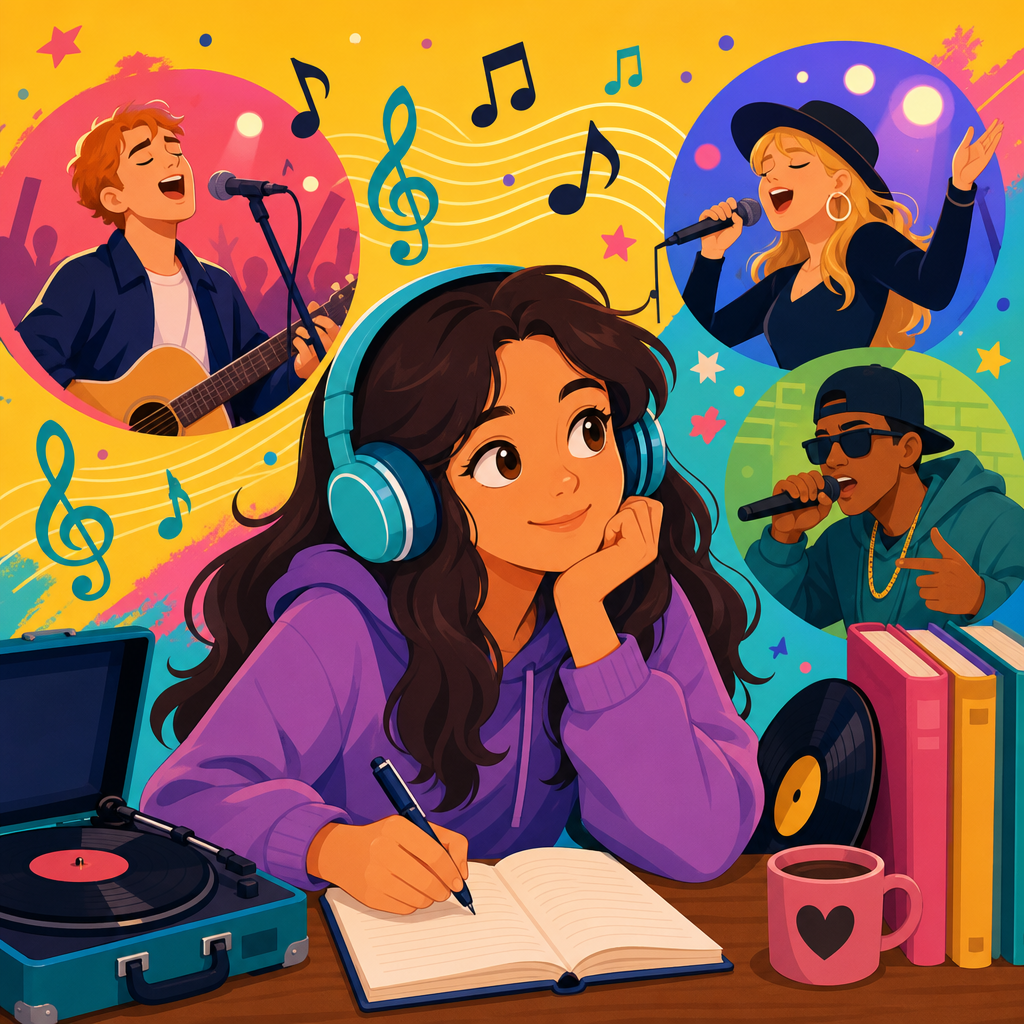
English vocabulary from popular songs is one of the fastest ways for ESL learners to absorb real-world language, because music repeats memorable phrases, exposes natural pronunciation, and carries culture in every line. In classroom programs and private coaching, I have seen learners remember a single lyric for years when they forget a worksheet in a week. That practical staying power makes songs especially valuable inside Pop Culture English, the branch of language study that uses entertainment, trends, media, and everyday cultural references to teach how people actually speak. A hub article on this topic needs to do more than celebrate music. It should define what learners can gain, explain what kinds of words songs teach well, and show how this area connects to broader ESL Cultural English & Real-World Usage goals.
Popular songs help learners build vocabulary in several layers at once. First, they teach high-frequency words such as love, leave, night, heart, dream, and change, which appear across genres and everyday conversation. Second, they introduce idioms, slang, contractions, and emotional language that textbooks often underuse. Third, they reveal pronunciation patterns, including linking, reduction, stress, rhyme, and regional accents. Songs also matter because they offer context. A learner who hears “break up,” “move on,” or “hold on” in a song can connect the phrase to emotion, situation, and tone, not just a dictionary entry. That combination improves recall and helps learners sound more natural when they speak, write messages, or understand films, interviews, and social media clips.
At the same time, learning English vocabulary from popular songs requires smart filtering. Lyrics can be poetic, ungrammatical, repetitive, censored, or culturally specific. Some words are timeless; others disappear quickly. The goal is not to memorize every line, but to identify useful vocabulary, understand meaning in context, and notice what belongs in casual speech versus formal English. Used correctly, songs become a gateway to collocations, phrasal verbs, emotional nuance, and cultural literacy. That is why this sub-pillar hub matters: it organizes Pop Culture English around song-based vocabulary, highlights the most teachable language patterns, and prepares learners to explore related articles on slang, idioms, pronunciation, media English, and conversational usage with a stronger, more authentic foundation.
Why songs teach vocabulary so effectively
Songs work because they combine repetition, rhythm, and emotion, three factors strongly linked to memory. Repetition is obvious: choruses repeat key words and phrases, often far more than a dialogue exercise would. Rhythm gives language a pattern, which helps the brain chunk sounds into units. Emotion matters because people remember language attached to feeling. When learners connect a phrase like “I miss you” to sadness or “we found love” to excitement, the vocabulary becomes easier to retrieve later. In practice, I have watched intermediate learners begin using phrases from songs spontaneously in conversation once they have heard them enough times in meaningful context.
Another advantage is exposure to connected speech. In natural spoken English, words are often reduced or linked together. Songs highlight this reality. Learners hear forms like “gonna,” “wanna,” “ain’t,” “gotta,” or compressed pronunciation in lines that fit the beat. This can be helpful if teachers explain that some forms are very common in speech but inappropriate in formal writing. Songs also improve listening tolerance. Learners get used to different voices, speeds, accents, and styles, from clear pop vocals to more stylized rap, R&B, indie, or country delivery. That variety mirrors real life more closely than highly controlled textbook recordings.
Popular songs also create cultural entry points. When a lyric becomes widely recognized, understanding it gives learners access to jokes, memes, interviews, and everyday references. A phrase from Taylor Swift, The Beatles, Adele, Beyoncé, Ed Sheeran, or Olivia Rodrigo may appear in conversation, captions, or headlines. Recognizing those references supports broader comprehension beyond the song itself. This is a central principle of Pop Culture English: language lives inside culture, and songs are one of the easiest, most repeatable ways to enter that cultural space while still focusing on concrete vocabulary development.
What kinds of English vocabulary songs teach best
Not every vocabulary category is equally suited to music. Songs are strongest for emotional language, common verbs, relationship vocabulary, time expressions, movement words, descriptive adjectives, and conversational chunks. Love songs alone provide dozens of recurring items: “fall for,” “let go,” “stay,” “leave,” “forever,” “used to,” “on my mind,” and “torn apart.” Dance and pop tracks often add imperatives such as “come on,” “turn it up,” “slow down,” and “wake me up.” Story-based songs teach sequencing and narrative vocabulary, while protest songs introduce social terms like freedom, change, power, and justice.
They are also excellent for collocations and phrasal verbs. Learners may know the verb “give,” but a song can teach “give up,” “give in,” “give away,” and “give me a chance” in memorable settings. The same is true for “hold on,” “break down,” “run away,” “work out,” and “move on.” These combinations are crucial because fluent English depends less on isolated words than on words that naturally travel together. Songs make these patterns stick. Once a learner remembers a phrase as a unit, production becomes faster and more accurate.
Another valuable area is register. Songs expose the difference between formal dictionary English and casual everyday usage. Learners meet contractions such as “I’m,” “you’re,” “we’ve,” and “don’t,” plus informal choices like “kid,” “guy,” “mess,” “crazy,” or “stuff.” They also encounter intensifiers such as “so,” “really,” “too,” and “kind of.” However, teachers and self-learners need to classify what they hear. A line may be common in conversation but weak in academic writing. Knowing that distinction protects learners from overgeneralizing lyrical language in the wrong setting.
| Vocabulary type | What songs teach well | Example lyric-style phrase | Real-world use |
|---|---|---|---|
| Phrasal verbs | Meaning through repetition and emotion | “move on” | Talking about recovery after change |
| Collocations | Words that naturally combine | “broken heart” | Describing sadness naturally |
| Slang and informal English | Current conversational patterns | “ain’t no” | Understanding casual speech, not formal writing |
| Pronunciation patterns | Stress, linking, reduction | “wanna stay” | Improving listening accuracy |
| Cultural references | Shared themes and symbols | “summer nights” | Understanding media and social posts |
How to study vocabulary from popular songs without wasting time
The most effective method is selective listening, not passive replay. Start with songs that have clear vocals and a moderate speed. Ballads, acoustic pop, and many mainstream hits are better for most learners than extremely dense rap or highly experimental music. Read the official lyrics if available, then listen once without stopping. On the second pass, underline unknown words, but do not chase every item. Focus on terms that are useful, repeated, and likely to appear outside the song. A practical rule I use is to keep phrases that fit at least one of these tests: common in daily life, useful for conversation, or helpful for understanding other media.
Next, study vocabulary in chunks rather than single words. If a song includes “call me back,” learn the whole phrase, the likely situation, and a sample sentence such as “Can you call me back after work?” If the lyric says “I’m over it,” note that it means someone has emotionally moved past a problem. This chunk-based approach aligns with how fluent speakers store language. It also prevents learners from creating unnatural combinations from dictionary meanings alone. Good tools for this process include Cambridge Dictionary, Merriam-Webster, YouGlish for pronunciation and real usage, and lyric databases that preserve line structure for review.
Finally, recycle the vocabulary. Use spaced repetition with flashcards, but include context, not just translation. Shadow short lines to practice pronunciation. Write two or three original sentences using each phrase. Discuss the song’s theme with a partner. If possible, compare how the phrase appears in interviews, subtitles, or social media posts. That final step is important because it tests whether the language is truly transferable. Songs should open the door to real-world usage, not become a separate, isolated learning activity.
Common challenges: slang, metaphor, grammar, and accent
Learners often assume that if a word appears in a hit song, it must be useful everywhere. That is not true. Slang can be highly regional, age-specific, or short-lived. A phrase popular in one American pop song may sound outdated two years later, or unfamiliar in the UK, India, Singapore, or Nigeria. Metaphor creates another problem. Songwriters bend language for emotional effect, so lines may not mean what they seem to mean literally. “Drowning in love,” “fire in my veins,” or “cold heart” are understandable and common metaphors, but they still need explanation if the learner is building literal vocabulary.
Grammar in songs also needs caution. Artists may drop subjects, change verb forms, or use double negatives to fit rhythm, rhyme, or identity. These choices are not wrong inside artistic expression, but they should be labeled clearly. I often tell learners to separate lyrics into three boxes: standard and reusable, informal but common, and artistic or nonstandard. This simple framework prevents confusion. It allows students to enjoy the song while still learning what they can safely use in exams, job interviews, and professional emails.
Accent and vocal style can make comprehension harder than the vocabulary itself. British pop, American country, Caribbean-influenced dance tracks, and global English collaborations all carry different sounds. That diversity is useful, but beginners may need transcripts and repeated listening. Turning on subtitles in live performances or interviews can help bridge the gap between sung and spoken forms. Over time, this challenge becomes an advantage. Learners who train with music often become more flexible listeners, better able to understand the variation that defines real English around the world.
Building a complete Pop Culture English learning path
As a hub within ESL Cultural English & Real-World Usage, song vocabulary should connect naturally to adjacent learning areas. One branch is slang and internet English, where learners examine how lyric phrases move into TikTok captions, memes, and comment sections. Another is pronunciation, especially connected speech, weak forms, and rhythm. A third is idioms and figurative language, since many songs rely on image-based expressions rather than plain description. Film, television, celebrity interviews, and fan communities extend the same vocabulary into spoken conversation and online interaction, showing learners how one phrase changes across contexts.
A strong learning path moves from recognition to controlled practice to real use. For example, a learner hears “ghosted” in a pop lyric or social media discussion, checks the meaning, notices that it belongs to dating and digital communication, then uses it in a role-play: “He ghosted me after two dates.” From there, the learner may encounter related expressions like “left on read,” “text back,” or “mixed signals.” This network effect is what makes pop culture powerful for vocabulary growth. Songs are not just entertainment; they are launch points for semantic families and real communicative situations.
The main benefit of studying English vocabulary from popular songs is that it turns abstract language into memorable, usable English tied to emotion, culture, and real conversation. Songs teach high-frequency words, phrasal verbs, collocations, informal expressions, and pronunciation patterns in ways that many learners retain more easily than traditional drills. They also support broader Pop Culture English study by linking music to slang, media references, idioms, listening practice, and social usage. When approached carefully, with attention to context and register, songs become one of the most efficient bridges between classroom English and the language people actually use.
The key is to study actively. Choose clear songs, focus on reusable phrases, verify meanings with reliable dictionaries, and practice vocabulary in your own sentences and conversations. Treat lyrics as a source of real-world examples, not as automatic models for every situation. Keep what is common, label what is informal, and enjoy what is artistic. If you want to build stronger listening skills and sound more natural in everyday English, start with the songs you already love, then use this hub to explore connected topics across Pop Culture English and expand your vocabulary with purpose.
Frequently Asked Questions
Why is learning English vocabulary from popular songs so effective for ESL learners?
Learning English vocabulary from popular songs works so well because music helps language stick in long-term memory. Songs repeat key words and phrases, which gives learners multiple chances to hear the same vocabulary in context without the repetition feeling boring. A catchy chorus can reinforce a phrase far more naturally than a traditional word list, and many learners find they can remember a lyric months or even years later. That kind of retention is extremely valuable for ESL students who want vocabulary they can actually use and remember.
Popular songs also expose learners to real-world English rather than overly simplified textbook sentences. Through music, students hear how native speakers connect words, reduce sounds, stress important syllables, and use everyday expressions. This helps with pronunciation, listening comprehension, and fluency at the same time. In addition, songs carry cultural meaning, emotional tone, and social context, which makes vocabulary more meaningful. Instead of memorizing isolated definitions, learners absorb words as part of a living language experience. That is one reason music plays such an important role in Pop Culture English: it turns vocabulary study into something memorable, practical, and culturally rich.
What kind of vocabulary can learners gain from popular songs?
Popular songs can teach a wide range of vocabulary, from common everyday words to emotional expressions, slang, idioms, phrasal verbs, and informal sentence patterns. Many songs focus on themes like relationships, dreams, confidence, struggle, celebration, and personal identity, so learners are repeatedly exposed to language that appears often in real conversation. For example, songs may include useful phrases about feelings, time, movement, decision-making, or social interaction. These are the kinds of expressions learners are likely to hear in movies, conversations, social media, and everyday life.
At the same time, songs can introduce vocabulary that is more figurative or poetic. This is important because real English is not always literal. Learners may encounter metaphors, cultural references, shortened grammar, and creative word choices that reflect how people actually communicate. While not every lyric is ideal for direct imitation, songs help learners recognize style, tone, and emotional nuance. The key is to study lyrics selectively and understand which words are standard, which are casual, and which are artistic. When used thoughtfully, songs become a powerful source of vocabulary that is both useful and authentic.
How can students study English vocabulary from songs without getting confused by slang or unusual grammar?
The best approach is to treat songs as a source of real English, not perfect textbook English. Many lyrics include slang, informal contractions, poetic phrasing, regional accents, or grammar choices designed to fit rhythm and rhyme. That does not make them useless; it simply means learners need guidance and context. A smart study method is to choose one song at a time, read the lyrics carefully, highlight unfamiliar words, and then separate them into categories such as standard vocabulary, informal expressions, idioms, and artistic language. This helps students understand what they can use in daily conversation and what they should recognize without necessarily copying.
It also helps to compare lyrics with dictionary definitions, teacher explanations, and example sentences from normal spoken or written English. If a song says something grammatically unusual, learners should ask why it sounds different. In some cases, it reflects casual speech. In others, it may be shortened for style. This process builds language awareness rather than confusion. In classroom settings and private coaching, songs are most effective when they are used as guided listening tools instead of passive entertainment. With the right support, learners can enjoy the creativity of music while still building accurate, practical vocabulary.
What is the best way to use popular songs to improve both vocabulary and pronunciation?
A highly effective method is to combine lyric study with active listening and repetition. First, learners should listen to the song once for general understanding. Then they can read the lyrics while listening again and identify important vocabulary, repeated phrases, and pronunciation patterns. After that, they should focus on how the singer actually delivers the words: where sounds are linked, where syllables are stressed, and how certain words are reduced in fast speech. This is especially useful because many ESL learners know vocabulary on paper but struggle to recognize it when native speakers say it naturally.
Singing along, shadowing, and repeating short lines can significantly improve pronunciation, rhythm, and confidence. Shadowing means listening to a lyric and immediately repeating it while copying the singer’s timing and intonation as closely as possible. This helps learners internalize connected speech and natural phrasing. It is also useful to pause and practice selected lines rather than trying to master an entire song at once. Over time, learners begin to notice patterns in pronunciation and sentence flow that transfer to everyday speaking. When vocabulary study and pronunciation practice are combined through music, learners gain more than definitions; they develop a feel for how English sounds in real life.
How should teachers and independent learners choose the right songs for vocabulary study?
The best songs for vocabulary learning are clear, memorable, and rich in useful language. Teachers and self-study learners should look for songs with understandable lyrics, repeated phrases, and themes that connect to everyday communication. Slower songs or songs with strong choruses are often especially helpful because they make it easier to catch pronunciation and remember key expressions. It is also important to choose music that matches the learner’s level. Beginners may benefit from simple, high-frequency vocabulary, while more advanced learners can explore songs with idioms, storytelling, or cultural references.
Song selection should also depend on the learning goal. If the goal is emotional vocabulary, a ballad may be useful. If the goal is informal conversation, a contemporary pop song may work better. Teachers should preview lyrics carefully to make sure the content is appropriate and that the vocabulary is worth studying. Independent learners should do the same and avoid assuming every popular lyric is good English to imitate directly. The strongest results usually come from songs that learners genuinely enjoy, because motivation matters. When students care about the music, they listen more often, repeat more willingly, and remember vocabulary more deeply. That is exactly why popular songs remain one of the most effective tools in Pop Culture English.