Netflix has become one of the most practical tools for learners who want to improve English through real conversation, modern culture, and repeat exposure to everyday speech. Learning English with Netflix means using films, series, documentaries, and stand-up specials to build listening comprehension, vocabulary, pronunciation, cultural awareness, and confidence in context rather than through isolated textbook sentences. It matters because classroom English often teaches grammar accurately but misses how people actually interrupt, joke, soften opinions, use slang, and respond emotionally. In my work with adult learners, I have seen students make faster progress once they start hearing English used naturally across genres and accents. A crime drama trains one kind of listening, a sitcom trains another, and a reality series reveals how people react spontaneously under pressure.
For learners interested in pop culture English, Netflix is especially valuable because it exposes you to references that appear in office talk, social media, YouTube clips, and everyday conversation. Pop culture English includes catchphrases, casual idioms, relationship language, humor, celebrity references, internet-influenced speech, and the tone patterns people use when they are excited, sarcastic, embarrassed, or persuasive. If you understand those patterns, you do more than decode words. You begin to understand why a line is funny, why an apology sounds sincere or weak, and why one phrase sounds friendly while another sounds rude. That kind of awareness supports speaking, listening, and cultural fluency at the same time.
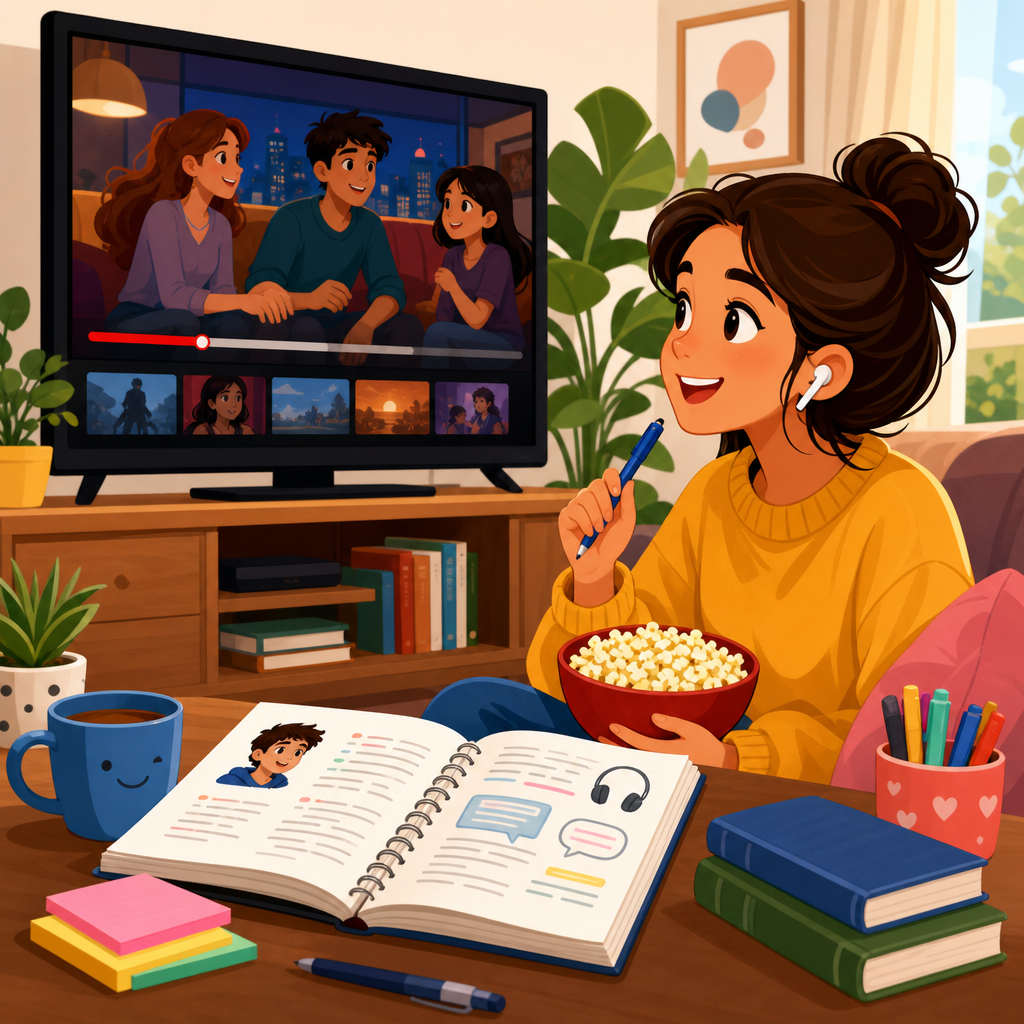
The key is to use Netflix actively, not passively. Watching for two hours with no method may entertain you, but structured viewing produces measurable gains. Effective learners choose material at the right difficulty level, work with subtitles strategically, repeat short scenes, collect high-frequency expressions, shadow lines aloud, and review what they hear. This hub article explains how to do that and maps the broader world of pop culture English so you can use related resources more effectively. If you want to sound more natural, follow conversations more easily, and understand the cultural English people actually use, Netflix can become one of your best study tools.
Why Netflix Works for Pop Culture English
Netflix works because it delivers authentic input at scale. Language acquisition research consistently shows that frequent exposure to comprehensible input supports vocabulary growth and listening development, and streaming platforms make that exposure convenient. What makes Netflix different from many learning apps is density and variety. A single season of a dialogue-heavy show can contain thousands of lines of usable English, from greetings and disagreement to persuasion, humor, complaint, and emotional disclosure. You are not learning only what words mean. You are learning when speakers choose them, how quickly they say them, and what social effect they create.
It also helps that Netflix content reflects contemporary usage. Textbooks may teach “I am very tired,” while a series gives you “I’m exhausted,” “I’m wiped,” “I can’t even,” or “I need coffee before I talk to anyone.” Those alternatives are not interchangeable in every situation, and hearing them in scenes teaches nuance. I often tell learners that subtitles reveal only half the lesson. The other half is stress, pause, facial expression, and relationship context. A line like “That’s fine” can mean acceptance, disappointment, irritation, or passive aggression depending on delivery. Streaming drama and comedy make these distinctions visible in a way printed dialogues cannot.
Another strength is accent exposure. Learners who only hear one teacher often struggle when they meet American regional speech, British understatement, Australian intonation, or multilingual urban English. Netflix broadens that range. If your goal is workplace communication, travel, study abroad, or social interaction online, this flexibility matters. It prepares you for real-world listening conditions, where pronunciation is reduced, overlap is common, and people do not slow down for learners.
How to Choose the Right Shows and Movies
Not every title is equally useful. The best choice depends on your level, goals, and tolerance for ambiguity. Beginners and lower-intermediate learners usually improve fastest with modern series that use everyday settings: school, family, friendship, dating, work, food, and routine conflict. Sitcoms, teen dramas, reality shows, and lifestyle programs often provide clearer context than fantasy or period drama. Advanced learners can benefit from legal thrillers, political series, historical stories, satire, and stand-up because these formats contain denser vocabulary, faster rhythm, and more implied meaning.
Genre matters. Sitcoms are excellent for timing, humor, and repeated social situations, but they often include fast jokes and cultural references. Reality shows reveal interruption, filler language, emotional reactions, and informal speech. Documentaries offer clearer narration and topic vocabulary. Crime dramas teach questioning, suspicion, and consequence language but may overrepresent police and forensic terms. Romantic comedies help with flirting, disagreement, vulnerability, and relationship vocabulary. A balanced Netflix study plan uses more than one genre because pop culture English is broader than slang alone.
Difficulty should feel challenging but not overwhelming. A practical benchmark is understanding about 70 to 85 percent of a scene before pausing. If you understand less than that, you spend too much energy decoding. If you understand almost everything, progress slows because there is not enough stretch. I recommend testing three shows for ten minutes each and choosing the one where you can follow the main conflict, identify several unknown but repeated expressions, and stay engaged enough to rewatch scenes without boredom. Motivation is not a small factor. Learners return to material they genuinely want to watch.
| Content type | Best for | Common language gains | Main caution |
|---|---|---|---|
| Sitcoms | Intermediate learners | Humor, reactions, idioms, turn-taking | Jokes can depend on culture |
| Reality series | Lower-intermediate to advanced | Natural fillers, interruptions, emotion language | Messy speech is harder to transcribe |
| Documentaries | All levels | Clear narration, topic vocabulary, pronunciation models | Less conversational language |
| Teen or family dramas | Intermediate learners | Friendship, school, conflict, modern expressions | Some slang becomes dated quickly |
| Stand-up comedy | Advanced learners | Timing, cultural references, informal rhetoric | Fast pace and implied meaning |
The Best Viewing Method for Real Improvement
The most effective method is a three-pass approach. First, watch a short segment for meaning only. Do not pause every few seconds. Train yourself to follow the scene, identify who wants what, and notice emotional shifts. Second, rewatch with English subtitles and mark useful phrases, reduced pronunciation, and lines that surprised you. Third, watch again without subtitles and speak selected lines aloud. This sequence mirrors how strong listeners build skill: global understanding first, detail second, retrieval third.
Short scenes beat marathon sessions. Ten focused minutes can produce more learning than two distracted hours. I usually recommend clips of one to three minutes for serious study, especially for speaking practice. Within a short clip, you can repeat, compare subtitle wording to actual pronunciation, and notice discourse markers such as “I mean,” “look,” “actually,” “you know,” “kind of,” and “to be fair.” These markers are everywhere in pop culture English because they manage tone and attitude. Learners who master them sound less robotic even before their grammar becomes perfect.
Shadowing is one of the most efficient techniques. Listen to a line and repeat it immediately, copying rhythm, stress, linking, and emotion. Do not aim only for perfect accent imitation. Aim for smoother speech and stronger awareness of how connected English really sounds. For example, “What are you doing?” often becomes something closer to “Whaddaya doing?” in fast speech. If you only know the textbook form, real conversation may sound like a different language. Repeating these reductions helps your ear catch them later.
Tracking matters too. Keep a notebook or digital document with categories such as reactions, agreement, disagreement, apologizing, flirting, joking, and workplace phrases. This turns random watching into a personal phrase bank. Over time, you will see patterns across titles, which is exactly how fluent speakers internalize frequency.
How to Use Subtitles Without Becoming Dependent
Subtitles are useful, but only when used deliberately. English subtitles can improve word segmentation, help you identify unknown vocabulary, and confirm phrases you partially heard. They are especially helpful with reduced speech, unfamiliar accents, and names. However, constant subtitle use can shift your attention from listening to reading. Many learners think they are training comprehension when they are actually training fast reading.
A better strategy is staged support. Start with no subtitles for a first watch when the material is near your level. Add English subtitles on the second pass to confirm details. Remove them again on the third pass. If the show is significantly above your level, begin with English subtitles from the start, but limit how long you stay in that mode. The goal is always to move toward hearing, not permanent textual support. Native-language subtitles are best used sparingly, mainly to confirm plot when total confusion blocks motivation.
It also helps to know that subtitles are not always exact transcripts. Closed captions may simplify, shorten, or reformat spoken language for readability. That means learners should treat subtitles as support, not absolute evidence of every sound. When a line and the caption do not perfectly match, trust your ears and replay the scene. That gap often teaches an important lesson about connected speech.
What to Learn From Netflix Besides Vocabulary
Vocabulary is only one layer. The deeper gains come from pragmatics, pronunciation, and cultural framing. Pragmatics means knowing how language functions socially. For instance, English speakers often soften requests with “could,” “would,” “do you mind,” or indirect framing like “I was wondering if.” In drama and comedy, you hear how directness changes depending on power, intimacy, urgency, and emotion. That is essential for real-world usage because correct grammar alone does not guarantee appropriate tone.
Pronunciation benefits are equally important. Netflix teaches weak forms, assimilation, elision, and sentence stress naturally. Learners hear “going to” become “gonna,” “want to” become “wanna,” and “did you” sound like “didja.” These are not careless exceptions. They are normal features of fast, informal speech. Understanding them improves listening dramatically, and practicing them selectively improves fluency. The goal is not to imitate every casual form in formal situations, but to recognize them when others speak.
Cultural knowledge is the third major advantage. Pop culture English includes reference points that explain humor, conflict, and identity. A dating show teaches the language of boundaries and attraction. A workplace comedy teaches sarcasm, awkwardness, and office hierarchy. A documentary teaches how public issues are framed in modern media. These patterns help learners participate in conversation because they understand more than literal words. They understand what a scene signals socially. That is why this topic connects naturally with related areas like American small talk, internet English, workplace idioms, humor, and conversational storytelling.
Tools, Habits, and Common Mistakes
Several tools can make Netflix study more efficient. Language Reactor is widely used for dual subtitles, transcript navigation, and saved phrases on supported platforms. Anki works well for spaced repetition if you turn short lines into review cards. YouGlish is useful for checking how an expression sounds across many speakers after you encounter it in a show. Standard references such as the Cambridge Dictionary and Merriam-Webster help confirm meaning, register, and pronunciation. If you want transcript-based analysis, even a simple spreadsheet can organize phrases by function, speaker intention, and emotional tone.
The most productive habit is consistency. Four sessions of twenty minutes usually beat one long weekend binge because memory strengthens through repeated retrieval. After each session, write three expressions you want to use this week and then use them in speaking or journaling. Transfer is the real test. If you never use what you collect, recognition grows faster than active skill.
Common mistakes are predictable. Learners often choose shows that are too difficult, collect too many rare slang terms, pause so often that they lose the scene, or copy phrases without understanding register. Another mistake is assuming all on-screen language is broadly appropriate. Some lines are intentionally rude, manipulative, or exaggerated for dramatic effect. Context determines whether an expression belongs in your own speech. I tell learners to prioritize high-frequency, reusable lines such as “I’m not sure that’s a good idea,” “What do you mean exactly?” or “I didn’t see it that way” over flashy slang that may sound forced.
Building a Long-Term Pop Culture English Plan
To make Netflix part of a serious English system, build a weekly cycle. Choose one main show for repeated study and one secondary title for relaxed exposure. Study two short scenes deeply, watch one full episode extensively, review your phrase bank, and practice five to ten lines aloud. Add one conversation task: discuss a character decision, summarize a conflict, or explain a joke. This connects input to output, which is where fluency starts to stabilize.
As a hub topic, pop culture English should also lead you into related skills. Use Netflix scenes to study slang carefully, but also move into humor, celebrity interviews, music lyrics, social media language, regional accents, and everyday cultural references. The strongest learners do not treat entertainment English as separate from practical English. They use it to become better at listening to coworkers, understanding online discussions, joining casual conversation, and expressing personality naturally.
Netflix can absolutely help you learn English if you use it with purpose. Choose level-appropriate content, rewatch short scenes, use subtitles strategically, practice aloud, and focus on phrases people actually reuse. Over time, you will notice faster listening, more natural speaking, and stronger cultural understanding. Start with one show you enjoy, study one scene tonight, and turn entertainment into real English progress.
Frequently Asked Questions
1. How does Netflix actually help you learn English more effectively?
Netflix helps you learn English by exposing you to the kind of language people really use in daily life. Instead of practicing isolated textbook sentences, you hear natural conversation, connected speech, slang, humor, hesitation, emotion, and different speaking speeds. This is important because real English often sounds very different from the clear, slow examples used in traditional lessons. On Netflix, you can observe how vocabulary, pronunciation, grammar, and tone work together in context, which makes new language easier to understand and remember.
Another major advantage is repetition. In a classroom, you may hear a phrase once and move on. With Netflix, you can pause, replay, and rewatch scenes as many times as you need. That repeated exposure strengthens listening comprehension and helps your brain recognize common sentence patterns automatically. Over time, you begin to understand phrases as complete units rather than translating word by word, which is a big step toward fluency.
Netflix also improves cultural awareness. Language is not only about words; it is also about social situations, humor, politeness, relationships, and body language. Watching English-language films, series, documentaries, and stand-up specials shows you how native and fluent speakers interact in different settings. This makes your English more natural because you are learning how the language is actually used, not just how it is explained in grammar rules.
2. What is the best way to use subtitles when learning English with Netflix?
Subtitles can be extremely useful, but the best approach depends on your current level. If you are a beginner, starting with subtitles in your native language can help you follow the story and stay motivated. However, this should only be a temporary step. If you rely on native-language subtitles for too long, your brain focuses more on reading translations than on listening to English. That can slow down progress in listening comprehension.
For most learners, English subtitles are the most effective option. They allow you to connect spoken words with written forms, which helps you notice pronunciation differences, spelling patterns, contractions, and everyday expressions. For example, you may hear “gonna,” “wanna,” or reduced forms of common phrases that are hard to catch at first. Seeing them while hearing them makes recognition much easier.
A highly effective method is to watch in stages. First, watch a short scene with English subtitles and focus on understanding the main idea. Next, replay the same scene and pay attention to useful vocabulary, pronunciation, and sentence structure. Then try watching it again without subtitles to test your listening. This gradual method trains both comprehension and independence. As your ability improves, aim to use subtitles less often so you become more comfortable understanding spoken English directly.
3. What kinds of Netflix shows or movies are best for English learners?
The best content is content you can understand enough to stay engaged with consistently. In general, learners make faster progress when they choose programs with clear speech, everyday topics, and strong visual context. Sitcoms, family dramas, documentaries, reality shows, and teen or workplace series are often good choices because the language tends to be more practical and repetitive. These formats regularly include useful expressions for daily conversation, such as greeting people, asking questions, giving opinions, making plans, and responding naturally.
Documentaries can be especially helpful for learners who want clearer pronunciation and more structured vocabulary. The narration is often slower and more organized than fast fictional dialogue. On the other hand, scripted series and films are excellent for learning conversational rhythm, informal speech, and emotional expression. Stand-up comedy can also be valuable at higher levels because it teaches timing, cultural references, and advanced listening skills, though it may be difficult for beginners because jokes often depend on wordplay and fast delivery.
It is usually smart to avoid starting with content that is linguistically dense or highly specialized, such as legal dramas, historical period pieces, or shows full of heavy slang and regional accents. Those can be useful later, but they may feel overwhelming too early. A better strategy is to choose something you genuinely enjoy and can follow without constant frustration. Motivation matters. If you like the story, characters, or topic, you are far more likely to keep watching, repeating, and learning.
4. How can you turn casual Netflix watching into a real English study method?
To make Netflix an effective learning tool, you need to watch actively rather than passively. Passive watching may help a little through exposure, but active watching creates far stronger results. Start by choosing a short segment, usually five to fifteen minutes, instead of trying to study an entire movie at once. Focus on understanding who is speaking, what is happening, and why certain phrases are being used. This helps you connect language to meaning and situation.
Keep a notebook or digital document for useful vocabulary and expressions. Do not try to write down every unknown word. Instead, collect phrases that are common, practical, and likely to appear again, such as “That makes sense,” “I’m just kidding,” “What do you mean?” or “Let me think.” Learning chunks like these is more powerful than memorizing isolated words because they prepare you for real conversation.
It is also very effective to practice shadowing. This means listening to a line and repeating it immediately, copying the speaker’s pronunciation, rhythm, and intonation as closely as possible. Shadowing improves speaking confidence, accent awareness, and fluency because it trains your mouth and ear together. You can also pause after a line and say it aloud yourself before replaying it. If you do this regularly, you begin to sound more natural because you are imitating real spoken English instead of inventing sentences from grammar rules alone.
A strong routine might look like this: watch a scene once for general meaning, watch it again with attention to key phrases, replay difficult lines, repeat them aloud, and review your notes later. Even twenty to thirty minutes of this kind of focused practice several times a week can produce meaningful improvement over time.
5. How long does it take to improve your English by learning with Netflix?
The timeline depends on your starting level, consistency, study method, and how actively you engage with the material. If you simply watch English content in the background, improvement will likely be slow and limited. But if you use Netflix regularly with a clear strategy, many learners notice progress in listening and vocabulary within a few weeks. They begin recognizing repeated expressions, understanding familiar voices more easily, and feeling less intimidated by natural spoken English.
More noticeable gains in comprehension, pronunciation, and speaking confidence usually come over several months of steady practice. This is because your brain needs repeated exposure to the same kinds of sounds, patterns, and structures before they become automatic. The good news is that Netflix makes this repetition easier and more enjoyable than traditional drills. When you watch multiple episodes of the same show, you hear similar voices, vocabulary, and relationship dynamics again and again, which helps reinforce learning naturally.
It is also important to keep realistic expectations. Netflix is a powerful tool, but it works best as part of a broader learning routine. You will get stronger results if you combine watching with speaking practice, vocabulary review, reading, and occasional grammar study. Think of Netflix as a bridge between formal learning and real-world English. Used consistently, it can dramatically improve your ability to understand natural conversation, respond more confidently, and feel more connected to how English is actually spoken today.