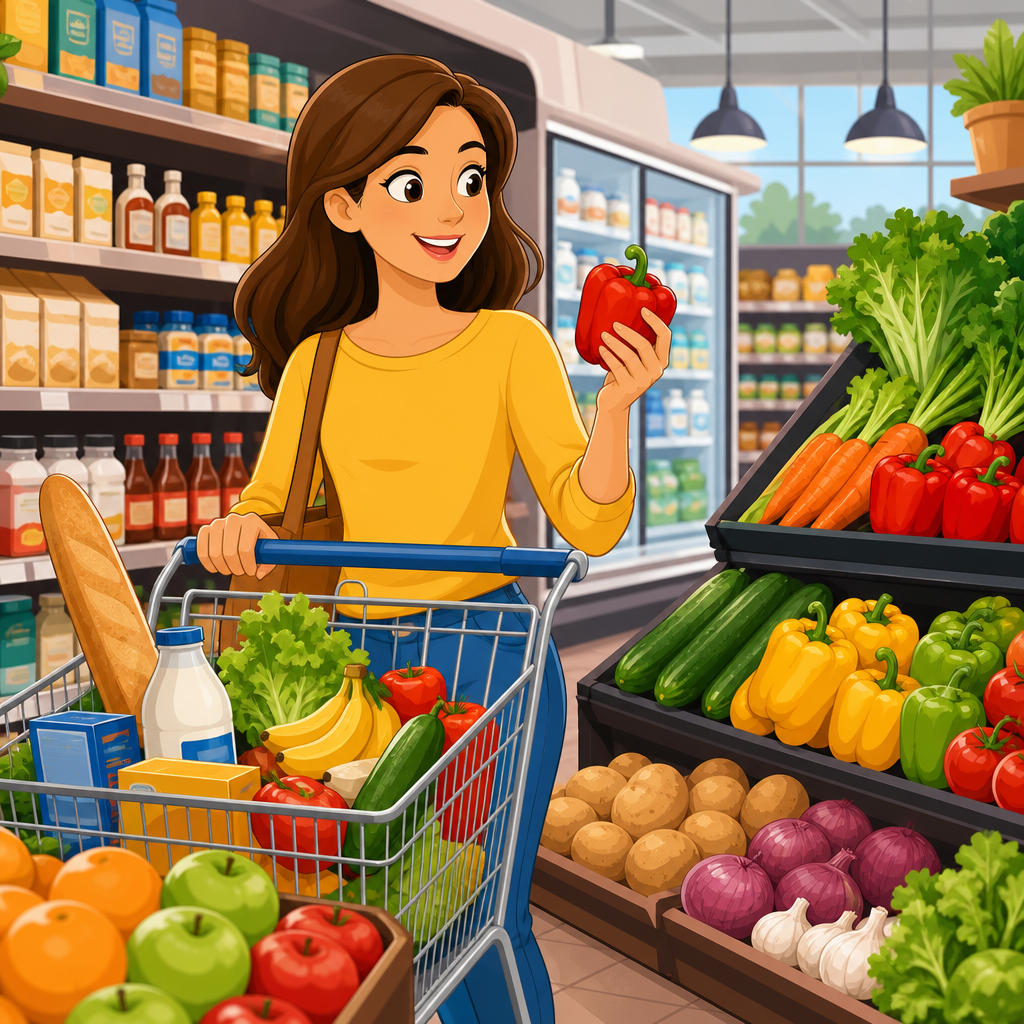
English vocabulary for grocery shopping is one of the most practical parts of daily life vocabulary because it helps learners handle routine errands, read labels, ask questions, compare prices, and speak confidently in stores. Grocery shopping vocabulary includes the words and phrases people use for food categories, store sections, quantities, packaging, prices, payment, and customer service. I teach this topic early in ESL programs because learners use it immediately, often the same day, and because it connects naturally to speaking, listening, reading, and pronunciation practice. It also supports larger ESL vocabulary building goals: understanding everyday instructions, making small decisions in English, and navigating unfamiliar systems without stress.
In real classrooms, grocery shopping language solves specific problems. A beginner may know the word apple but not bag, bunch, pound, receipt, aisle, or cashier. An intermediate learner may recognize bread, milk, and eggs but still struggle with labels such as low sodium, whole grain, frozen, organic, or buy one get one free. I have seen learners freeze when asked, “Paper or plastic?” or “Do you need help finding anything?” because textbook word lists often stop at food names. A strong daily life vocabulary lesson must go beyond naming objects and include the exact language people hear in supermarkets, convenience stores, markets, and self-checkout lanes.
This hub article gives that broader foundation. It explains the key English vocabulary for grocery shopping, organizes words by real shopping tasks, and shows how to use them in plain, natural sentences. It also acts as a central guide within daily life vocabulary study, linking ideas that connect to future lessons on food, money, measurements, directions, and everyday conversations. If a learner can understand store signs, ask where items are, compare brands, and complete checkout smoothly, that learner has gained useful independence. That is why grocery shopping English matters: it turns vocabulary study into immediate, measurable daily success.
Core Grocery Store Words and Store Sections
The first layer of grocery shopping vocabulary is knowing the place itself. Learners should know grocery store, supermarket, market, convenience store, shopping cart, shopping basket, aisle, shelf, refrigerator section, freezer section, checkout, cashier, customer service desk, entrance, and exit. These are not advanced words, but they appear in nearly every shopping trip. Aisle is especially important because staff often give directions using it: “It’s in aisle seven” or “You’ll find it on the top shelf.” In American English, cart is more common than trolley in daily use, while basket usually means the hand-carried option for a smaller purchase.
Store sections are another essential part of daily life vocabulary. Common sections include produce, bakery, dairy, meat department, seafood counter, deli, frozen foods, canned goods, snacks, beverages, household supplies, and pharmacy. Produce means fresh fruits and vegetables. Deli usually refers to sliced meats, cheeses, prepared salads, and ready-to-eat items. Bakery can mean both the area that sells bread and pastries and an independent shop. Many learners benefit from matching sections to products: lettuce in produce, yogurt in dairy, chicken in meat, peas in frozen foods, and toothpaste in household or personal care. That kind of practical grouping builds memory faster than isolated lists.
Signs inside stores also teach important vocabulary. Words such as sale, special, clearance, in stock, out of stock, limit, fresh, local, imported, and seasonal affect what shoppers choose. “Out of stock” means the item is unavailable now, not discontinued forever. “Limit two” means each customer may buy only two units, often during promotions or shortages. “Seasonal” usually means produce is available and often cheaper during a certain time of year. When learners understand these signs, they become more independent readers in public spaces, which is one of the clearest goals of daily life vocabulary instruction.
Food Categories, Packaging, and Quantity Words
Food names matter, but category words make grocery shopping English far more efficient. Instead of memorizing hundreds of items randomly, learners should organize them into fruits, vegetables, grains, dairy products, meat, poultry, seafood, canned foods, frozen foods, snacks, condiments, spices, and beverages. Category language helps with shopping lists, recipes, and store navigation. If someone asks, “Do you need any dairy products?” the learner should think of milk, cheese, butter, and yogurt immediately. If a recipe says “frozen vegetables,” the learner should know where to look without depending on pictures.
Packaging terms are just as important because shoppers rarely buy food in abstract form. They buy a loaf of bread, a carton of milk, a dozen eggs, a can of beans, a jar of pasta sauce, a bottle of oil, a bag of rice, a box of cereal, a package of chicken, or a tub of yogurt. In ESL lessons, I emphasize that the container word often appears in normal speech before the food word. A customer is more likely to say “a bag of apples” than simply “apples” when speaking to a cashier or family member. These combinations improve both fluency and listening accuracy.
Quantity words create another common difficulty. Learners need to understand pound, ounce, kilogram, gram, liter, gallon, dozen, half dozen, bunch, slice, piece, and each. In the United States, produce and meat are often sold by the pound, while many other countries use kilograms more consistently. That difference matters in real shopping situations. A shopper at a supermarket deli may hear, “How many slices?” or “How much ham would you like?” At a market, they may hear, “Do you want a whole bag or half a pound?” Without quantity vocabulary, even advanced learners can become confused.
| Vocabulary Type | Examples | Typical Use |
|---|---|---|
| Category words | produce, dairy, snacks, beverages | Finding store sections and organizing lists |
| Packaging words | carton, jar, loaf, can, bottle | Describing how products are sold |
| Quantity words | pound, bunch, dozen, slice, liter | Buying the right amount |
| Label words | organic, low-fat, unsalted, whole grain | Comparing products and health information |
Reading Labels, Comparing Products, and Understanding Prices
One reason grocery shopping is such a strong daily life vocabulary topic is that stores are full of short, meaningful texts. Product labels teach adjectives, nutrition terms, and comparison language. Common label words include fresh, frozen, organic, natural, ripe, low-fat, fat-free, sugar-free, unsalted, reduced sodium, gluten-free, whole grain, and expiration date. Learners should know that some words are regulated more strictly than others. For example, nutrition facts and ingredient lists follow legal standards in many countries, while terms like natural may be less precise. That is useful cultural knowledge as well as vocabulary knowledge.
Comparing products requires both language and strategy. Shoppers compare price, size, brand, quality, ingredients, and expiration date. Unit price is especially valuable vocabulary because it tells the cost per ounce, pound, or liter, making it easier to compare different package sizes fairly. I often show learners two cereal boxes: one larger, one smaller, with different sale tags. The cheaper box is not always the better value. When students learn unit price, they gain a practical decision-making tool, not just a new term. Other important comparison phrases include cheaper than, more expensive, better value, on sale, full price, and store brand.
Price language also includes coupon, discount, tax, total, change, and refund. In some regions, grocery food is taxed differently from prepared food or household items, so final prices may not exactly match shelf labels. “Buy one get one free” and “two for five dollars” are common promotional phrases that can confuse learners if they translate word by word. A clear explanation helps: the promotion applies only under certain quantity rules. Stores may also require a loyalty card or phone number for discount pricing. That means grocery shopping vocabulary overlaps with number recognition, money vocabulary, and basic consumer literacy.
Useful Questions, Polite Requests, and Checkout Language
Speaking in a grocery store usually follows predictable patterns, which makes it ideal for ESL practice. The most useful customer questions are direct and short: “Where can I find rice?” “Do you have brown eggs?” “How much is this?” “Is this on sale?” “Can I get half a pound of turkey?” “Do you have a larger size?” and “What time do you close?” Staff often answer with location language such as next to, across from, at the end of the aisle, in the back, or near the freezer section. These are high-frequency phrases that support wider daily life communication, not just shopping.
Polite requests matter because grocery shopping is a service interaction. Learners should practice “Could you help me find this?” “Can you slice it thin?” “May I use this coupon?” and “Could I have a paper bag?” These forms are more natural than blunt commands. Pronunciation also affects success. Words like aisle, receipt, coupon, and cashier can be tricky because their spelling and sound relationship is not obvious. In class, I have found that brief repetition drills tied to realistic dialogues work better than isolated pronunciation worksheets. Learners remember the phrase “Can I have the receipt?” because they can imagine using it immediately.
Checkout language deserves focused attention because it comes at the most stressful point of the trip. Common phrases include “Did you find everything?” “Cash or card?” “Do you need a bag?” “Your total is twenty-three fifty.” “Please insert your card.” “Would you like your receipt?” and “Have a nice day.” At self-checkout, learners may see “Scan item,” “Place item in bagging area,” “Unexpected item in bagging area,” and “Please wait for assistance.” These messages can feel intimidating, but they are formulaic. Once students learn them, confidence rises quickly. Grocery shopping English becomes a repeatable routine instead of a source of anxiety.
Building Daily Life Vocabulary Through Real Practice
The best way to learn English vocabulary for grocery shopping is to combine memorization with real-world exposure. I recommend starting with a personal shopping list in English, grouped by section: produce, dairy, meat, frozen foods, and household supplies. Then add packaging and quantity words, such as two loaves of bread, one carton of milk, and a bag of onions. After that, learners should practice reading weekly ads, store apps, and online grocery pages from major chains such as Walmart, Kroger, Tesco, or Carrefour, depending on location. These materials show authentic prices, labels, discounts, and product names in context.
Role-play is useful, but it works best when it reflects actual shopping problems. One student needs to ask where soy sauce is. Another needs to compare regular yogurt and Greek yogurt. A third has a coupon that will not scan. These scenarios produce better retention than broad conversations like “I am at the supermarket.” Phone photos also help. I often advise learners to photograph signs, labels, and receipts, then review the vocabulary later. This turns every shopping trip into a field lesson. It also reveals local variation, such as aubergine versus eggplant or coriander versus cilantro.
To build this daily life vocabulary steadily, focus on function before perfection. Learn the words you need to shop, ask one question each trip, and review common labels until they become automatic. Expand from basic nouns to packaging, quantity, comparison, and checkout phrases. Use a notebook or flashcard app, but connect every word to a real product, aisle, or conversation. Grocery shopping English is not abstract academic language; it is survival vocabulary that quickly becomes confidence vocabulary. Start with your next shopping list in English, and use each store visit as a chance to strengthen the broader ESL vocabulary building skills that support everyday independence.
Frequently Asked Questions
Why is English vocabulary for grocery shopping so important for ESL learners?
English vocabulary for grocery shopping is important because it helps learners manage one of the most common real-life tasks they face every week. In a grocery store, people need to understand product names, food categories, signs, prices, quantities, packaging, and payment language. They may also need to ask store employees where to find something, compare brands, read expiration dates, or understand labels such as “fresh,” “frozen,” “low-fat,” “organic,” or “gluten-free.” Because shopping is such a practical activity, learners can use this vocabulary immediately, often on the same day they study it. That immediate use builds confidence and helps new words stay in memory. It also supports independence, because students who know grocery shopping vocabulary can make better choices, solve simple problems, and communicate more comfortably in everyday English-speaking environments.
What kinds of words and phrases should learners study first for grocery shopping?
Learners should begin with the most useful and high-frequency vocabulary. A strong foundation includes food categories such as fruits, vegetables, dairy, meat, seafood, frozen foods, canned goods, snacks, and beverages. It also helps to learn store sections and common signs, including produce, bakery, deli, checkout, aisle, sale, and customer service. After that, students should focus on quantity and packaging words such as a bag of rice, a loaf of bread, a carton of milk, a bottle of juice, a dozen eggs, a pound of apples, and a can of soup. Price language is also essential, including expressions like “How much is this?”, “It’s on sale,” “buy one get one free,” and “Which one is cheaper?” Finally, learners should practice useful question forms such as “Where can I find the pasta?”, “Do you have brown rice?”, “Can I pay by card?”, and “Is this fresh?” These words and phrases give students the language they need to shop successfully and speak naturally in stores.
How can learners improve their speaking confidence when shopping for groceries in English?
The best way to improve confidence is to combine vocabulary study with speaking practice that feels realistic. Learners should not only memorize single words, but also practice short, useful sentences they can actually say in a store. For example, they can rehearse phrases like “Excuse me, where is the bread aisle?”, “I’m looking for cooking oil,” “Do you sell almond milk?”, and “Can I have a paper bag?” Role-play is especially effective because it prepares students for common store interactions with cashiers and employees. Listening practice also helps, since grocery stores often include announcements, quick questions, and fast spoken replies. Another useful strategy is to study from real supermarket materials such as flyers, receipts, labels, and online grocery websites. This shows learners how vocabulary appears in context. Repetition is important as well. When students see, hear, say, and use the same words many times, they become more automatic and less stressful to use. Confidence grows when learners know what to expect and have ready-made phrases they can use without hesitation.
What are some common grocery shopping expressions that learners should know?
There are many practical expressions that make shopping easier and more natural. For asking where items are, useful phrases include “Where can I find the eggs?”, “What aisle is the cereal in?”, and “Do you have this in stock?” For comparing products, learners should know expressions such as “Which brand is cheaper?”, “This one costs less,” “It’s a better deal,” and “What’s the difference between these two?” For checking quality and information, common questions include “Is this fresh?”, “When does it expire?”, “Is this organic?”, and “Does this contain nuts?” At the checkout, students should recognize and use phrases like “Cash or card?”, “Do you need a bag?”, “Can I get a receipt?”, and “I’d like to pay separately.” It is also helpful to know problem-solving language such as “I think this was the wrong price,” “This item was damaged,” or “Can I return this?” Learning these expressions helps students move beyond basic vocabulary and communicate more smoothly in real shopping situations.
What is the best way to teach or learn grocery shopping vocabulary effectively?
The most effective approach is to teach grocery shopping vocabulary in context, not as isolated word lists. Students learn faster when vocabulary is grouped into meaningful categories such as produce, dairy, packaging, prices, and payment. Visual support is especially useful, so teachers and learners should use pictures of food items, supermarket maps, store signs, product labels, and real packages. Practical speaking tasks are also essential. For example, students can practice making a shopping list, asking for help in a role-play, comparing prices between two products, or reading a label and explaining what it means. It is also valuable to include cultural information, since grocery stores may be organized differently in different countries, and payment habits, bagging customs, or self-checkout systems can vary. Repeated exposure matters a lot, so learners should review vocabulary through listening, speaking, reading, and writing activities rather than studying it only once. The goal is not just to recognize words, but to use them confidently during real errands. When lessons connect directly to everyday life, students stay motivated and see immediate results.