Household items vocabulary in English gives learners the words they need for the objects they touch, move, clean, store, and talk about every day. In ESL teaching, this topic sits at the center of daily life vocabulary because home language appears in beginner lessons, workplace conversations, travel situations, shopping trips, and family routines. When students can name common items such as kettle, pillow, drawer, sponge, charger, shelf, and laundry basket, they move from vague description to accurate communication. That shift matters. A learner who says “the thing for boiling water” can usually be understood, but a learner who says “kettle” sounds clearer, faster, and more confident.
Household items vocabulary includes furniture, appliances, kitchen tools, bathroom products, cleaning supplies, electronics, storage containers, and soft furnishings. It also includes useful collocations such as make the bed, load the dishwasher, wipe the counter, plug in the lamp, hang up a towel, and take out the trash. In my experience teaching adult learners, students often know isolated nouns but struggle when they need related verbs, countability, location phrases, and category words. They may know table, for example, but not dining table, bedside table, coffee table, or tablecloth. They may know soap but not hand soap, dish soap, soap dispenser, or bar of soap. A strong vocabulary hub should connect those related terms.
This topic matters because household language is practical, high frequency, and immediately reusable. Learners use it when renting an apartment, reading online product listings, following cleaning instructions, asking children to tidy a room, describing missing objects, or understanding safety warnings on appliances. It also supports grammar in a natural way. Prepositions of place become easier with home vocabulary: on the shelf, under the sink, next to the sofa, inside the cupboard. Count and noncount nouns also become concrete: a chair, two mugs, some toothpaste, a little detergent. Because the home is familiar, it is one of the best domains for building speaking fluency and listening accuracy.
As a hub within ESL Vocabulary Building, this guide covers the full landscape of daily life vocabulary around the home and points learners toward the most useful patterns. The goal is not to memorize a random list. The goal is to organize household items vocabulary in English by room, function, and everyday action so learners can understand, remember, and actually use the words in real conversations.
What counts as household items vocabulary
Household items vocabulary refers to the names of objects commonly found in a home, plus the verbs and phrases used with them. The most effective way to learn these words is by category. Categories reduce memory load and create meaningful links. For instance, in the bedroom, learners commonly need bed, mattress, pillow, blanket, sheet, wardrobe, hanger, dresser, drawer, bedside table, and alarm clock. In the living room, common items include sofa, armchair, rug, curtain, remote control, bookshelf, lamp, coffee table, and television. In the bathroom, key terms include sink, mirror, towel, toothbrush, toothpaste, razor, shower curtain, toilet paper, and medicine cabinet.
Function is another useful organizing principle. Some items are for cooking, some for storage, some for cleaning, some for comfort, and some for power or connectivity. Teaching by function helps students answer everyday questions. What do you use to chop vegetables? A cutting board and a knife. What do you use to store leftovers? A container with a lid. What do you use to charge a phone? A charger or charging cable. This method is especially effective for multilingual classes because students can link new English words to familiar routines rather than to abstract definitions.
Household vocabulary also includes regional variation. British English often uses cupboard, cooker, and washing-up liquid, while American English commonly uses cabinet, stove, and dish soap. Neither set is wrong; learners simply need to recognize both, especially if they read product labels, watch international media, or move between English-speaking environments. Good instruction makes these differences visible without overwhelming beginners.
Core household vocabulary by room
The room-by-room approach is the most intuitive place to start because people navigate homes spatially. In the kitchen, essential words include fridge or refrigerator, freezer, stove, oven, microwave, sink, faucet or tap, cupboard or cabinet, counter or countertop, kettle, toaster, blender, frying pan, saucepan, spatula, whisk, chopping board or cutting board, plate, bowl, mug, glass, fork, spoon, and knife. These words support routine tasks such as cooking breakfast, washing dishes, and putting groceries away.
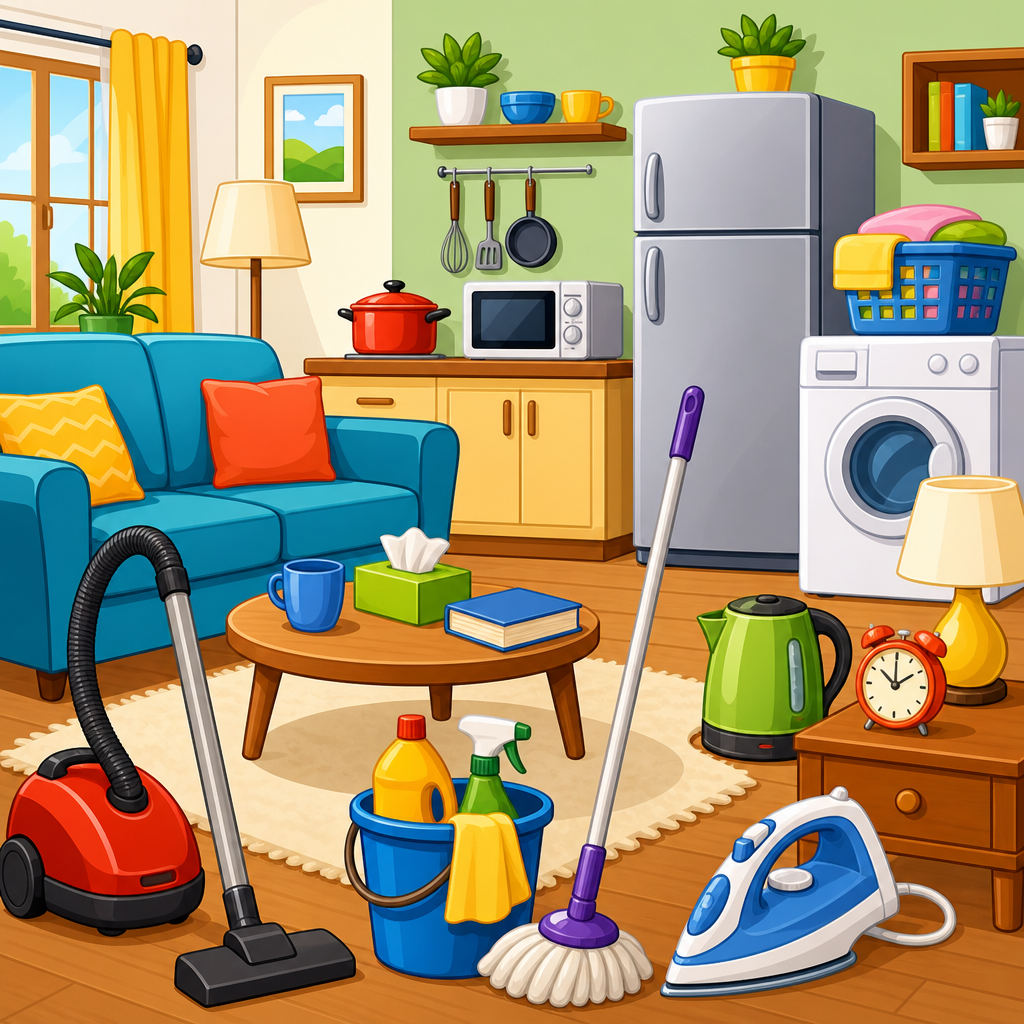
In the bedroom, learners need words connected to sleep, clothing, and storage. Core items include bed frame, mattress, pillowcase, blanket, duvet, sheet, wardrobe, closet, hanger, laundry hamper, dresser, mirror, nightstand, and alarm clock. In the bathroom, practical vocabulary includes shower, bathtub, sink, drain, towel rail, bath mat, soap dispenser, toilet seat, plunger, tissue box, and first-aid kit. In the living room, students should know sofa, cushion, armchair, side table, rug, curtain rod, speaker, remote, floor lamp, and shelf. Utility areas add vacuum cleaner, broom, dustpan, mop, bucket, detergent, ironing board, iron, toolbox, extension cord, and lightbulb.
| Room | Essential items | Useful actions |
|---|---|---|
| Kitchen | fridge, stove, kettle, pan, plate, cupboard | cook, boil, fry, wash, store |
| Bedroom | bed, pillow, blanket, wardrobe, hanger | sleep, fold, hang, tidy, make the bed |
| Bathroom | sink, towel, toothbrush, shower, mirror | brush, rinse, wipe, shower, dry off |
| Living room | sofa, lamp, rug, shelf, remote | sit, relax, switch on, watch, tidy up |
| Laundry area | washing machine, detergent, basket, iron | wash, dry, sort, fold, iron |
When learners study rooms, they should practice location language at the same time. A lamp can be on the bedside table. Plates are in the cupboard. Towels hang behind the door. Shoes are under the bed. Chargers are in the top drawer. These pairings build natural sentence patterns, which makes the vocabulary easier to recall under pressure.
Kitchen and cleaning vocabulary learners use most
Kitchen vocabulary deserves extra attention because it combines objects, actions, safety language, and measurable quantities. In most beginner and intermediate classes I have taught, the highest-value kitchen words are not the rare tools but the common items used several times a day. Learners benefit most from mastering sink, tap, dish rack, sponge, dish soap, trash can, cutting board, knife, bowl, plate, mug, container, lid, and kettle. These words appear in homes, offices, hotels, and shared accommodation. They also appear in instructions: rinse the mug, wipe the counter, empty the bin, or put the leftovers in a container.
Cleaning vocabulary is equally important because it often appears in chores, rental agreements, and workplace English. Students should know broom, mop, bucket, vacuum cleaner, dust cloth, scrub brush, detergent, bleach, disinfectant, rubber gloves, trash bag, and paper towel. They also need the verbs that naturally fit these items: sweep the floor, mop the tiles, vacuum the carpet, scrub the sink, wipe the mirror, empty the trash, and do the laundry. Collocations matter more than isolated words. Native speakers rarely say “use vacuum cleaner floor”; they say “vacuum the floor” or “run the vacuum over the rug.”
There is also an important difference between object names and material names. Sponge is countable when it refers to one item, but detergent and bleach are usually noncount nouns. Learners therefore need patterns such as a sponge, two sponges, some detergent, and a bottle of bleach. These grammar links are not separate from vocabulary learning; they are part of accurate usage.
Furniture, appliances, and electronics in daily life
Furniture vocabulary helps learners describe rooms, shop online, speak with landlords, and understand assembly instructions. Basic terms include chair, table, desk, shelf, cabinet, drawer, stool, bench, wardrobe, bookcase, and couch or sofa. More precise vocabulary becomes useful quickly: folding chair, office chair, dining table, bedside table, shoe rack, chest of drawers, and storage ottoman. Precision matters because furniture is often discussed when giving directions or solving practical problems. If a tenant reports “the cabinet door is loose,” that is more helpful than saying “the furniture is broken.”
Appliances are another core category. Learners should know refrigerator, freezer, dishwasher, washing machine, dryer, microwave, fan, heater, air conditioner, water filter, rice cooker, and electric kettle. They also need common parts and states: plug, cord, switch, battery, screen, handle, lid, full, empty, broken, charged, unplugged, and out of order. In real life, people often speak about malfunction rather than ownership. The washing machine is leaking. The lamp will not switch on. The remote needs new batteries. The freezer door is not closing properly. This language is practical and high frequency.
Home electronics bridge household vocabulary and modern daily communication. Students should know router, charger, power bank, headphones, speaker, extension cord, adapter, and power outlet. In many homes, these items are as common as blankets and lamps. Including them reflects how people actually live now, not how vocabulary lists looked twenty years ago.
Useful phrases, collocations, and common learner mistakes
Knowing the noun is only the first step. Learners need the phrase patterns that make speech natural. Strong household English includes collocations such as set the table, clear the table, do the dishes, make the bed, change the sheets, fold the laundry, hang up your coat, tidy your room, wipe down the counter, and take out the trash. These combinations are fixed enough that they should be learned together. Corpus-based teaching materials consistently show that high-frequency chunks improve fluency because learners retrieve one unit rather than assembling each sentence word by word.
Common mistakes often come from translation. Many learners overuse thing, machine, or box when a more exact noun exists. Others mix up closet, wardrobe, cupboard, and cabinet. A closet is usually a built-in storage space, especially in American English. A wardrobe is a large piece of furniture for clothes. A cupboard or cabinet stores dishes, food, or household supplies. Another frequent issue is confusing sink and basin, or blanket and sheet. A sheet is the thin fabric on the bed; a blanket is the warmer covering on top.
Pronunciation can also block understanding. Words like cupboard are often pronounced “cubbard,” and comfortable may reduce to “comfterble” in natural speech. Teachers should model the spoken form early. Spelling matters too. Drawer is not pronounced like draw-er with a strong second syllable in many accents, and towel often causes vowel errors. Short, repeated speaking practice with real objects works better than long memorization lists.
How to learn and teach household vocabulary effectively
The fastest way to learn household items vocabulary in English is to attach words to visible objects and daily actions. Labeling real items at home works remarkably well: mirror, door handle, shelf, kettle, charger, trash can. Learners can then say mini-sentences aloud: The keys are on the shelf. I plugged in the charger. I need to empty the trash can. This method combines vocabulary, grammar, and retrieval practice. Research on memory consistently shows that active recall and spaced repetition produce better retention than passive rereading.
Pictures, realia, and room maps are effective in class, but the strongest gains usually come from task-based practice. Ask learners to describe their kitchen, compare two bedrooms, give cleaning instructions, or explain where to find a first-aid kit. Digital tools can support this process. Quizlet is useful for set review, while Anki is excellent for spaced repetition. Cambridge Dictionary and Merriam-Webster help with pronunciation audio and usage examples. For multilingual learners, photo dictionaries can bridge meaning quickly, but they should always be followed by sentence production.
For a complete Daily Life Vocabulary hub, household items connect naturally to related subtopics: rooms in a house, chores and routines, food and cooking vocabulary, shopping for home products, prepositions of place, and describing problems or repairs. Learners build real fluency when these topics reinforce one another instead of staying isolated as separate word lists.
Household items vocabulary in English is one of the most practical parts of ESL Vocabulary Building because it turns everyday experience into clear communication. Learners who know the names of common objects, the actions used with them, and the patterns that connect them can describe their homes, follow instructions, ask for help, shop accurately, and speak with more confidence. That is the real value of this topic: immediate usefulness.
The most effective approach is organized, not random. Learn words by room, then by function, then in natural collocations. Study the kitchen, bedroom, bathroom, living room, and laundry area. Add verbs such as wipe, fold, plug in, store, rinse, and hang up. Notice regional differences like cupboard and cabinet or tap and faucet, but focus first on the terms you are most likely to hear and use. Be precise when possible. Charger is better than “phone thing,” and duvet is better than “bed cover” when the exact word is needed.
If you are building stronger daily life vocabulary, start with your own home today. Walk from room to room, name ten objects in each space, and say one action for every object. Then review those words across the week until they become automatic. That simple habit will expand your English faster than memorizing disconnected lists, and it will give you language you can use immediately in real life.
Frequently Asked Questions
Why is household items vocabulary important for English learners?
Household items vocabulary is important because it connects English to daily life in a very practical way. Learners use these words constantly when talking about routines, cleaning, cooking, organizing, shopping, family life, and personal needs. If a student knows words like kettle, pillow, drawer, sponge, charger, shelf, and laundry basket, they can describe their home more clearly, ask for help more accurately, and understand common conversations more easily. Instead of saying “the thing in the kitchen” or “the box in the bedroom,” they can use exact vocabulary that makes communication smoother and more confident.
This topic is also central in ESL because household language appears across many situations, not just at home. A learner may need it when renting an apartment, staying in a hotel, shopping for supplies, asking a roommate a question, reporting a problem to a landlord, or following instructions at work. For example, understanding the difference between a cabinet, a cupboard, and a drawer can matter in both conversation and comprehension. In short, household vocabulary helps learners move from vague description to precise, natural English, which is one of the biggest steps toward real fluency.
What are the most useful household items words to learn first?
The best household items to learn first are the ones learners see and use every day. Start with high-frequency nouns from the main areas of a home: kitchen, bedroom, bathroom, living room, and laundry area. In the kitchen, useful words include kettle, fridge, microwave, plate, cup, spoon, and sponge. In the bedroom, common words include bed, pillow, blanket, lamp, dresser, and drawer. In the bathroom, learners should know towel, soap, toothbrush, mirror, and shower curtain. In the living room, practical words include sofa, shelf, remote, rug, and coffee table. For laundry and storage, helpful vocabulary includes laundry basket, hanger, detergent, closet, and charger.
It is also smart to learn words in useful groups rather than random lists. Grouping vocabulary by room or function makes it easier to remember and easier to use in conversation. For example, learners can study “things used for cleaning,” “things used for cooking,” or “things used for storage.” This method builds memory through context. It also prepares students for natural speaking tasks such as describing a room, asking where something is, or explaining what they need to buy. The goal is not to memorize every object in a house immediately, but to master the most common words first and then expand step by step.
How can learners remember household items vocabulary more easily?
The most effective way to remember household vocabulary is to connect each word to a real object, action, and place. When learners see a shelf, open a drawer, plug in a charger, or carry a laundry basket, they should say the word out loud or think it in English. This creates a strong mental link between the object and the language. Vocabulary becomes easier to retain when it is tied to real experience instead of isolated memorization. Labeling items around the house with sticky notes can also be extremely helpful, especially for beginners.
Another strong method is to learn words in short phrases instead of as single nouns. For example, instead of only learning pillow, learn phrases such as “fluff the pillow” or “put your head on the pillow.” Instead of only learning kettle, learn “boil water in the kettle.” This makes vocabulary more active and prepares learners to use it in real sentences. Picture cards, vocabulary notebooks, room-by-room lists, and repetition through daily speaking practice also work well. The key is consistent review. Household vocabulary is especially useful because learners can practice it every day in their own environment, which makes long-term memory much stronger.
What is the best way to teach household items vocabulary in an ESL lesson?
The best way to teach household items vocabulary in an ESL lesson is to make it visual, contextual, and interactive. Begin with clear pictures or real objects and introduce words by room or function. For example, a teacher might present kitchen items together, then ask students to identify each object, repeat the pronunciation, and use it in a short sentence. This approach helps learners understand meaning quickly and reduces confusion. It is especially effective for beginners because home-related vocabulary is concrete and easy to demonstrate.
After introducing the words, the next step is guided practice. Students can match words to pictures, sort items by room, complete labeling activities, or answer practical questions such as “Where do you keep your towels?” or “What do you use a sponge for?” Role-play is also very effective. Learners can practice dialogues about cleaning, shopping, unpacking, or helping a guest in a home. More advanced students can compare household items, describe their homes, explain daily routines, or discuss cultural differences in homes and furniture. A strong ESL lesson on this topic should combine vocabulary, pronunciation, sentence building, and real communication so students move beyond recognition and into confident use.
How can household items vocabulary improve speaking and writing skills?
Household items vocabulary improves speaking and writing because it gives learners specific language for common situations. In speaking, it helps students explain daily activities more naturally. They can say, “I put the towels on the shelf,” “The charger is in the drawer,” or “There is a laundry basket next to the washing machine,” instead of relying on unclear general words like “thing” or “stuff.” This precision makes conversation easier to follow and helps learners sound more fluent. It also supports practical communication in real life, such as asking for an item, giving directions inside a home, or describing a problem.
In writing, household vocabulary helps learners produce richer descriptions and more accurate sentences. It is useful in personal paragraphs, emails, apartment descriptions, shopping lists, journal entries, and beginner essays about daily routines or family life. A student who knows a wider range of home vocabulary can write with more detail and confidence: not just “My room is nice,” but “My room has a small desk, a wooden shelf, a bedside lamp, and two pillows on the bed.” This kind of vocabulary development strengthens grammar at the same time, because learners naturally practice articles, prepositions, singular and plural forms, and common verbs. As a result, household items vocabulary becomes a foundation for clearer speaking, stronger writing, and more natural everyday English.