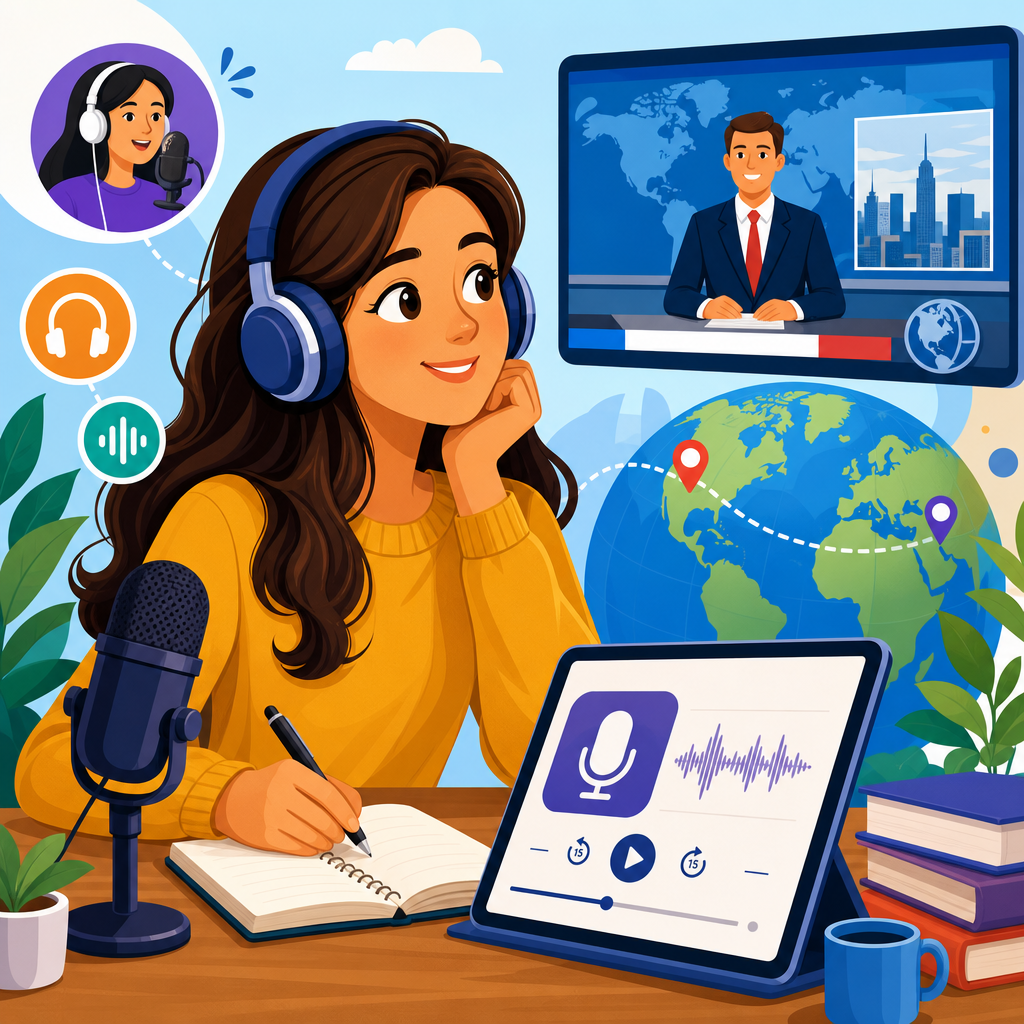
Advanced Listening Course with Podcasts and News helps high-level English learners turn passive exposure into measurable fluency. In an advanced ESL course, listening is no longer about catching isolated words; it is about processing speed, recognizing stance, decoding reduced speech, following argument structure, and responding accurately in real time. Podcasts and news are ideal training materials because they combine authentic vocabulary, varied accents, cultural references, and the discourse patterns learners encounter in university seminars, meetings, interviews, and professional discussions. I have used both formats extensively in advanced classes, and the difference is consistent: learners who move beyond textbook audio develop sharper comprehension, stronger note-taking, and more natural speaking. This hub article explains what an advanced listening course includes, why podcasts and news are especially effective, how lessons are structured, which subskills matter most, and how this advanced ESL course connects to broader learning paths. If you want a clear framework for building expert-level listening, this is the page to start with.
What an Advanced Listening Course Covers
An advanced listening course is designed for learners who already understand everyday English but still struggle with density, speed, nuance, and unpredictability. At this level, the challenge is rarely basic grammar. The real barrier is managing authentic spoken language as it happens: unstressed function words disappear, speakers interrupt themselves, ideas are layered with examples and qualifications, and meaning often depends on tone rather than vocabulary alone. In practical terms, advanced listening instruction focuses on discourse markers, inference, pragmatic meaning, topic shifts, speaker intention, and memory load.
Within an advanced ESL course, listening should connect directly to speaking, reading, and writing. A learner who can summarize a ten-minute news analysis, identify bias in a podcast interview, and ask follow-up questions is developing integrated competence, not isolated test skills. That is why this hub sits naturally within ESL Courses & Learning Paths: advanced listening supports academic English, workplace communication, presentation skills, pronunciation development, and exam preparation. It also creates a bridge to specialized articles on note-taking, accent exposure, shadowing, debate listening, and current-events vocabulary.
Effective course design usually combines intensive listening and extensive listening. Intensive listening means close analysis of a short audio segment, often thirty seconds to three minutes, with repeated listening, transcript work, and attention to features such as linking, elision, stress, hedging, and contrastive emphasis. Extensive listening means regular contact with longer content for meaning, such as a twenty-minute news podcast or a documentary segment. Advanced learners need both. Intensive work builds precision; extensive work builds stamina and automaticity.
Why Podcasts and News Are Powerful for Advanced ESL Course Progress
Podcasts and news offer a unique balance of authenticity and structure. Unlike casual street conversations, they are usually recorded clearly enough for learning, but unlike many textbook dialogues, they reflect real rhetorical choices. News segments often follow recognizable patterns: headline, context, evidence, quote, implication. Podcasts vary more, but strong shows still reveal introductions, transitions, examples, disagreement, and synthesis. These patterns make them excellent for training learners to predict content and organize notes.
Podcasts are especially useful because they expose learners to different speaking styles. Interview shows train turn-taking comprehension, narrative podcasts train long-form attention, and expert discussions build tolerance for specialized terminology. A learner listening to programs from NPR, BBC World Service, The Guardian, CBC, ABC Australia, or Freakonomics Radio hears not just vocabulary, but pacing, register, humor, and framing. In class, I have seen students improve dramatically when they stop trying to understand every word and start listening for claims, evidence, and conclusion.
News is equally valuable because it teaches compression. A two-minute report may contain a full chain of meaning: event, timeline, stakeholders, reaction, uncertainty, and forecast. For advanced learners, that density is productive. It mirrors the cognitive demands of meetings and lectures, where important information appears quickly and not always in simple language. News also builds cultural literacy. Understanding references to elections, inflation, climate targets, labor strikes, or central bank decisions makes later listening easier because background knowledge reduces processing load.
There are limitations, and a serious advanced listening course addresses them directly. Some news language is formulaic and may overrepresent formal register. Some podcasts contain overlapping speech or strong host personalities that can intimidate learners. Content can also become outdated quickly. The solution is curation: select episodes for a clear learning goal, provide pre-listening context, and rotate among accents, formats, and levels of complexity. Authentic material works best when difficulty is deliberate, not random.
Core Listening Subskills That Separate Advanced Learners from Intermediate Learners
Advanced listening depends on a cluster of subskills that can be trained explicitly. The first is segmentation: hearing where one word ends and another begins in connected speech. Learners may know the phrase “what are you going to do” on paper but miss “whaddaya gonna do” in fast speech. The second is prosodic awareness: using stress, rhythm, and intonation to detect focus, contrast, certainty, and attitude. When a speaker says, “He said he finished it,” the emphasis changes the meaning.
A third subskill is inference. In authentic audio, speakers imply as much as they say. If a guest responds, “That’s one way to describe it,” the literal words are simple, but the pragmatic meaning may signal disagreement or skepticism. A fourth is discourse tracking: following signposts such as however, that said, to be fair, on the other hand, and the bigger issue is. These phrases help listeners map the argument and avoid getting lost in details. A fifth is selective retention, which matters in academic and professional settings. Learners must decide what to write down, what to ignore, and what to hold in working memory until the point becomes clear.
Pronunciation knowledge also matters more than many advanced learners expect. Understanding weak forms, assimilation, intrusive sounds, and reductions is not only a speaking issue. It directly affects listening accuracy. For example, “next year” may sound like “नेक्स्चियर,” and “did you” may become “didja.” When learners study these features systematically, comprehension often improves faster than with vocabulary memorization alone. This is one reason an advanced ESL course should never separate listening entirely from pronunciation.
| Subskill | What It Means | Podcast or News Example | Recommended Practice |
|---|---|---|---|
| Segmentation | Identifying words in connected speech | Hearing “gonna” and “wanna” in interviews | Short dictation with transcripts |
| Prosodic awareness | Using stress and intonation to detect meaning | Noticing sarcasm or emphasis in panel shows | Shadowing key lines aloud |
| Inference | Understanding implied meaning | Recognizing polite disagreement in commentary | Ask “What does the speaker really mean?” |
| Discourse tracking | Following structure and transitions | Tracing claim, evidence, and conclusion in analysis | Outline the audio while listening |
| Selective retention | Keeping only useful information | Capturing names, numbers, and causes in news | Cornell notes after one listen |
How Lessons in an Advanced Listening Course Should Be Structured
The most effective lessons follow a three-stage sequence: before listening, during listening, and after listening. Before listening, the teacher activates background knowledge, previews essential vocabulary, and sets a concrete purpose. The goal is not to pre-teach every difficult word. It is to reduce unnecessary friction so learners can focus on the listening objective. For a news report on interest rates, for example, students may need to know inflation, borrowing costs, and central bank, but they do not need a full economics lecture.
During listening, tasks should move from global understanding to detailed analysis. First listen for the main idea. Second listen for structure, stance, or evidence. Third listen for language features, numbers, or quotations. This sequence mirrors how competent listeners actually process speech. When teachers begin with micro-detail, many learners panic and miss the overall meaning. I have found that even strong students perform better when they answer broad questions first, then revisit difficult segments with transcripts and replay tools.
After listening, learners should produce something. They can write a summary, compare two speakers’ positions, evaluate bias, or record a spoken response. Output reveals whether comprehension was accurate and complete. It also transforms listening from consumption into active language use. In advanced classes, post-listening discussion is especially valuable because it exposes gaps between what students thought they heard and what the speaker actually meant. Those moments are where durable learning happens.
Good lessons also vary the replay policy. Some activities allow one listen only to build real-world resilience. Others use multiple listens because the target is analytical depth. Both are valid if the rationale is clear. A strong advanced ESL course does not confuse difficulty with quality. The objective determines the method.
Choosing the Right Podcasts and News Sources
Not every authentic source is equally useful. Selection should be based on clarity, relevance, speaker variety, transcript availability, and update frequency. For advanced learners, transcripts are not a crutch; they are an analysis tool. They allow precise checking of missed words, discourse markers, and pronunciation features. Sources such as BBC Learning English, VOA Learning English, and TED Talks can be useful transitional materials, but a true advanced listening course should increasingly include native-speed content from mainstream outlets.
For news, reliable sources include Reuters, BBC, NPR, Al Jazeera English, CBC, and The Economist’s audio products. Reuters is especially helpful for concise, neutral reporting language. BBC and NPR offer strong range in accent and topic. For podcasts, the best choice depends on the learner’s goal. Business English learners benefit from Marketplace or The Indicator. Academic learners often do well with discussion-based shows that model evidence and qualification. Professionals may prefer interview podcasts in their own field, where motivation offsets difficulty.
Teachers and self-directed learners should also balance familiarity and challenge. If every audio is about an unfamiliar topic, listening becomes a test of background knowledge rather than language skill. If every source uses the same accent and format, progress becomes narrow. A practical weekly mix might include one straightforward news briefing, one in-depth interview, one analytical explainer, and one learner-selected episode tied to personal interests. That combination develops range without sacrificing consistency.
Assessment, Progress Tracking, and Common Mistakes
Progress in advanced listening should be measured with more than quiz scores. Useful indicators include summary quality, note accuracy, ability to identify speaker stance, response time in discussion, and tolerance for unfamiliar accents. I recommend periodic benchmark tasks using the same rubric: main idea, supporting detail, inference, organization, and spoken or written response. Over several weeks, patterns become visible. Many learners discover that detail recognition improves before inference does, while others gain confidence with long audio before they improve at fast exchanges.
One common mistake is overusing subtitles. Full subtitles can turn listening practice into reading practice, especially on video platforms. A better sequence is audio first, transcript later. Another mistake is choosing material that is consistently too hard. If a learner understands almost nothing, there is little basis for strategy training. Productive difficulty usually means understanding the main idea and some support, while still missing enough detail to justify focused work.
A third mistake is ignoring review. Advanced learners often consume large amounts of content but rarely revisit it. Re-listening is powerful because the second pass frees attention for deeper features: tone, cohesion, collocations, and rhetorical structure. Finally, many learners underestimate the value of speaking back to the audio. Brief oral summaries, shadowing, and response recordings strengthen processing speed and make listening gains more transferable to real conversation.
Advanced Listening Course with Podcasts and News gives advanced learners a practical route from strong comprehension to confident real-world performance. The central idea is simple: authentic audio, used systematically, teaches the skills textbooks alone cannot develop. Podcasts train stamina, speaker tracking, and nuanced interpretation. News trains concise comprehension, note-taking, and awareness of how information is organized under time pressure. Together, they create a high-value foundation for any advanced ESL course.
As the hub for this subtopic within ESL Courses & Learning Paths, this page connects the full picture. Advanced listening is not an isolated module. It supports pronunciation, discussion skills, academic study, professional communication, and exam readiness. The most effective learning path combines intensive analysis, extensive exposure, transcript-based review, and regular output. Learners who follow that structure improve faster because they are training how English actually sounds in the world, not just how it appears in print.
If you are building or choosing an advanced ESL course, prioritize curated podcasts, trustworthy news sources, explicit subskill training, and consistent progress tracking. Start with one weekly routine, keep the materials authentic, and review more than you think you need. Then use this hub to explore the related articles in the Advanced ESL Course cluster and turn listening practice into fluent, accurate communication.
Frequently Asked Questions
Who is an advanced listening course with podcasts and news designed for?
An advanced listening course with podcasts and news is designed for high-level English learners who already understand the basics of spoken English but want to improve how quickly, accurately, and confidently they process real-world language. This usually includes upper-intermediate to advanced ESL students, university learners, professionals working in English, exam candidates, and fluent speakers who still struggle when conversations become fast, dense, or culturally loaded. At this level, the challenge is rarely simple vocabulary recognition. The real difficulty is understanding connected speech, identifying the speaker’s intention, following complex argument structure, and reacting in real time without mentally translating every sentence.
These courses are especially useful for learners who can read English well but feel less secure when listening to interviews, panel discussions, documentaries, breaking news, or long-form podcast episodes. Authentic audio exposes learners to natural pauses, hesitation, reduced pronunciation, emphasis, irony, disagreement, and shifts in tone that textbooks often simplify. Because podcasts and news include expert commentary, storytelling, and analysis, they help advanced learners train for the kind of listening required in academic, professional, and international communication settings. In other words, this kind of course is ideal for learners who want to move beyond “I understand most of it” and reach a level where they can follow nuanced spoken English with precision.
Why are podcasts and news considered some of the best materials for advanced listening practice?
Podcasts and news are among the strongest tools for advanced listening development because they offer exactly what high-level learners need: authentic language delivered at natural speed in meaningful contexts. Unlike scripted classroom recordings, these sources expose learners to real discourse patterns. That includes interruption, reformulation, hedging, emphasis, contrast, and the subtle ways speakers organize information for persuasion or explanation. News reports also train learners to process facts quickly, while podcasts often develop deeper skills such as following narrative structure, interpreting opinion, and recognizing bias, stance, and implication.
Another major advantage is range. Podcasts and news cover politics, science, business, culture, health, technology, and social issues, which means learners build vocabulary in context instead of memorizing disconnected word lists. They also hear multiple accents, speaking styles, and levels of formality. This variety is essential for advanced fluency because real listening success depends on flexibility, not familiarity with a single voice. A strong advanced ESL course uses these materials strategically, helping learners notice reduced speech, discourse markers, stress patterns, and rhetorical structure rather than simply pressing play and hoping comprehension improves over time. Used properly, podcasts and news turn passive exposure into active, measurable listening progress.
What listening skills does this kind of course actually improve beyond general comprehension?
An advanced listening course with podcasts and news develops a much wider set of skills than general comprehension alone. First, it improves processing speed, which is the ability to understand spoken English in real time without constantly falling behind. This matters because advanced learners often know the words but still need too much time to decode them in fast speech. Second, it strengthens recognition of reduced and connected speech, such as contractions, weak forms, linking, and sound changes that make natural English difficult to follow even for strong learners.
Just as importantly, this kind of course teaches learners to track argument structure. In advanced audio, speakers do not simply present isolated ideas; they compare claims, qualify opinions, signal uncertainty, introduce evidence, and shift between main points and supporting details. Learners become better at hearing how a speaker builds a case, changes direction, or implies a position without stating it directly. The course also develops sensitivity to tone, stance, and intention. For example, learners learn to hear whether a speaker is skeptical, enthusiastic, cautious, critical, ironic, or neutral. This is crucial in both academic and professional communication, where meaning often depends as much on attitude as on literal words.
Finally, effective training improves response accuracy. Listening is not just about understanding input; it is about reacting appropriately. By working with podcasts and news, learners practice summarizing, paraphrasing, answering questions, discussing implications, and responding under time pressure. That combination of comprehension, interpretation, and output is what turns advanced listening into functional fluency.
How can learners use podcasts and news effectively instead of just listening passively?
The most effective approach is to treat listening as structured training rather than background exposure. Passive listening can be useful for familiarity and rhythm, but it rarely produces strong gains on its own at the advanced level. To improve measurably, learners should listen with a clear purpose. For example, one listening session might focus on identifying the main argument, another on noticing transition phrases and discourse markers, and another on tracking how the speaker expresses certainty, doubt, agreement, or criticism. This targeted approach helps learners build skills deliberately instead of hoping comprehension improves automatically.
A strong method is to use a repeated listening cycle. On the first listen, focus on the big picture: topic, speakers, purpose, and overall message. On the second listen, identify structure, examples, and supporting points. On the third listen, pay attention to pronunciation features such as linking, reductions, stress, and intonation. Learners should also pause strategically to summarize sections aloud, predict what comes next, or paraphrase key ideas in their own words. Transcript work can be extremely valuable, but only after an initial attempt to understand the audio independently. Comparing what you heard with what was actually said reveals patterns in your listening gaps.
Keeping a listening journal is another highly effective strategy. Learners can record unfamiliar expressions, recurring pronunciation features, topic-specific vocabulary, and notes about what made a segment difficult. Over time, this creates a clear record of progress and recurring weaknesses. In a well-designed advanced ESL course, these activities are guided and sequenced so that learners build endurance, speed, and precision rather than simply consuming more content. The goal is not to listen to everything. The goal is to listen in a way that trains the brain to process spoken English more efficiently and more intelligently.
How long does it typically take to see results from an advanced listening course using podcasts and news?
The timeline depends on the learner’s starting level, consistency, and the quality of the training method, but many advanced learners begin to notice meaningful changes within a few weeks of focused practice. Early improvements often include better concentration during long audio segments, greater comfort with natural speaking speed, and stronger recognition of familiar words in fast or reduced speech. These initial gains are important because they usually signal that the learner is beginning to process speech more automatically rather than word by word.
More substantial progress typically appears over a longer period of steady work. With regular, structured listening practice, learners often become much better at following complex discussions, understanding nuance, and responding more accurately in conversation or class. They may find that they need fewer replays, miss fewer transitions in an argument, and feel less overwhelmed by unfamiliar accents or dense information. This kind of progress is especially noticeable when the course includes measurable tasks such as summaries, comprehension checks, shadowing, transcript analysis, and discussion-based follow-up activities.
It is also important to understand that advanced listening improvement is not always linear. Learners often experience periods where they feel challenged despite consistent study, especially when moving into more specialized topics or more demanding speakers. That is normal. Authentic podcasts and news are rich, unpredictable sources of language, which is exactly why they are so valuable. With consistent practice and the right guidance, learners usually build not only stronger comprehension but also greater confidence, faster processing, and more flexible real-world listening ability. Those are the results that matter most for lasting fluency.