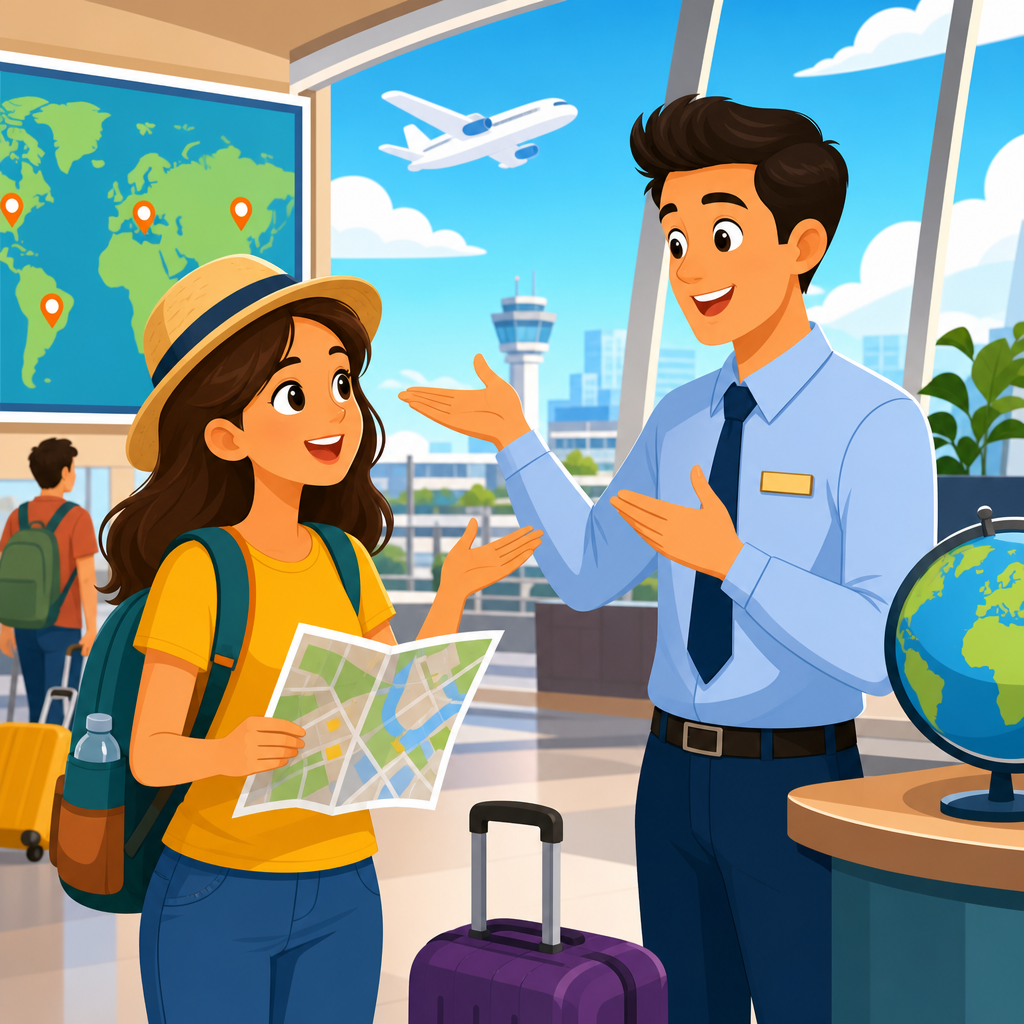
Basic Travel English for Beginners helps new English learners handle real situations before, during, and after a trip. In simple terms, travel English is the set of words, phrases, questions, and listening skills people use in airports, train stations, hotels, restaurants, shops, and tourist sites. It is practical English, not academic English. The goal is not perfect grammar. The goal is getting from one place to another, understanding what staff ask, solving small problems, and feeling confident enough to speak.
I have taught travel-focused English to first-time travelers, international students, and working adults who needed quick results before a flight. The same pattern appears every time: beginners do not fail because they know too little vocabulary overall. They struggle because they do not know the exact phrases used in predictable situations. A traveler may know colors, numbers, and common verbs, yet still freeze when an airline agent says, “May I see your boarding pass?” or when a hotel receptionist asks, “Would you like a wake-up call?” Learning targeted travel English fixes that gap fast.
This matters because travel is full of time pressure. In an airport line, you may have only ten seconds to answer. In a taxi, the driver may not repeat a question slowly. In a restaurant, the server may ask two things at once: “Still or sparkling? Cash or card?” When beginners prepare for these short exchanges in advance, they become easier to understand and easier to answer. That confidence often improves pronunciation, listening, and memory at the same time.
As a hub for English for travel, this guide covers the essential language beginners need, the situations where that language appears, and the study methods that produce fast practical results. It also connects naturally to broader ESL for specific goals study because travel English uses the same core skills found in workplace English, survival English, and functional speaking. If you can ask for directions, confirm a reservation, explain a problem, and understand basic instructions, you can travel more independently and keep building fluency through real-life use.
Core travel English every beginner should learn first
The best starting point is high-frequency language. Beginners should learn greetings, polite requests, numbers, dates, times, common signs, transportation words, and question forms. Start with phrases such as “Excuse me,” “Can you help me?” “Where is…?” “How much is it?” “I have a reservation,” and “I don’t understand.” These phrases work almost everywhere. They are flexible, easy to memorize, and useful even with limited grammar.
Travel English also depends heavily on key nouns. Learners should know passport, ticket, boarding pass, gate, platform, exit, luggage, reservation, receipt, menu, bill, map, address, pharmacy, and restroom. Verbs matter too: book, check in, check out, cancel, miss, change, pay, carry, open, close, and recommend. In class, I always pair each word with a realistic action. Students do not just memorize “boarding pass”; they practice saying, “Here is my passport and boarding pass.” That full phrase is what they will actually use.
Question patterns deserve special attention because travel requires constant information exchange. Beginners need to recognize and produce “Where is…?”, “What time…?”, “How much…?”, “Which one…?”, “Do I need to…?”, and “Can I…?” They should also train short answers: “Yes, please,” “No, thank you,” “Just one,” “Round trip,” “Aisle seat, please,” and “Two nights.” These compact responses are often enough in service interactions.
Pronunciation should focus on intelligibility, not accent reduction. Travelers especially need clear numbers, letters, and place names. If room 15 sounds like 50, or Tuesday sounds like Thursday, small mistakes become expensive. Practice spelling with the standard pattern used in real life: “My name is Ana, A-N-A.” Practice flight times, prices, and dates aloud. Clear stress in phrases like “check IN,” “boarding PASS,” and “credit CARD” also improves understanding because staff expect those rhythm patterns.
English at the airport, station, and on local transportation
Airports are one of the most stressful places for beginners because they combine announcements, documents, security rules, and fast interactions. The most important phrases are direct and repetitive. At check-in, a traveler may say, “I’m flying to Madrid,” “I’d like to check in,” “Here is my passport,” and “Do I need to check this bag?” Staff may ask, “Did you pack your bags yourself?” “Do you have any liquids?” or “Would you prefer a window or an aisle?” Preparing these exact exchanges makes airport English manageable.
Security and boarding require listening for short instructions. Common phrases include “Please remove your laptop,” “Take off your jacket,” “Place your bag on the belt,” “This way, please,” and “Your gate has changed.” Beginners should know that gate means the departure area, boarding means entering the plane, delayed means late, and cancelled means the trip will not happen as planned. On flights, useful language includes “Could I have water?” “Where is my seat?” “Can I put this bag here?” and “Is this seat taken?”
Train and bus travel use similar language with a few different nouns. Instead of a gate, you may hear platform or stop. Instead of boarding pass, you may use ticket or pass. A traveler should be able to ask, “Which platform is for the 10:30 train?” “Does this bus go downtown?” “How many stops until Central Station?” and “Can I buy a ticket on board?” In many cities, these questions save time and prevent missed connections.
Taxis and ride-hailing add another set of highly practical expressions. A beginner should know how to state a destination clearly: “Please take me to this address,” “I’m going to the City Hotel,” or “Can you drop me off here?” It is also useful to confirm basics: “How long will it take?” “How much is the fare?” “Can I pay by card?” and “Please stop here.” Showing the address on a phone is common and effective, but speaking the key words still helps when there is confusion or heavy traffic noise.
| Travel situation | Useful beginner phrase | What it helps you do |
|---|---|---|
| Airport check-in | I have a reservation under Singh. | Identify your booking quickly |
| Security | Do I need to take this out? | Clarify instructions about bags and electronics |
| Train station | Which platform is for the next train to Oxford? | Find the correct departure point |
| Bus stop | Does this bus go to the museum? | Confirm the route before boarding |
| Taxi | Please take me to this address. | State your destination clearly |
Hotel English, dining English, and shopping English
Hotels produce some of the most predictable conversations in travel, which makes them ideal for beginners. At check-in, guests usually need only a few pieces of information: name, reservation, number of nights, and passport or ID. The core phrases are “I have a reservation,” “I’d like to check in,” “It’s under Lopez,” “I’m staying for three nights,” and “What time is breakfast?” If there is a problem, simple sentences work best: “The room is too cold,” “The Wi-Fi isn’t working,” “I need another towel,” or “Can I have a late check-out?”
Beginners should also understand standard hotel questions. Reception staff may ask, “Would you like one bed or two?” “Do you need help with your bags?” “Would you like to pay now or at check-out?” and “Could you fill out this form?” In my experience, students improve fastest when they practice both sides of the conversation. If they only memorize what they want to say, they still get stuck when staff use an unexpected but common question. Listening practice with short hotel dialogues solves that issue.
Restaurant English matters because meals create repeated speaking opportunities every day of a trip. The essential phrases are “A table for two, please,” “Can I see the menu?” “What do you recommend?” “I’m allergic to nuts,” “I’d like the chicken,” “No ice, please,” and “Could we have the bill?” Beginners should also know common service questions: “Still or sparkling water?” “How would you like that cooked?” “Anything else?” and “Cash or card?” If a learner can answer these four smoothly, most restaurant interactions become much easier.
Shopping English is usually short but fast. Travelers need to ask about price, size, color, payment, and returns. Useful phrases include “How much is this?” “Do you have this in a larger size?” “Can I try it on?” “I’m just looking, thank you,” and “Can I pay by card?” In markets, especially in tourist areas, learners may hear reduced or informal speech. That is why numbers practice is so important. Knowing prices quickly prevents confusion and helps learners confirm what they heard: “Did you say fifteen or fifty?”
Asking for directions, handling problems, and staying safe
Direction language is basic travel English in its purest form: simple grammar, clear purpose, immediate results. Beginners should learn place words such as left, right, straight, corner, block, across from, next to, between, upstairs, downstairs, and near. A strong starter phrase is “Excuse me, how do I get to…?” Other useful questions are “Is it within walking distance?” “How far is it?” and “Which way is the subway?” Travelers should also practice checking understanding by repeating the key point: “So I go straight and turn left at the bank, right?”
Problems happen on nearly every trip, so problem-solving English deserves direct preparation. Common issues include lost luggage, wrong reservations, overcharges, missed buses, weak phone battery, and illness. The most useful survival phrases are “I need help,” “There seems to be a mistake,” “My bag is missing,” “I missed my connection,” “I was charged twice,” and “I need a doctor.” These are not advanced sentences, but they are high value because they let staff know the situation immediately.
Safety language is equally important. Beginners should know how to say “Please call the police,” “I need an ambulance,” “My passport was stolen,” “I am lost,” and “Can you write that down?” They should also understand common warning language such as “Keep your belongings with you,” “Watch your step,” “No entry,” and “Emergency exit.” In many countries, official signs use straightforward English even when local conversation is difficult, so reading these common terms can make a real difference.
Technology can support beginners, but it should not replace core language. Translation apps, offline maps, hotel booking apps, and airline notifications are excellent tools. Google Translate, DeepL, Google Maps, and airline apps reduce friction, especially when internet access is limited. Still, I advise learners to memorize at least twenty essential travel phrases and keep them available in notes on their phone. When a device battery dies or a network fails, spoken basics become your backup system.
How beginners can study travel English effectively
The fastest way to learn English for travel is scenario-based practice. Instead of studying random vocabulary lists, beginners should study by situation: airport, hotel, restaurant, shopping, directions, emergencies. Build each situation around ten to fifteen phrases, then practice them aloud in short role-plays. This method works because travel conversations are highly repetitive. A learner who can manage five common service encounters already covers a large part of a typical trip.
Listening should come before long speaking practice. Beginners often know the phrase they want to say but cannot catch the question from a native or fluent speaker. Use short audio clips, slow dialogues, and shadowing practice. Shadowing means listening to a sentence and repeating it immediately with the same rhythm and stress. It is especially effective for travel English because many exchanges are formulaic. Phrases like “Can I see your passport?” and “Would you like anything to drink?” appear again and again.
Vocabulary review should use spaced repetition, not one-time memorization. Tools such as Anki, Quizlet, and Memrise help learners revisit travel words at the right interval. Keep flashcards practical. Instead of one card for “reservation,” use “I have a reservation under Kim.” Full chunks are easier to remember and easier to use under pressure. It also helps to create mini-dialogues from your own travel plans, using the city names, hotel type, and transportation you actually expect to use.
Finally, connect this hub to your broader study path. Travel English is part of functional ESL, but it also strengthens pronunciation, listening, confidence, and everyday grammar. Review these phrases before your next trip, practice with a partner, and build from simple scripts to real conversation. If you want faster progress, move next into focused lessons on airport English, hotel English, restaurant English, and asking for directions. The more specific your practice, the more natural your travel English will feel when it matters most.
Frequently Asked Questions
What is basic travel English, and why is it important for beginners?
Basic travel English is the practical, everyday English people use when they travel. It includes simple words, short questions, common signs, and useful phrases for real situations such as checking in at the airport, asking for directions, ordering food, booking a hotel room, shopping, and solving small problems. For beginners, this kind of English is more useful than advanced grammar because travel situations usually move quickly. You often need to understand key information, respond clearly, and ask for help without having much time to think.
It is important because it helps you do the essentials of a trip with less stress. If you can understand questions like “Passport, please,” “How many nights?” “Window or aisle?” or “Cash or card?” you can move through airports, hotels, restaurants, and stations more confidently. Basic travel English also helps you avoid misunderstandings, especially when you need to confirm times, prices, locations, or transportation details. Even if your grammar is not perfect, being able to communicate the main idea can save time and prevent problems.
Most importantly, basic travel English builds confidence. Many beginners worry that they need to speak perfectly before they travel, but that is not true. Travel English is about being understood and understanding others well enough to manage common situations. A small set of useful phrases can make a big difference. When learners focus on practical communication instead of perfection, they often feel calmer, more independent, and more ready to enjoy the trip.
Which English phrases should beginners learn first before traveling?
Beginners should start with high-frequency phrases that work in many different situations. The best first phrases are polite, simple, and flexible. Useful examples include “Hello,” “Excuse me,” “Please,” “Thank you,” “I’m sorry,” “Can you help me?” “I don’t understand,” “Can you say that again?” and “Could you speak more slowly?” These are essential because they help you start conversations, ask for clarification, and stay polite even when communication is difficult.
After that, learners should focus on travel-specific phrases. At the airport, phrases such as “Where is check-in?” “Which gate is it?” “What time does boarding start?” and “Do I need to show my passport?” are very useful. At hotels, good phrases include “I have a reservation,” “Can I check in?” “What time is breakfast?” “Is Wi-Fi included?” and “Can I have a late check-out?” In restaurants, useful phrases include “Can I see the menu?” “I would like this,” “What do you recommend?” “Can I have the bill, please?” and “Do you take cards?”
It is also smart to learn problem-solving phrases because small issues are common during travel. Examples include “I missed my train,” “My room key doesn’t work,” “My bag is missing,” “I need a taxi,” “Where is the restroom?” and “How much is it?” These phrases cover many everyday needs. Beginners do not need hundreds of expressions. A strong core of practical phrases is usually enough to handle most travel situations, especially when combined with clear pronunciation, gestures, and a calm attitude.
How can beginners improve their listening skills for airports, hotels, and other travel situations?
Improving listening skills for travel starts with listening to the kind of English you will actually hear on a trip. Beginners should practice with short, realistic audio or video clips from airports, hotels, restaurants, train stations, and tourist information desks. This is helpful because travel English often includes repeated question patterns, simple instructions, numbers, times, dates, and prices. If you become familiar with these common patterns, you will understand more even if you do not catch every word.
One of the most effective methods is to focus on key words instead of trying to understand every sentence perfectly. In real travel situations, hearing words such as “passport,” “gate,” “departure,” “platform,” “reservation,” “breakfast,” “receipt,” “ticket,” “left,” “right,” or “delayed” can tell you a lot. Numbers are especially important, so beginners should practice understanding flight numbers, room numbers, prices, times, and dates. If someone says, “Boarding starts at gate twelve at six fifteen,” you do not need to understand advanced grammar. You need to catch the important details.
Beginners should also practice asking people to repeat or simplify what they said. This is a real listening skill, not a weakness. Phrases like “Sorry, could you repeat that?” “Can you speak more slowly?” and “Can you write it down, please?” are extremely useful. In many travel settings, staff are used to speaking with non-native speakers and will often help if you ask clearly and politely. Repeating key information back is another strong strategy. For example, you can say, “Gate 12, right?” or “Breakfast starts at 7:00?” This confirms that you understood correctly and reduces mistakes.
Do beginners need perfect grammar to use travel English successfully?
No, beginners do not need perfect grammar to use travel English successfully. In fact, one of the most important ideas in travel communication is that clear meaning matters more than grammatical perfection. When you travel, people usually want to understand your need quickly. If you say, “I need taxi,” “Where train station?” or “I have booking,” the grammar may not be perfect, but the message is often clear enough for the other person to help you. This is why travel English is especially useful for beginners.
That said, simple sentence patterns can still make communication smoother. Useful patterns include “I need…,” “I want…,” “Where is…?” “How much is…?” “Can I…?” and “Do you have…?” These structures are easy to remember and work in many situations. For example, “I need help,” “Where is my gate?” “How much is this?” and “Can I pay by card?” are short, correct, and effective. Beginners should focus on building confidence with these common forms instead of worrying about long or complicated sentences.
Pronunciation, listening, and confidence often matter more than grammar during a trip. Speaking slowly, using simple words, and checking important details can help more than trying to create perfect sentences under pressure. If you are polite and direct, most people will understand your purpose. The best goal is not to sound like an advanced speaker. The best goal is to communicate successfully in real moments, whether you are checking in, ordering food, asking for directions, or solving a small problem.
What is the best way to practice basic travel English before a trip?
The best way to practice basic travel English before a trip is to prepare for real situations, not just memorize isolated vocabulary. Start by making a list of the places and moments you are most likely to experience: airport check-in, passport control, boarding, taking a taxi, checking into a hotel, ordering at a restaurant, shopping, asking for directions, and visiting tourist sites. Then learn the most common phrases and questions for each situation. This type of practice is effective because it connects language to action, which makes it easier to remember and use when you need it.
Role-play is one of the strongest practice methods for beginners. You can practice short conversations aloud by yourself, with a teacher, or with a study partner. For example, one person can play the hotel receptionist and the other can say, “Hello, I have a reservation under Maria Silva,” or “What time is check-out?” You can also practice restaurant conversations, ticket purchases, and asking for help in a station. Speaking out loud is important because travel English is not only about recognizing words. It is about being able to produce them quickly and clearly in real time.
Another excellent strategy is to combine speaking, listening, and reading. Read signs such as “Departures,” “Arrivals,” “Customs,” “Platform,” and “Exit.” Listen to short travel dialogues and repeat them. Practice numbers, dates, and times every day because they appear constantly during travel. It also helps to save useful phrases on your phone or in a small notebook for quick review. The most successful beginners usually do not try to learn everything. They focus on the most common situations, repeat practical phrases many times, and build comfort with simple communication. That kind of preparation creates real confidence when the trip begins.