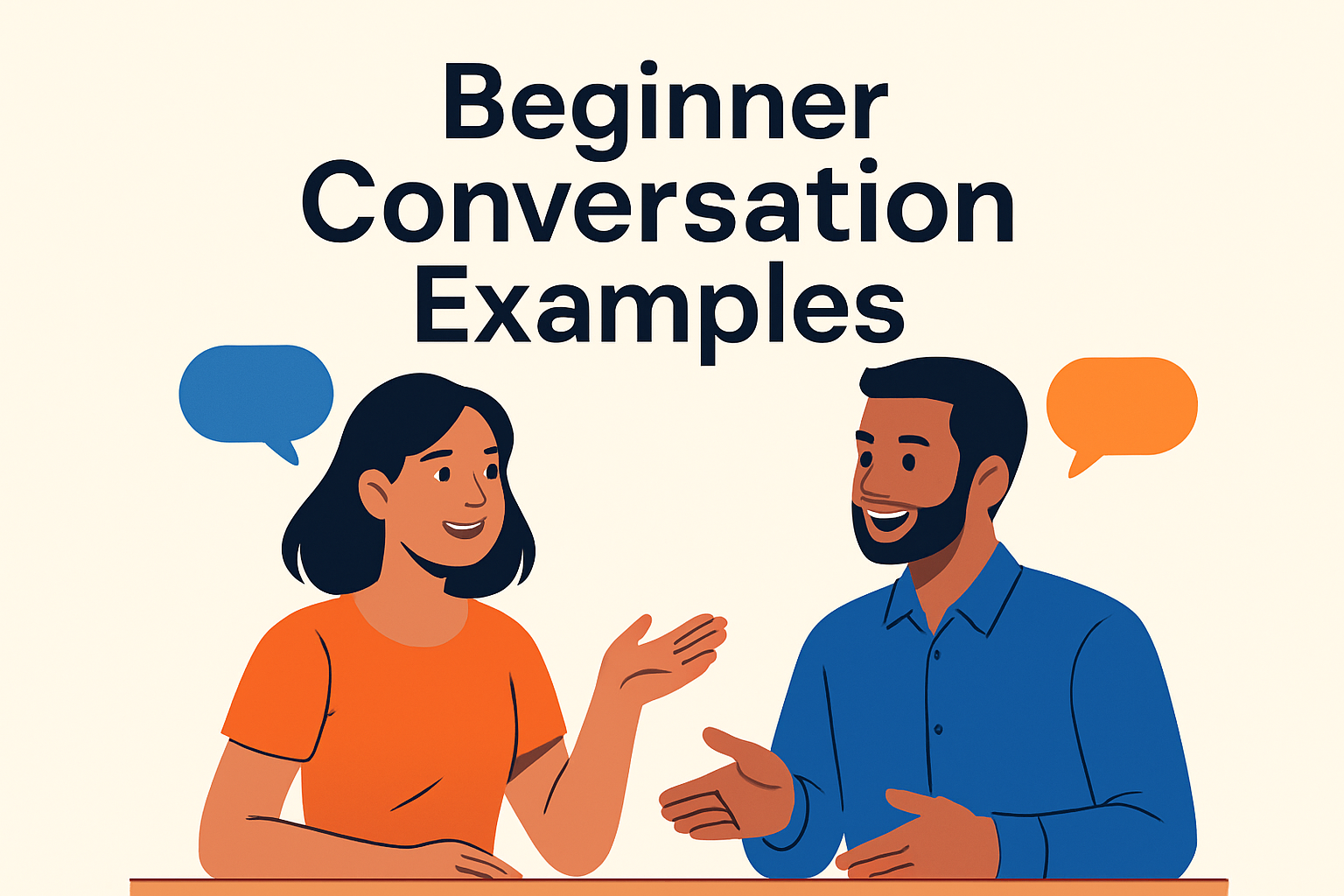
Beginner conversation examples help new English learners move from memorizing isolated words to using language in real interactions. In ESL Basics, the topic of Greetings & Introductions is usually the first practical skill because it appears in classrooms, workplaces, shops, video calls, and everyday social situations. A greeting is the opening language people use to acknowledge each other, such as “Hello,” “Good morning,” or “Hi.” An introduction is the language used to share names, roles, or basic personal information, such as “I’m Maria,” “This is my classmate,” or “Nice to meet you.” Together, these small exchanges form the foundation of spoken confidence.
I have taught beginner learners in mixed-level classes, one-to-one lessons, and workplace training, and the same pattern appears every time: students may know grammar rules, yet still freeze when someone says, “Hi, how are you?” That happens because greetings require speed, listening, pronunciation, and social judgment at the same time. Learners must choose formal or informal language, respond naturally, and know when to continue or close the exchange. Strong beginner conversation examples solve that problem by giving learners predictable models they can practice until the language becomes automatic.
This hub article covers Greetings & Introductions comprehensively so beginners can understand what to say, when to say it, and why native and fluent speakers choose different phrases in different situations. It also functions as a central reference point for related ESL Basics lessons, including small talk, classroom English, workplace English, meeting new people, and polite leave-taking. If a learner can greet someone, introduce themselves clearly, and ask simple follow-up questions, they can participate in hundreds of daily situations with much less anxiety. That is why this skill matters so much at the beginner level.
What beginners need to know first
The first rule of greetings and introductions is that context changes the language. “Hey” can be friendly with a classmate but too casual in many job interviews. “Good evening” sounds polite and clear in formal settings, while “Hi” works almost everywhere in daily life. Beginners need a small core set of phrases that are accurate, flexible, and common. I usually start with six greetings: “Hello,” “Hi,” “Good morning,” “Good afternoon,” “Good evening,” and “Nice to meet you.” Then I add simple response patterns: “I’m fine, thank you,” “I’m doing well,” “My name is…,” and “What’s your name?” These cover most first-contact situations.
Pronunciation matters early because short phrases carry a lot of meaning. Learners often study vocabulary on paper but do not recognize natural spoken rhythm. For example, “How are you?” is often pronounced quickly, and the answer is usually short. In real conversation, many speakers are not asking for a long health report; they are making polite contact. A beginner who answers with a basic response like “I’m good, thanks. And you?” sounds more natural than someone who gives a long explanation. Understanding that social function is as important as understanding the words themselves.
Beginners also need to know that introductions often come in sequences. A common order is greeting, name, optional extra information, and a closing response. For example: “Hi, I’m Elena.” “Hi, I’m Sam. Nice to meet you.” “Nice to meet you too.” This predictable structure reduces pressure. Once learners master the pattern, they can add details such as nationality, job, class, hometown, or reason for being there. At beginner level, accuracy and clarity are more important than originality. Repeating reliable conversation models is not boring; it is how speaking becomes fluent.
Core beginner conversation examples for greetings and introductions
Below are practical beginner conversation examples that reflect the most common real-world situations. Each model is short enough to memorize, but natural enough to use immediately. In class, I have seen learners improve quickly when they practice the exact same dialogue in different voices, speeds, and settings, then personalize one detail at a time. That method builds confidence without overwhelming memory.
| Situation | Useful example | Why it works |
|---|---|---|
| Meeting a classmate | “Hi, I’m Lucas.” “Hi, I’m Amina. Nice to meet you.” | Simple, friendly, and easy to repeat in school settings. |
| Meeting a teacher | “Good morning, Ms. Chen. I’m Diego, a new student.” | Uses a formal greeting and clear self-identification. |
| Joining a video call | “Hello everyone, I’m Fatima. Can you hear me?” | Matches online communication and solves a practical issue fast. |
| Starting work | “Hi, I’m Ben. I’m new here.” “Welcome, Ben.” | Common workplace language for first-day interactions. |
| Meeting a friend of a friend | “Hi, I’m Sara.” “I’m Alex. Nice to meet you.” | Neutral and useful in social introductions. |
| Phone introduction | “Hello, this is Nina speaking.” | Standard phrase for identifying yourself on a call. |
These examples show a key principle: beginners do not need many sentences at first, but they need the right sentences. “This is …” is useful on the phone and when introducing another person. “I’m …” is more common for introducing yourself face to face. “Nice to meet you” is used after the first introduction, not as an opening line by itself. These small distinctions help learners sound natural from the beginning.
Questions are the next step. After a greeting and introduction, the conversation usually continues with one or two easy questions. The best beginner options are “What’s your name?” “Where are you from?” “Are you new here?” “What class are you in?” and “What do you do?” These questions are high-frequency and practical. They also create predictable answer patterns, which lowers stress for both speakers. For beginners, a successful short conversation is often better than a longer conversation with many mistakes and long silences.
Formal and informal greetings: when to use each
One of the biggest challenges for learners is deciding how formal to sound. English does not change formality through verb endings as much as some languages do, so the choice comes from words, tone, and context. In general, use formal greetings with teachers, managers, interviewers, customers, older strangers in professional settings, and anyone you want to show extra respect to. Use informal greetings with friends, classmates, close coworkers, and people in relaxed social settings.
Formal beginner conversation examples include “Good morning,” “Good afternoon,” “It’s nice to meet you,” and “How are you today?” Informal examples include “Hi,” “Hey,” “How’s it going?” and “Nice to meet you.” Notice that some phrases, especially “Hi” and “Nice to meet you,” work in both formal and informal situations. That makes them especially useful for beginners. If learners are unsure, “Hello” is usually the safest option because it is polite, neutral, and widely accepted across settings.
I tell students to pay attention to three signals. First, where are you? A bank, interview room, and classroom usually require more formal language than a café with friends. Second, who is the other person? A supervisor and a close classmate are not addressed the same way. Third, how is the other person speaking to you? Matching tone is a practical communication skill. If someone says, “Good morning, I’m Mr. Patel,” the best response is not “Hey!” but “Good morning, Mr. Patel. I’m Ana.” That match creates smoother interaction and shows awareness.
There are also regional differences. In the United States, “How are you?” may be a routine greeting. In the United Kingdom, “You alright?” can mean the same thing. In many international business settings, “Nice to meet you” remains the safest choice. Beginners do not need to master every variety at once, but they should know that meaning depends on context. A phrase that sounds natural in one country or workplace may sound too casual in another. Learning standard forms first gives a stable base.
Building a full self-introduction step by step
A strong beginner self-introduction is short, clear, and relevant to the situation. Many learners make the mistake of trying to say too much too soon. A better method is to build introductions in layers. Start with name: “Hi, I’m Keiko.” Add role or reason: “I’m a new student.” Add origin if useful: “I’m from Japan.” Add one simple personal detail if the setting is social: “I like basketball.” This creates a flexible four-part introduction that can be shortened or expanded depending on time and context.
For example, in a classroom, a natural introduction might be: “Hello, I’m Omar. I’m a new student in this class. I’m from Egypt.” In a workplace: “Good morning, I’m Priya. I’m the new sales assistant.” In a social group: “Hi, I’m Daniel. I’m a friend of Mia.” These are effective because each one answers the listener’s main question immediately: who are you, and why are you here? That clarity is more important than complex grammar.
Introducing another person uses different patterns. The most common beginner forms are “This is my friend, Leo,” “I’d like to introduce my coworker, Ana,” and “Have you met Carlos?” In business English, “I’d like to introduce…” is especially useful because it sounds polite and professional. In everyday conversation, “This is…” is simpler and more common. After that, the other person usually replies, “Nice to meet you,” or “It’s nice to meet you.” Teaching this full exchange helps learners move beyond isolated lines and handle group situations confidently.
Name clarification is another essential subskill. Real conversations are noisy, and names are often unfamiliar. Beginners should practice “Sorry, what’s your name again?” “How do you spell that?” and “Did I say your name correctly?” These questions are polite and practical. They also show respect. In multilingual classrooms and international workplaces, accurate name pronunciation matters. It is not a minor detail; it is part of successful introductions and positive first impressions.
Common mistakes beginners make and how to fix them
The most common mistake is using textbook English that is grammatically correct but socially unusual. For example, some learners say “How do you do?” because they saw it in old materials, but in most everyday settings it sounds outdated. Another frequent issue is answering “How are you?” too literally. In most beginner interactions, the expected response is short: “I’m fine, thanks,” “I’m good, thank you,” or “Doing well, thanks.” A long answer is not wrong, but it can feel unexpected if the exchange is only a greeting.
A second mistake is skipping the return question. Conversation is cooperative. If someone says, “Hi, I’m Jane. How are you?” and the learner says only “Fine,” the exchange can stop awkwardly. Teaching the full pattern “I’m fine, thanks. And you?” keeps the conversation moving. The same principle applies to names. If someone asks, “What’s your name?” a strong beginner response is “I’m Luis. What’s your name?” not only “Luis.” These small additions create balance.
Third, many beginners mix formal titles and first names incorrectly. In English, “Mr.,” “Ms.,” “Mrs.,” and “Dr.” are usually followed by a family name, not a first name. “Ms. Anna” may sound unnatural in many contexts unless it reflects a local custom. “Ms. Brown” is standard. Learners also need to know that “Mrs.” indicates a married woman, while “Ms.” is the neutral professional option when marital status is unknown or irrelevant. This matters in schools, customer service, and office communication.
Finally, beginners often memorize one perfect dialogue and then struggle when the other person changes the script. The fix is controlled variation. Practice “Hi” and “Hello,” “I’m” and “My name is,” “Nice to meet you” and “It’s nice to meet you.” The goal is not infinite creativity. The goal is flexibility within a small, high-frequency language set. That is how learners become ready for authentic interactions.
How to practice greetings and introductions effectively
The fastest improvement comes from short, repeated speaking practice with realistic changes. In my lessons, the best results come from three stages. First, learners listen and repeat model dialogues to improve stress, rhythm, and confidence. Second, they do substitution practice, changing only one detail at a time, such as the name, country, or job. Third, they role-play new situations, such as meeting a teacher, classmate, customer, or neighbor. This sequence mirrors how spoken fluency develops: imitation first, adaptation second, independent use third.
Useful tools include voice recording on a phone, pronunciation support from dictionaries such as Cambridge and Merriam-Webster, and spaced repetition flashcards for key phrases. For online learners, video platforms and conversation apps provide low-pressure speaking opportunities. For classroom learners, circle introductions, partner rotations, and information-gap activities work well because they force multiple repetitions without sounding mechanical. The Common European Framework of Reference supports this kind of task-based beginner practice by focusing on what learners can do in real communication, not only what grammar they know.
As the hub for Greetings & Introductions within ESL Basics, this page should lead learners into connected skills: responding to “How are you?”, spelling names, introducing family members, classroom small talk, workplace first meetings, telephone greetings, and ending conversations politely. Master these beginner conversation examples, practice them aloud, and use them in real life today. A short, confident introduction opens doors in school, work, travel, and daily community life. Start with one greeting, one name, and one question, then build from there through consistent repetition.
Frequently Asked Questions
What are beginner conversation examples in English?
Beginner conversation examples are short, practical dialogues that show new English learners how people actually speak in everyday situations. Instead of studying single words by themselves, learners see how common vocabulary and simple grammar work together in real interactions. These examples often include basic greetings, introductions, polite questions, and short responses such as “Hello,” “What’s your name?”, “My name is Anna,” or “Nice to meet you.” They are especially useful in early ESL learning because they give students a clear model to follow when speaking in classrooms, workplaces, shops, phone calls, and video meetings. In other words, beginner conversation examples help learners move from memorization to communication by showing exactly how a simple conversation begins, continues, and ends.
Why are greetings and introductions usually taught first in ESL Basics?
Greetings and introductions are usually taught first because they are the foundation of almost every real-life conversation in English. Before learners can ask for help, make friends, join a class, or speak to a coworker, they need to know how to open a conversation politely and confidently. Greetings such as “Hi,” “Hello,” and “Good afternoon” are used constantly, and introductions allow people to share names, roles, and basic personal information in a natural way. These skills are immediately useful, which makes them highly motivating for beginners. They also build confidence because learners can start using them right away in simple, successful interactions. From a teaching perspective, greetings and introductions introduce essential sentence patterns, common question forms, polite expressions, pronunciation practice, and social awareness, all within a manageable and familiar topic.
What should a simple beginner conversation example include?
A strong beginner conversation example should include language that is realistic, easy to understand, and useful in everyday life. Most importantly, it should have a clear structure: an opening greeting, a simple introduction, one or two follow-up questions, and a polite closing. For example, a basic conversation might begin with “Hello,” continue with “I’m Maria. What’s your name?”, move to “I’m Daniel. Nice to meet you,” and end with “Nice to meet you too.” Good beginner dialogues also use short sentences, common vocabulary, and predictable patterns so learners can repeat them without feeling overwhelmed. It is also helpful when the example matches a real context, such as meeting a classmate, talking to a teacher, greeting a customer, or joining an online meeting. The best examples are not too long, but they still feel natural enough to prepare learners for actual conversation.
How can beginners practice conversation examples effectively?
Beginners can practice conversation examples effectively by repeating them regularly and using them in interactive ways rather than only reading them silently. A useful starting point is to listen to the dialogue and read it aloud several times to become familiar with the rhythm, pronunciation, and sentence flow. After that, learners should practice with a partner, taking turns in each role. Repetition is important, but variation is equally important, so students should change names, times of day, jobs, or places to make the conversation more flexible. For example, they can replace “Good morning” with “Hello,” or change “I’m a student” to “I’m a new employee.” Recording spoken practice can also help learners notice pronunciation issues and build confidence. The key is to move from memorizing the exact script to understanding the communication pattern, so that the learner can respond naturally in similar real-world situations.
How do beginner conversation examples help build speaking confidence?
Beginner conversation examples build speaking confidence by giving learners a safe, clear model for what to say in common situations. One of the biggest challenges for new English learners is not always vocabulary alone, but the fear of not knowing how to begin. When learners study and practice simple dialogues, they become familiar with common expressions, expected responses, and the natural order of conversation. This reduces hesitation and helps them feel more prepared when they meet someone in real life. Greetings and introductions are particularly powerful because they happen so often and follow predictable patterns. After learners successfully say “Hi, my name is…” or “Nice to meet you,” they begin to trust their ability to communicate. Over time, these small wins create fluency, improve pronunciation, strengthen listening skills, and make longer conversations feel much less intimidating.