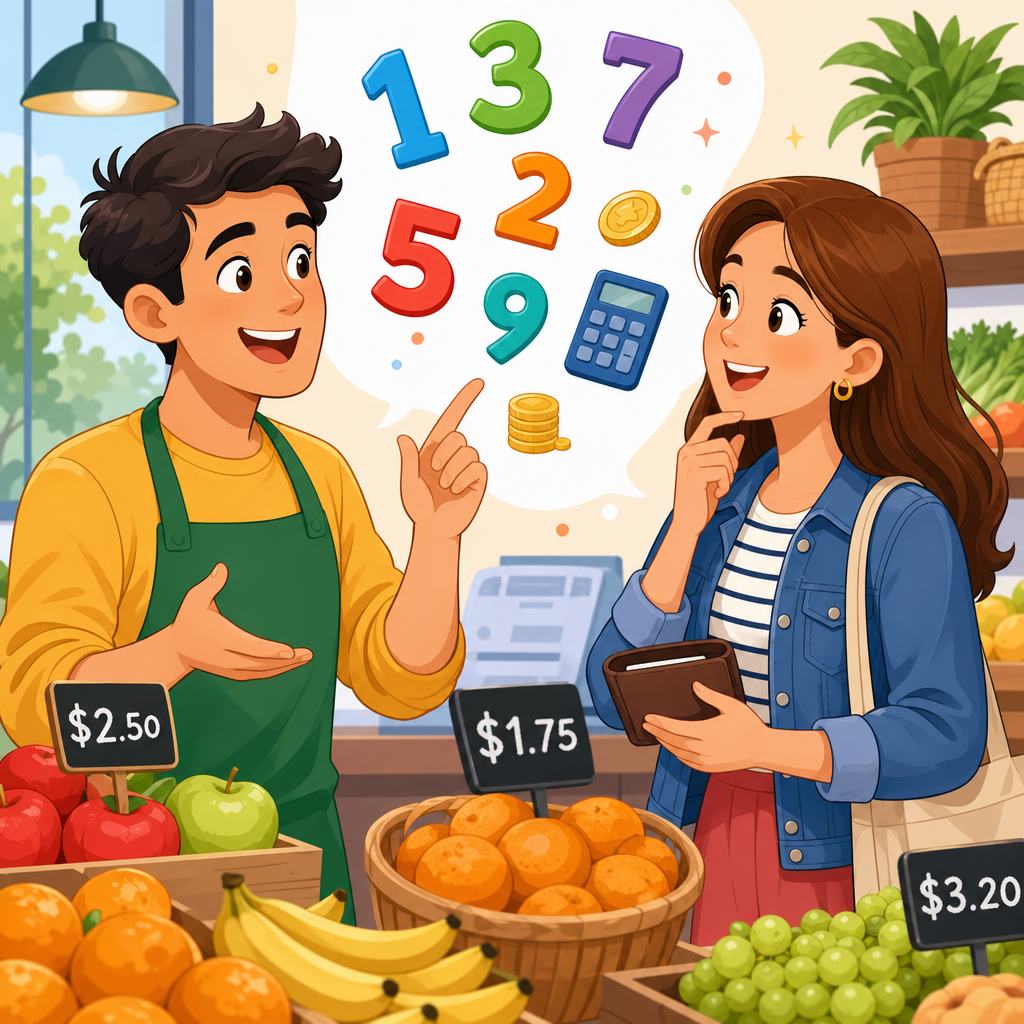
How to say prices and numbers in English is one of the first skills ESL learners need because numbers appear in shopping, travel, work, banking, dates, schedules, addresses, and phone calls. In my classroom and client sessions, this topic causes more confusion than grammar does, because students may recognize digits on a page but hesitate when they must say them aloud naturally. English also uses different patterns for prices, years, decimals, fractions, percentages, times, and large numbers, so a learner who can say “twenty” may still struggle with “$20.50,” “1998,” or “3.75%.” A clear system matters.
In everyday use, numbers are not just mathematics. They are spoken forms tied to context. The number 12 can be “twelve,” “a dozen,” “noon,” “midnight,” “December,” “12th,” “12:00,” “12 dollars,” or “size 12,” depending on the situation. Prices add another layer because currency names change by country, written symbols vary, and native speakers often shorten what they say. For example, $5.00 is usually “five dollars,” not “five point zero zero dollars.” In the UK, £3.50 is often “three pounds fifty.” In the US, $1.25 is commonly “one twenty-five” in casual speech, especially in shops.
This hub article explains the core patterns for numbers, prices, dates, and time in plain English. It is designed to give you the foundation for the full Numbers, Dates & Time subtopic inside ESL Basics. You will learn how to read whole numbers, large numbers, decimals, fractions, percentages, money amounts, dates, years, clock times, and common real-world number expressions. You will also see where British and American English differ, which mistakes cause misunderstandings, and how to practice in a way that builds automatic speaking skills. If you can say numbers confidently, you sound more fluent immediately and handle daily tasks with less stress.
How to Say Whole Numbers and Large Numbers
Start with the basic cardinal numbers: one, two, three, through nineteen, then twenty, thirty, forty, fifty, and so on. A common learner mistake is misspelling or mispronouncing “forty” as “fourty.” After 20, English combines tens and ones: 21 is “twenty-one,” 58 is “fifty-eight,” and 99 is “ninety-nine.” In standard writing, compound numbers from 21 to 99 usually take a hyphen. In speech, the rhythm matters as much as the words. Native speakers stress the final part clearly, especially when comparing pairs like thirteen and thirty.
For numbers over 100, use “hundred,” “thousand,” “million,” and “billion.” In American English, 245 is usually “two hundred forty-five.” In British English, many speakers include “and”: “two hundred and forty-five.” Both forms are correct, but you should choose one style and use it consistently for your target exam, workplace, or region. With larger numbers, group digits in threes from the right: 1,200 is “one thousand two hundred,” 45,000 is “forty-five thousand,” and 3,400,000 is “three million four hundred thousand.” English does not add an -s to these words when a specific number comes before them, so say “two million,” not “two millions.”
Very large numbers often intimidate learners, but the structure is predictable. Read 12,450,900 as “twelve million four hundred fifty thousand nine hundred” in US style, or “twelve million four hundred and fifty thousand nine hundred” in common UK style. In finance and business English, accuracy is essential because a missing word changes the value dramatically. I train learners to pause slightly at each comma group and identify the label first: thousand, million, billion. This reduces errors on reports, invoices, and presentations. If you are reading numbers in public, scan the comma pattern before you speak.
How to Say Prices and Money Amounts
Prices in English follow spoken conventions more than mathematical logic. For whole amounts, say the number plus the currency: $10 is “ten dollars,” €20 is “twenty euros,” and £5 is “five pounds.” For amounts with cents or pence, there are several natural patterns. $10.50 can be “ten dollars and fifty cents,” “ten fifty,” or in some contexts simply “ten dollars fifty.” £4.99 is commonly “four pounds ninety-nine.” The exact form depends on the country, the setting, and how precise or formal you need to be.
Coins have special names that learners should know. In the United States, $0.01 is a penny, $0.05 a nickel, $0.10 a dime, and $0.25 a quarter. So $1.25 may be said as “one dollar and twenty-five cents,” but in casual conversation people usually say “one twenty-five.” In the UK, speakers refer to pence: £0.50 is “fifty pence” or “fifty p.” For small amounts under one pound, £0.99 is “ninety-nine p.” Understanding these short forms helps in shops, cafés, and transport systems, where staff often speak quickly.
When I coach learners for customer-facing jobs, I teach them to match speech to situation. A cashier might say “That’ll be twelve ninety-nine.” A bank employee will usually say “twelve dollars and ninety-nine cents.” A waiter may say “It’s twenty even,” meaning exactly twenty dollars with no cents. Discounts and sales add more useful expressions: “half price,” “ten percent off,” “buy one get one free,” and “three for ten.” If a menu shows $18++, common in some countries, staff may explain that tax and service are added. Always learn the local retail language, not just the written symbol.
| Written form | Common spoken form | Notes |
|---|---|---|
| $5.00 | five dollars / five | “Five” is common when the currency is obvious |
| $5.25 | five twenty-five / five dollars and twenty-five cents | US casual speech often drops “dollars” |
| £3.50 | three pounds fifty | Common UK retail style |
| €12.99 | twelve euros ninety-nine | Varies by country and language influence |
| $0.75 | seventy-five cents | Usually not “zero dollars seventy-five” |
| £0.80 | eighty pence / eighty p | Common in the UK |
Decimals, Fractions, Percentages, and Measurements
Decimals are read with “point,” and each digit after the decimal is said separately. So 3.14 is “three point one four,” 0.8 is “zero point eight,” and 12.05 is “twelve point zero five.” This rule applies in science, test scores, exchange rates, and product dimensions. Do not read 2.45 as “two hundred forty-five” or “two point forty-five.” After the decimal, English says individual numbers, not a full two-digit number. In many non-English-speaking countries a comma marks the decimal, but in English-language contexts a decimal point is standard.
Fractions are different. 1/2 is “one-half” or more commonly “a half.” 1/4 is “one-quarter” or “a quarter.” 3/4 is “three-quarters.” For most other fractions, use a cardinal number plus an ordinal plural: 2/5 is “two-fifths,” 7/8 is “seven-eighths.” Fractions are common in cooking, construction, and informal speech. You will hear “half an hour,” “a quarter past six,” and “one and a half kilos.” In practical ESL learning, fractions matter because native speakers often prefer them over decimals in recipes, measurements, and everyday estimates.
Percentages use the number plus “percent.” 5% is “five percent,” 12.5% is “twelve point five percent,” and 0.7% is “zero point seven percent.” In business English, percentages appear in interest rates, inflation, discounts, and analytics dashboards. Measurements follow the same number rules but require accurate unit pronunciation: 6 km is “six kilometers,” 2.5 kg is “two point five kilograms,” and 5’10" in height is “five foot ten” or “five feet ten inches,” depending on style. Clear number speech is especially important in healthcare, engineering, and travel, where mistakes can create real problems.
Dates, Years, and Calendar Language
English dates are a major source of confusion because written order changes by region. In American English, 04/07/2025 usually means April 7, 2025. In British English, it usually means 4 July 2025. To avoid misunderstandings in international settings, write the month as a word: April 7, 2025 or 7 April 2025. Spoken forms are easier once you know the pattern. Use ordinal numbers for the day: “April seventh,” “the seventh of April,” “July twenty-third,” or “the twenty-third of July.” The preposition is usually “on,” as in “on May 12.”
Years have their own speaking style. 1998 is usually “nineteen ninety-eight,” 2005 is “two thousand five,” and 2019 is often “twenty nineteen.” For 1900, say “nineteen hundred.” For 2000, say “two thousand.” Years after 2010 can often be read two ways, but “twenty twenty-four” is now more common than “two thousand twenty-four” in everyday speech. Centuries are said as ordinals: the 19th century is “the nineteenth century.” Decades are “the eighties,” “the 1990s,” or “the late 2000s.” In formal announcements, pronunciation should be slow and unambiguous.
Calendar English also includes useful phrases beyond dates themselves. Learners should know weekday names, month names, and terms like “today,” “tomorrow,” “yesterday,” “the day after tomorrow,” and “the day before yesterday.” For planning, common expressions include “next Friday,” “last Monday,” “this weekend,” and “in two weeks.” I have found that learners often know the written date but cannot confirm it naturally in conversation. Practice short exchanges such as “What’s the date today?” “It’s September 14th,” and “When is the meeting?” “It’s on Tuesday, June 18th at 3 p.m.” These compact patterns are used constantly.
How to Say Time in English Naturally
Clock time uses two main systems: the 12-hour clock and the 24-hour clock. In everyday conversation, especially in the US, the 12-hour clock is more common: 3:00 is “three o’clock,” 3:15 is “three fifteen,” and 3:30 is “three thirty.” You can also use traditional forms: 3:15 is “a quarter past three,” 3:30 is “half past three,” and 3:45 is “a quarter to four.” For morning and evening, add a.m. and p.m. In speech, people usually say “three in the morning,” “three in the afternoon,” or “three at night” when clarity matters.
The 24-hour clock is standard in aviation, hospitals, military settings, many transport systems, and much of Europe. 14:30 is read as “fourteen thirty” or converted in conversation to “two thirty p.m.” Learners should recognize both instantly. Time expressions also include duration and frequency: “for two hours,” “in ten minutes,” “from nine to five,” “twice a week,” and “every other day.” Native speakers shorten routine questions: “What time is it?” “What time does the train leave?” “Do you have the time?” If you miss a number in a schedule, ask directly: “Did you say 13:15 or 13:50?”
Some of the most useful time phrases are not exact clock times. “Around six” means approximately six o’clock. “Just after nine” means a little later than nine. “By Friday” means no later than Friday. “Until Monday” marks an end point, while “from Monday” marks a starting point. These small differences matter at work and in travel. In hotel check-ins, medical appointments, and online meetings, I encourage learners to repeat the time back for confirmation. Saying “So the appointment is at 8:45 a.m., correct?” prevents the common and costly mistake of hearing the right number but storing the wrong one.
Common Mistakes and Smart Practice Strategies
The most frequent mistakes are predictable. Learners confuse teen numbers and tens, say every written symbol literally, mix up date formats, forget ordinal endings, and misread zeros. For example, 0.06 is “zero point zero six,” not “zero point six.” Room 205 may be “two oh five,” while the year 2005 is usually “two thousand five.” Phone numbers are read digit by digit, often with “oh” for zero: 4070 can be “four oh seven oh.” Addresses are another special case: 125 King Street is typically “one twenty-five King Street,” not “one hundred twenty-five King Street.” Context decides the pattern.
The best practice is short, frequent, and spoken aloud. Use price tags, calendars, train timetables, restaurant menus, weather reports, and maps. Read five prices, five dates, and five times every day. Record yourself and compare your rhythm with native audio from sources like BBC Learning English, VOA Learning English, Cambridge Dictionary, or Merriam-Webster pronunciation entries. If you use spaced-repetition tools such as Anki or Quizlet, build sets by category: money, dates, years, times, decimals. For classroom work, role-play store purchases, appointment booking, and travel check-ins because these activities force fast retrieval, not just recognition.
This Numbers, Dates & Time hub gives you the essential system for saying prices and numbers in English clearly and naturally. Master the patterns, and everyday communication becomes easier: you can understand schedules, quote costs, confirm dates, discuss data, and avoid expensive misunderstandings. The key is not memorizing random examples; it is learning which pattern belongs to which context. Use this page as your base, then continue with focused practice on money, dates, time expressions, phone numbers, and measurement language. Pick ten real examples from your daily life today, say them aloud, and turn passive knowledge into confident English.
Frequently Asked Questions
How do you say prices naturally in English?
To say prices naturally in English, start by noticing whether you are reading a whole amount or an amount with cents. If the price is a whole number, English speakers usually say the currency first in a natural way: $20 is “twenty dollars,” £50 is “fifty pounds,” and €30 is often “thirty euros.” If there are cents after the decimal point, say the dollars and then the cents: $19.99 is “nineteen dollars and ninety-nine cents.” In everyday conversation, especially in stores and restaurants, people often shorten this. For example, $19.99 may be said as “nineteen ninety-nine,” and $5.50 is often “five fifty.” This shorter pattern is very common when the currency is already understood from the situation.
It is also important to understand how English speakers read zeros in prices. $10.05 is “ten dollars and five cents,” not “ten point zero five dollars” in normal conversation. A decimal point in prices is usually understood through money vocabulary rather than read mathematically. For that reason, learners should practice the money form first. Compare these examples: $7.00 can be “seven dollars,” $7.25 is “seven twenty-five” or “seven dollars and twenty-five cents,” and $0.99 is “ninety-nine cents.” In British English, you may hear “ninety-nine p” or “ninety-nine pence” instead of “cents,” depending on the currency.
One of the biggest challenges for ESL learners is choosing between the formal full version and the quicker everyday version. In customer service, presentations, banking, or language exams, the complete version is usually safer and clearer. In casual speech, shorter forms sound more natural. The key skill is recognizing both styles. If you can understand and produce “three dollars and fifty cents” as well as “three fifty,” you will sound much more confident in real-world situations such as shopping, ordering food, discussing bills, or comparing prices.
What is the correct way to say large numbers in English?
Large numbers in English are usually read in groups of three digits from left to right. This grouping makes long numbers much easier to understand and pronounce. For example, 1,250 is “one thousand two hundred fifty” in American English, and many British speakers may say “one thousand two hundred and fifty.” For 45,000, say “forty-five thousand.” For 320,000, say “three hundred twenty thousand.” Once learners understand the group pattern, bigger numbers become much less intimidating.
The main place values you should know are thousand, million, billion, and trillion. For example, 2,500,000 is “two million five hundred thousand,” and 7,200,000,000 is “seven billion two hundred million.” English speakers do not usually say every zero. Instead, they use these place value words to organize the number efficiently. That is why recognizing the comma groups is so important. A number like 9,845,216 becomes “nine million eight hundred forty-five thousand two hundred sixteen.”
Students often hesitate because they try to read large numbers one digit at a time. That approach is slow and unnatural. It is much better to pause at each group and name the value. Also remember that pronunciation matters. Words like “thirteen” and “thirty,” or “fourteen” and “forty,” can easily be confused, especially in business, travel, and phone conversations. Practicing large numbers aloud helps with fluency, listening accuracy, and confidence in practical situations like salaries, populations, addresses, account balances, and statistics.
How do you say decimals, fractions, and percentages in English?
Decimals are usually read by saying the whole number, then “point,” then each digit after the decimal individually. For example, 3.14 is “three point one four,” 0.5 is “zero point five,” and 12.075 is “twelve point zero seven five.” This is different from prices, where we usually use money vocabulary instead of reading the decimal mathematically. In academic, scientific, technical, and business contexts, the decimal format is the normal way to speak these numbers aloud.
Fractions follow a different pattern. Common fractions are often memorized because they appear frequently in daily life. For example, 1/2 is “one-half” or just “a half,” 1/4 is “one-fourth” or “a quarter,” and 3/4 is “three-fourths” or “three-quarters.” With most fractions, the top number is read as a cardinal number and the bottom number as an ordinal form, usually plural if the top number is more than one. So 2/3 is “two-thirds” and 5/8 is “five-eighths.” Fractions are common in recipes, measurements, and everyday conversation, so learners benefit from practicing the most common ones first.
Percentages are usually simple once learners know the number. Just say the number followed by “percent.” For example, 15% is “fifteen percent,” 2.5% is “two point five percent,” and 100% is “one hundred percent.” In fast speech, native speakers may reduce the pronunciation slightly, but the structure remains the same. This pattern is essential for understanding discounts, interest rates, test scores, taxes, reports, and business news. Because decimals, fractions, and percentages all appear in different settings, learners should train themselves to identify the format first and then choose the correct speaking pattern.
How are years, times, phone numbers, and addresses said in English?
Years are often said differently from other four-digit numbers. For many years from 1000 to 1999, English speakers commonly split them into two pairs. For example, 1984 is “nineteen eighty-four,” and 1765 is “seventeen sixty-five.” Years in the 2000s can be said in more than one way. 2005 is often “two thousand five,” and 2010 may be “two thousand ten” or “twenty ten.” Today, many speakers say years such as 2024 as “twenty twenty-four.” Learners should become familiar with both patterns because listening comprehension is just as important as speaking.
Time also follows its own conventions. 3:00 is “three o’clock,” 3:15 is “three fifteen” or “a quarter past three,” 3:30 is “three thirty” or “half past three,” and 3:45 is “three forty-five” or “a quarter to four.” In modern everyday English, digital-style readings such as “seven twenty” are extremely common, especially for schedules, meetings, and travel. However, traditional expressions like “quarter past” and “half past” are still widely used and important to understand.
Phone numbers are usually read one digit at a time: 555-4829 becomes “five five five, four eight two nine.” Repeated digits may be read with “double,” as in “double five,” though this depends on region and situation. Addresses are often a mix of whole numbers and individual digits. For example, 125 King Street is usually “one twenty-five King Street,” not “one hundred twenty-five King Street,” although both can be understood. These categories cause confusion because the same digits are spoken differently depending on the context. That is exactly why learners need focused practice with real examples instead of trying to use one rule for every type of number.
Why do ESL learners understand numbers on paper but struggle to say them aloud?
This happens because recognizing digits visually and producing them naturally in speech are two different skills. Many learners can identify 14.99, 3/4, 2026, or 67% when they read them silently, but they pause when they must say them because they are trying to choose the correct English pattern in real time. The difficulty is not usually basic intelligence or even grammar knowledge. The real issue is that English uses different spoken systems for prices, years, decimals, percentages, times, phone numbers, and large figures. Until those patterns become automatic, hesitation is completely normal.
Another reason is