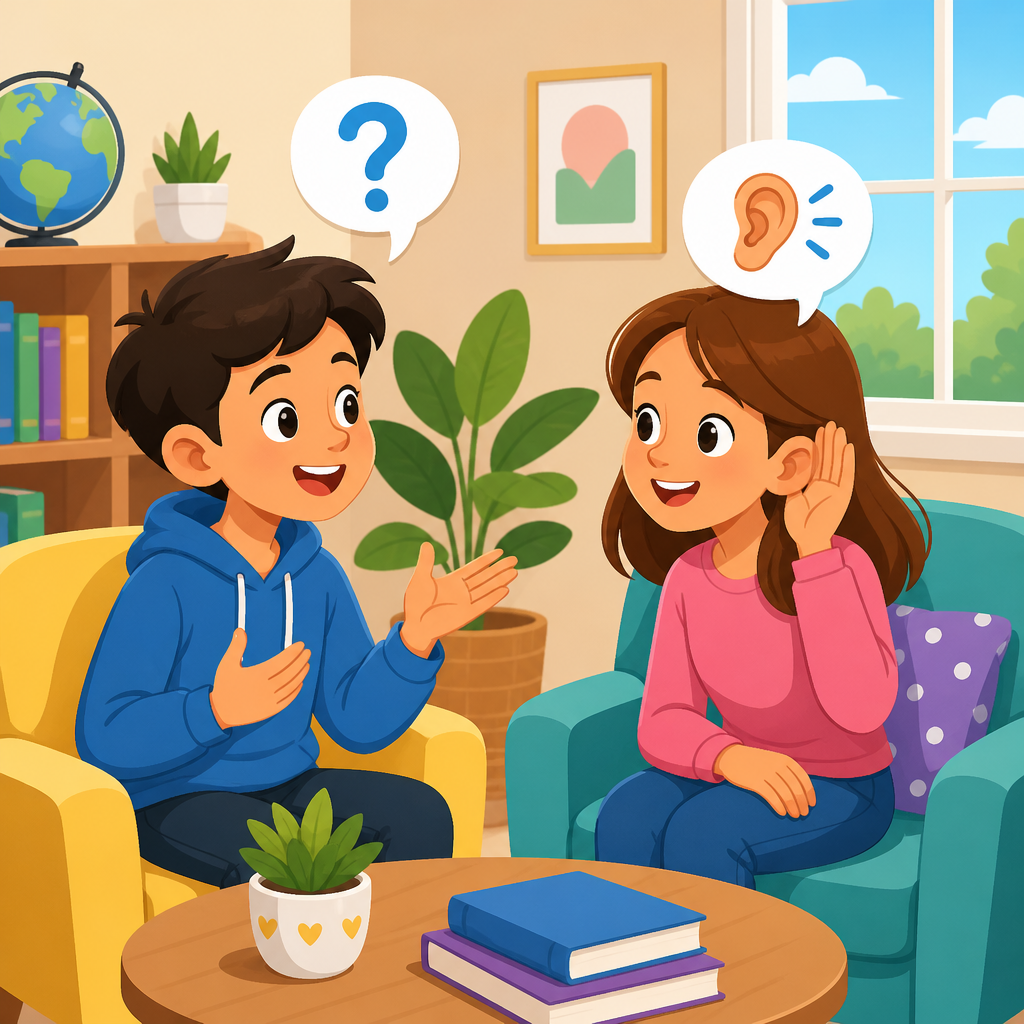
Listening practice with basic questions and answers is one of the fastest ways for English learners to build real comprehension, because it trains the ear to connect common sounds, meanings, and responses in everyday conversation. In ESL teaching, beginner listening exercises usually focus on short, predictable exchanges such as greetings, personal information, time, numbers, locations, preferences, and simple requests. These are the building blocks of spoken English. I have used these patterns repeatedly in beginner classrooms, placement interviews, and one-to-one tutoring, and the same truth appears every time: students improve faster when listening tasks are narrow, repetitive, and tied to useful questions they will hear outside class.
For beginners, listening is often harder than reading because spoken English moves quickly, reduces sounds, and rarely matches the careful pronunciation students hear in isolated vocabulary practice. A learner may know the words “What is your name?” on paper but still miss them in natural speech when they become “Whatcher name?” at conversational speed. That gap between textbook English and real spoken English is exactly why structured listening practice matters. It helps learners recognize stress, rhythm, weak forms, and common response patterns before they face longer dialogues or authentic audio.
This topic matters because beginner listening skills affect everything else. If students cannot catch a basic question, they cannot answer confidently, join a conversation, follow classroom instructions, or complete a simple task such as checking into a hotel or ordering food. Strong listening practice also improves speaking. When learners hear high-frequency question forms many times, they begin to produce them more naturally. In practical terms, this page serves as a hub for beginner listening exercises by showing what to practice, how to organize practice, which question types matter most, and how to measure progress without overwhelming the learner.
At the beginner level, effective listening practice is not about understanding every word. It is about identifying purpose, key details, and expected responses. Students should learn to answer questions like “What time is it?” “Where are you from?” “Do you like coffee?” and “Can you help me?” with speed and accuracy. They also need repeated exposure to yes-no questions, wh- questions, choice questions, and short follow-up exchanges. Once those patterns become familiar, learners can move from controlled beginner listening exercises to more open conversation, short stories, and task-based listening with greater confidence.
What Beginner Listening Exercises Should Teach First
The best beginner listening exercises start with language that is frequent, functional, and easy to recycle across contexts. In my experience, the first priority is not rare vocabulary or long dialogues. It is mastery of core survival questions and answers. Learners should hear and respond to greetings, introductions, age, country, job, family, days, times, prices, classroom language, and simple directions. These topics appear in almost every beginner course because they reflect real communicative needs and because they create strong repetition without sounding artificial.
A good sequence moves from recognition to response. First, students listen and choose the correct picture, word, or short answer. Next, they identify a detail such as a name, number, or place. After that, they produce a brief spoken or written answer. This progression mirrors how comprehension develops. It also reduces cognitive load, a major factor in beginner listening. When students are asked to decode unfamiliar sounds, remember information, and create a full answer all at once, performance drops sharply. Breaking the task into stages produces better retention and less frustration.
Question type matters. Yes-no questions are easiest because the range of possible answers is limited. Wh- questions require more detail and therefore more processing. Choice questions such as “Tea or coffee?” fall in the middle. Teachers should also introduce short confirmation checks like “Sorry?” “Can you repeat that?” and “Do you mean Tuesday?” because these are real listening strategies, not just classroom phrases. The Common European Framework of Reference places strong value on understanding slow, clear speech on familiar matters at early levels, and that principle should guide exercise design.
Audio length should stay short. For true beginners, five to fifteen seconds is often enough for a single item. A one-minute recording can already feel dense if it contains several speakers, background noise, and new vocabulary. Controlled short audio helps students notice key language features such as contractions, linked speech, and intonation. Over time, teachers can increase complexity by varying accent, speed, and context, but the foundation should remain stable: common questions, expected answers, and repeated listening with a clear purpose.
Core Question-and-Answer Patterns Every Beginner Needs
Beginner listening practice becomes more effective when it is organized around predictable conversational patterns rather than random sentences. In real life, questions come in families. If a learner can recognize one pattern, they can often understand many similar exchanges. Below is a practical framework I use when planning beginner listening exercises. Each category supports daily communication and appears across coursebooks, language apps, placement tests, and teacher-made materials.
| Question Type | Example Question | Expected Short Answer | Listening Focus |
|---|---|---|---|
| Greeting | How are you? | I’m fine, thanks. | Recognizing routine social language |
| Identity | What’s your name? | My name is Ana. | Catching reduced question forms |
| Origin | Where are you from? | I’m from Brazil. | Hearing country names clearly |
| Time | What time is it? | It’s three thirty. | Distinguishing numbers |
| Preference | Do you like tea? | Yes, I do. | Hearing do-support and intonation |
| Location | Where is the station? | It’s next to the bank. | Understanding place vocabulary |
| Ability/Request | Can you help me? | Yes, of course. | Recognizing polite requests |
These patterns work because they combine high-frequency grammar with practical meaning. For example, “What’s your name?” teaches contraction, possessive adjective, and a routine social exchange. “Do you like tea?” introduces auxiliary “do,” verb recognition, and rising yes-no intonation. “Where is the station?” adds place language and prepositions. If students hear ten versions of each pattern spoken by different voices, they start to process language in chunks rather than word by word, which is a major milestone in listening development.
Teachers and independent learners should rotate these patterns across topics. A name question can become a spelling task. A time question can become a schedule task. A location question can connect to a map activity. This type of recycling is more effective than introducing new structures too quickly. Research on second-language acquisition consistently shows that repeated exposure to comprehensible input strengthens recognition and automaticity. For beginners, automatic recognition of common questions is more valuable than broad but shallow exposure to dozens of unrelated forms.
How to Build Effective Beginner Listening Practice
Good beginner listening exercises follow a clear structure: prepare, listen, check, repeat, and extend. Preparation should be brief and focused. Pre-teach only the words students truly need, such as key nouns or numbers. Do not explain every possible phrase in the audio, because that removes the listening challenge. Then set a simple task before playing the recording: “Listen for the name,” “Listen for the time,” or “Listen and choose yes or no.” A precise task gives the learner a reason to listen and improves attention.
During listening, repetition is essential. In my classes, beginners almost always need at least two plays for controlled tasks and often three when the goal is detail. The first listen is for gist or confidence. The second is for the answer. The third, if needed, is for confirmation and noticing. This is standard good practice, not a sign of weak teaching. Native speakers also rely on repeated exposure when audio quality is poor or the topic is unfamiliar. The difference is that beginners need repetition by design, not by accident.
After listening, answer checking should include evidence. Students should know why an answer is correct. If the recording says, “Hi, I’m Carlos. I’m from Mexico,” the teacher should replay the line and point out the clue. This habit trains learners to listen for proof instead of guessing from one familiar word. Transcripts are useful at the final stage, not the first stage. When used after listening, they help students notice what they missed, especially contractions, linking, and unstressed words. Tools like subtitles, playback speed control, and waveform scrubbing can support this process when used carefully.
Extension turns passive listening into active language use. After hearing “Where are you from?” and “I’m from Turkey,” students can interview classmates, record themselves, or complete a substitution drill with different countries. This transfer step is where listening begins to strengthen speaking. It also helps with memory consolidation. When learners hear, repeat, personalize, and reuse a structure, retention improves sharply. That is why the strongest beginner listening programs combine short audio comprehension with immediate low-pressure production.
Common Problems Beginners Face and How to Fix Them
Most beginner listening problems fall into five categories: speed, sound reduction, limited vocabulary, weak attention control, and anxiety. Speed is the complaint students mention first, but it is not always the real issue. Often, they know the vocabulary visually but cannot recognize it in connected speech. Words change shape in fast English. “Did you” may sound like “didja,” and “going to” may sound like “gonna.” Beginners do not need every informal reduction immediately, but they do need exposure to common spoken forms or they will keep failing on familiar language.
Vocabulary gaps also matter, but selective teaching works better than large word lists. If the listening target is food preferences, teach “tea,” “coffee,” “juice,” “like,” and “don’t like,” then build several short exchanges around them. This is more effective than introducing twenty beverage words at once. Attention control is another hidden barrier. Beginners may miss the answer because they focus too hard on the first unknown word and stop listening. Short tasks with one goal reduce this problem. So do visual supports such as pictures, clocks, maps, and name cards.
Anxiety can block comprehension even when the language is within reach. I have seen students understand a recording during pair practice, then fail with the same recording in a test because they panic when they think every word matters. To reduce this, make success criteria explicit. Tell learners whether they need one detail or full understanding. Use familiar voices first, then unfamiliar voices. Start with clean audio before adding realistic noise. Confidence grows when challenge increases in small, visible steps. The goal is not to make listening easy forever; it is to make difficulty manageable and measurable.
Pronunciation work supports listening more than many beginners realize. Minimal pairs such as fifteen and fifty, ship and sheep, or can and can’t can change meaning completely. Short dictation, backchaining, and shadowing can help students hear distinctions they previously ignored. Free tools such as YouGlish, Forvo, and audio features in Cambridge and Oxford learner dictionaries are especially useful because they provide multiple voices and examples. Used alongside structured beginner listening exercises, these tools help learners connect pronunciation awareness with actual comprehension.
Best Resources and Next-Step Topics in ESL Listening Skills
As a hub within ESL listening skills, this page should lead learners toward a broader system of practice rather than a single set of activities. The most useful beginner listening resources share four qualities: short audio, clear tasks, level-appropriate vocabulary, and replay control. Trusted options include the British Council LearnEnglish site, Randall’s ESL Cyber Listening Lab, Elllo, VOA Learning English, and many course platforms built around CEFR-aligned materials. Teachers can also create highly effective recordings with a smartphone if the script is targeted and the task is clear.
Within the beginner listening exercises subtopic, the next articles should branch into specific skill pages that deepen one area at a time. Strong internal pathways include listening for greetings and introductions, numbers and prices, days and dates, classroom instructions, daily routines, shopping conversations, restaurant questions, directions and places in town, telephone basics, and simple workplace exchanges. Another valuable branch is listening strategy content: how to ask for repetition, how to catch key words, how to listen for gist, and how to use transcripts without becoming dependent on them.
Progress tracking should remain simple. A beginner does not need a complex analytics dashboard. A short checklist is enough: Can the learner identify names, numbers, times, places, and preferences from short audio? Can they answer routine yes-no and wh- questions correctly after one or two listens? Can they follow a two-step instruction such as “Open your book and turn to page ten”? These checkpoints align with practical communication and make improvement visible. They also help teachers choose the next step instead of repeating the same easy tasks for too long.
Listening practice with basic questions and answers gives beginners the foundation they need to understand spoken English in real situations. It works because it focuses on frequent language, short audio, clear tasks, and repeated exposure to patterns that appear in daily life. When learners can recognize greetings, names, times, places, preferences, and simple requests, they stop treating listening as an impossible blur and start hearing structure. That change is small on the surface, but in classroom practice it marks the beginning of real confidence.
The most effective beginner listening exercises do not try to cover everything at once. They start with controlled question-and-answer patterns, build from recognition to response, and recycle language across useful topics. They also respect how listening actually develops: through multiple listens, evidence-based checking, strategic transcript use, and immediate transfer into speaking. Beginners improve fastest when tasks are manageable, targeted, and connected to communication they can imagine using today, not months from now.
If you are building an ESL listening skills plan, use this page as your starting hub for beginner listening exercises, then move step by step into focused practice on numbers, directions, routines, and everyday conversations. Choose short recordings, track a few practical checkpoints, and repeat core question types until answers become automatic. Start with one listening set today, and build consistency before complexity.
Frequently Asked Questions
1. Why is listening practice with basic questions and answers so effective for English beginners?
Listening practice with basic questions and answers is highly effective because it teaches learners how spoken English actually works in real life. Beginners often know vocabulary on paper, but they struggle when they hear the same words in natural speech. Short question-and-answer patterns help bridge that gap. They train the ear to recognize common sentence structures, familiar vocabulary, and everyday pronunciation in a manageable way. Instead of trying to understand long conversations immediately, learners focus on small, repeated exchanges such as “What is your name?” “My name is Ana,” or “Where are you from?” “I’m from Brazil.” These predictable patterns make listening less overwhelming and much more productive.
Another reason this method works so well is that it builds automatic comprehension. In daily conversation, people do not have much time to translate each word mentally. Learners need to recognize meaning quickly. Repeated exposure to simple exchanges helps the brain connect sounds directly to meaning and response. Over time, students stop hearing language as isolated words and begin hearing it as complete, useful chunks. That is a major step in becoming comfortable with spoken English.
Basic listening practice also supports pronunciation, speaking, and confidence at the same time. When learners hear common questions and natural answers again and again, they begin to internalize rhythm, stress, and intonation. This makes it easier not only to understand others, but also to respond more naturally themselves. In other words, beginner listening exercises are not “too simple.” They are foundational. They create the listening habits and language recognition skills that support all future progress in English.
2. What kinds of questions should beginners practice first in listening exercises?
Beginners should start with the most common question types used in everyday conversation. These usually include greetings, introductions, personal information, numbers, time, days, locations, preferences, and simple requests. For example, questions like “How are you?”, “What’s your name?”, “How old are you?”, “What time is it?”, “Where do you live?”, and “Do you like coffee?” are ideal because they appear often in real communication and usually have short, clear answers. This makes them perfect for training listening comprehension without creating unnecessary confusion.
Simple functional language is especially important at the beginning. Learners benefit from hearing exchanges they can use immediately in class, at work, while traveling, or in social situations. Questions such as “Can you help me?”, “Where is the bathroom?”, “How much is it?”, or “Do you understand?” are practical and memorable. These are not just textbook examples; they are building blocks of survival English and daily communication. The more often learners hear and answer them, the more prepared they become for real-world conversations.
It is also helpful to group questions by topic. Practicing all number-related listening together, for example, can help learners distinguish ages, prices, dates, phone numbers, and times. Practicing location questions together can strengthen understanding of prepositions and common place vocabulary. Organizing listening this way reduces cognitive overload and allows students to notice patterns more clearly. For beginners, the best listening content is not random. It is simple, high-frequency, practical, and repeated enough to become familiar.
3. How can learners improve their listening comprehension faster with basic question-and-answer practice?
To improve faster, learners should listen actively rather than passively. That means they should not only hear the audio, but also focus on identifying the question type, key words, and expected kind of answer. For example, if the question begins with “Where,” the answer will usually be a place. If it begins with “What time,” the answer will be a time expression. This habit helps learners predict meaning, which is one of the most important real-life listening skills. Native and fluent speakers do this naturally, and beginners can develop the same skill through repeated practice.
Repetition is another major factor in faster improvement. Listening once is rarely enough, especially for beginners. A much better approach is to listen several times with different goals. First, listen for general meaning. Second, listen for specific words. Third, repeat the question and answer aloud. Fourth, try responding without looking at the text. This kind of layered practice strengthens comprehension, pronunciation, and memory at the same time. It also helps learners become comfortable with speed, reductions, and natural spoken rhythm.
Learners can also make strong progress by using short daily practice sessions. Ten to fifteen minutes of focused listening each day is often more effective than one long session per week. Because basic question-and-answer exercises are short, they fit easily into a daily routine. Students can listen while reviewing vocabulary, shadow the speaker to copy pronunciation, and then test themselves by answering similar questions independently. Consistency matters more than intensity. Small, regular practice sessions with familiar conversation patterns often produce surprisingly fast gains in listening confidence and real comprehension.
4. Should learners read the transcript while doing beginner listening practice?
Yes, but the transcript should be used strategically. Many learners think using a transcript is cheating, but it can actually be a very effective support tool when used at the right stage. A strong method is to listen first without reading anything. This encourages learners to focus on sound and meaning. After that, they can check the transcript to confirm what they heard, notice missed words, and identify pronunciation patterns that caused difficulty. This process helps learners connect spoken forms to written forms, which is especially useful in English because pronunciation is not always obvious from spelling.
Reading the transcript is also valuable for noticing features of connected speech. In natural English, words often link together, sounds may be reduced, and some syllables are stressed more strongly than others. A learner might know the written question “What do you do?” but not recognize it easily in fast speech. Seeing the transcript after listening can help explain why the spoken version sounded unfamiliar. This kind of awareness improves listening much more effectively than simply replaying confusing audio without understanding the reason for the problem.
That said, learners should avoid depending on the transcript too early or too often. If they read first and listen second every time, they may train reading more than listening. The best balance is usually this: listen first, check the transcript, listen again, and then practice repeating or answering aloud. In that sequence, the transcript becomes a learning tool rather than a crutch. Used correctly, it supports faster progress and helps beginners build more accurate, confident listening skills.
5. How does practicing basic listening questions help with speaking and real conversation?
Basic listening practice helps speaking because conversation is built on recognition as much as production. Before learners can respond naturally, they need to quickly understand what they are being asked. Practicing common question-and-answer patterns develops this speed and familiarity. When students hear the same structures repeatedly, they begin to anticipate responses and store useful language in memory. As a result, they do not need to invent every sentence from zero. They can rely on ready-made patterns such as “I’m from…,” “I live in…,” “I like…,” or “It’s at 7 o’clock.” This makes speaking easier, faster, and more accurate.
Listening practice also improves pronunciation and conversational rhythm. By hearing short exchanges many times, learners absorb natural stress, intonation, and pacing. This is important because good speaking is not only about grammar; it is also about sounding understandable and responding at an appropriate speed. Repeating after audio, answering aloud, and practicing mini-dialogues can turn listening exercises into speaking training. This is one reason beginner question-and-answer work is so valuable in ESL instruction: it creates a direct link between what learners hear and what they can say.
Most importantly, this kind of practice prepares learners for real interaction. Everyday conversation often begins with very basic exchanges, not complex speeches. Greetings, simple questions, personal details, preferences, times, and locations are the core of many social and practical situations. When learners are comfortable with these patterns, they feel more confident joining conversations, asking for information, and responding appropriately. That confidence often leads to more practice, and more practice leads to faster improvement. In this way, basic listening questions do much more than teach isolated comprehension; they create the foundation for successful spoken communication.