Prepositions cause more persistent grammar errors than almost any other small word in English because they look simple, yet they carry meaning about time, place, movement, relationships, and fixed expressions. In ESL teaching, I have seen advanced learners write clear sentences with strong vocabulary, then lose precision by choosing the wrong preposition in phrases like “married with,” “discuss about,” or “arrive to.” A preposition is a function word such as in, on, at, for, to, from, with, about, or by that links a noun, pronoun, or noun phrase to another part of the sentence. These words are short, but they affect accuracy, fluency, and credibility in academic writing, business communication, test performance, and everyday conversation.
This article is a hub for common grammar mistakes in the ESL Grammar topic, with a specific focus on common preposition mistakes and corrections. It matters because preposition choice is rarely one-to-one across languages. Learners often transfer patterns from their first language, memorize rules that are too broad, or rely on direct translation. English also uses many fixed combinations, including verb-preposition collocations, adjective-preposition patterns, and prepositional phrases of time and place. As a result, even strong learners can produce errors that sound minor but change meaning or make sentences sound unnatural.
To master prepositions, you need more than a list of rules. You need to know which errors are structural, which are collocational, and which are style issues. You also need to separate true mistakes from acceptable variation. For example, “different from” is standard in formal English, “different than” appears in American usage, and “different to” is common in British English. This hub explains the most frequent problem areas, gives corrected examples in plain terms, and shows how preposition mistakes connect to wider grammar issues such as verb patterns, countability, articles, and sentence structure. Use it as a starting point for deeper study across the full Common Grammar Mistakes cluster.
Why ESL Learners Make Preposition Mistakes
Most preposition errors come from interference, overgeneralization, and incomplete pattern learning. Interference happens when learners apply rules from their first language. A Spanish speaker may write “married with” because the equivalent pattern in Spanish uses a form that maps to with. An Arabic speaker may overuse from after certain verbs. A Korean or Japanese learner may struggle with articles and prepositions together because English marks relationships differently.
Overgeneralization is equally common. Students learn that in is used for enclosed spaces, then write “in Monday” instead of “on Monday.” They learn to for movement and use it after arrive, producing “arrive to the airport,” even though standard English uses arrive at for smaller places and arrive in for cities, countries, and large areas. In my editing work, I also see learners memorize vocabulary without the attached preposition. They know depend, interested, responsible, capable, and apologize, but not depend on, interested in, responsible for, capable of, and apologize for. That gap leads to repeated mistakes.
Another reason prepositions are hard is that English uses both logic and convention. “At 3:00,” “on Tuesday,” and “in July” follow a scale of specificity that can be taught clearly. But “good at music,” “good for you,” and “good with children” are different patterns with different meanings. Learners improve faster when they study prepositions in chunks, not as isolated words.
Common Preposition Mistakes in Time and Place
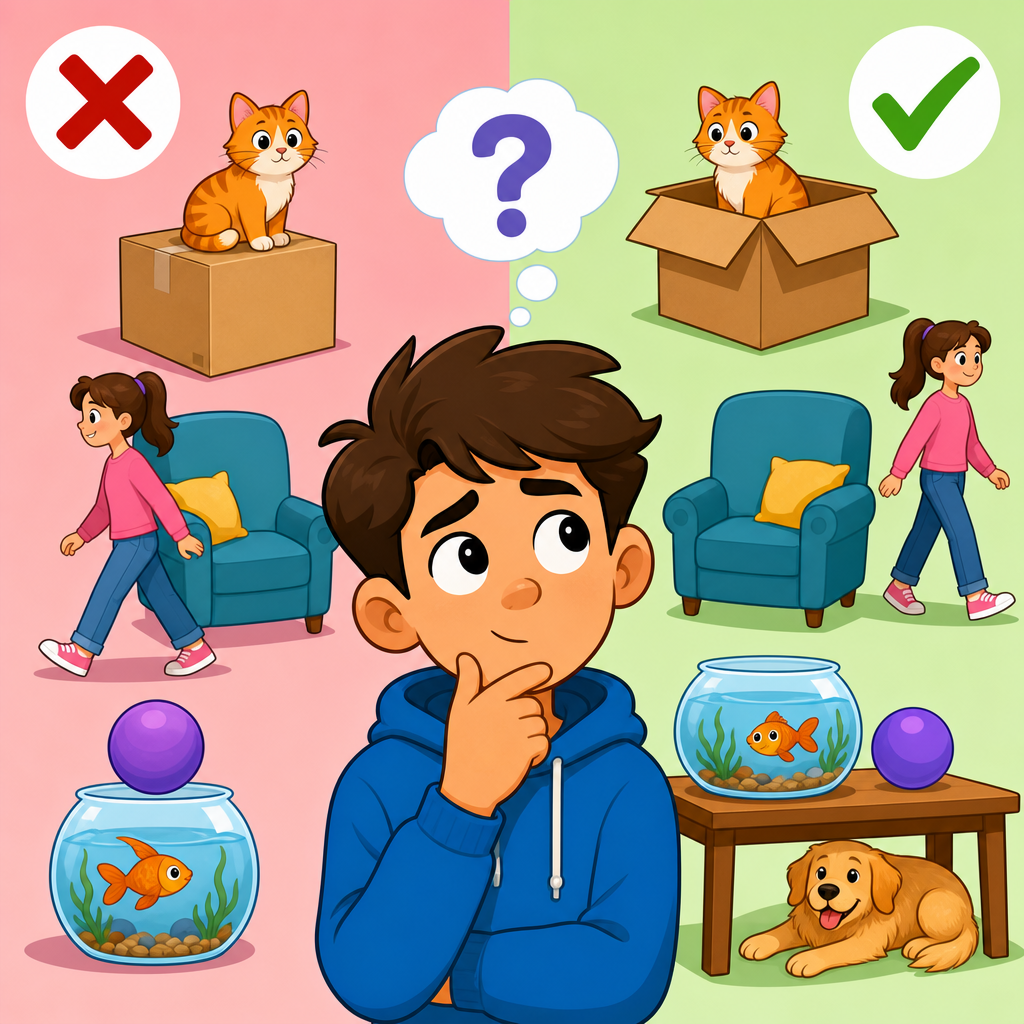
Time and place errors are the most teachable because many follow consistent patterns. For time, use at for precise times, on for days and dates, and in for months, years, centuries, and longer periods. Correct forms include “at 9 a.m.,” “on Friday,” and “in 2026.” Common errors include “in Friday,” “on 10 p.m.,” and “at summer.” The corrected versions are “on Friday,” “at 10 p.m.,” and “in summer,” though “during the summer” is also common when the season is treated as a period.
For place, at usually marks a point, on a surface, and in an enclosed space or area. We say “at the station,” “on the table,” and “in the room.” However, natural usage depends on perspective. “At school” focuses on the institution or activity, while “in the school” refers to the building interior. “On the bus” is standard for public transport, but “in the car” is standard for a private vehicle. “At the beach” means the general location; “on the beach” means physically on the sand.
Movement also causes confusion. Use to for motion toward a destination: “go to work,” “walk to the store,” “travel to Canada.” But some verbs take no preposition before the destination, such as enter, approach, reach, and leave. So “enter the room,” not “enter into the room,” in ordinary usage; “approach the door,” not “approach to the door”; and “reach the station,” not “reach to the station.”
Verb-Preposition Combinations That Learners Often Get Wrong
Many common grammar mistakes are actually verb pattern mistakes. Certain verbs require a specific preposition, while others do not take one at all. Learners often add unnecessary prepositions after discuss, mention, request, order, and answer. Standard English says “discuss the problem,” not “discuss about the problem”; “request information,” not “request for information” when request is a verb; and “answer the question,” not “answer to the question” unless answer to has a different meaning, such as being accountable to someone.
Other verbs require a preposition and sound incomplete without it. We say “depend on,” “belong to,” “suffer from,” “listen to,” “apologize for,” “complain about,” “focus on,” and “apply for” a job. In exam scripts, I repeatedly see “discuss about” and “emphasize on.” Both are wrong in standard usage because discuss and emphasize already carry the meaning. The correct forms are “discuss the issue” and “emphasize the main point.”
These patterns matter because the wrong preposition can change meaning. “Look at” means direct your eyes toward something. “Look for” means try to find. “Look after” means take care of. “Look into” means investigate. A learner who writes “I am looking my keys” is making a grammar error; one who writes “I am looking at my keys” when they mean searching creates a meaning error. Precision matters.
| Common error | Correction | Why it is correct |
|---|---|---|
| discuss about the plan | discuss the plan | discuss does not take about |
| arrive to London | arrive in London | arrive in is used for cities and countries |
| married with a doctor | married to a doctor | married collocates with to |
| good in math | good at math | ability uses good at |
| interested on science | interested in science | interested collocates with in |
| responsible of sales | responsible for sales | duty uses responsible for |
| listen music | listen to music | listen requires to before the object |
| explain me the rule | explain the rule to me | explain takes to before the person |
Adjective-Preposition Patterns and Fixed Expressions
Adjectives create another major source of preposition mistakes. English uses fixed adjective-preposition combinations that often cannot be predicted logically. Standard patterns include “afraid of,” “famous for,” “full of,” “similar to,” “different from,” “interested in,” “proud of,” “aware of,” “capable of,” and “responsible for.” Learners who know the adjective but not the full pattern often produce sentences that are understandable but incorrect, such as “interested on history,” “similar with mine,” or “proud for my team.”
Small changes in preposition can also create different meanings. “Angry with” is usually directed at a person, while “angry about” refers to a situation. “Good at” describes skill, “good for” describes benefit, and “good with” describes ability in handling people or things. Compare these sentences: “She is good at tennis,” “Vegetables are good for you,” and “He is good with children.” Students who replace one preposition with another may not simply sound wrong; they may communicate the wrong idea.
Fixed expressions deserve special attention because they appear constantly in spoken and written English. We say “on time” for punctuality and “in time” for early enough. We say “by accident” but “on purpose.” We say “at risk,” “under pressure,” “in charge,” “on duty,” and “for sale.” These combinations should be learned as complete units, much like vocabulary items. That approach is more effective than trying to invent the preposition each time.
Prepositions After Nouns, Gerunds, and Common Structures
Preposition mistakes do not appear only after verbs and adjectives. Many nouns also require specific patterns. We say “reason for,” “solution to,” “increase in,” “effect on,” “need for,” “answer to,” and “relationship with” or “relationship between.” A common business English error is “the demand of skilled workers” when the intended meaning is “the demand for skilled workers.” Another frequent mistake is “the reason of the delay” instead of “the reason for the delay.”
Gerunds after prepositions are another area where grammar problems cluster. A preposition is followed by a noun phrase or an -ing form, not usually by a base verb. Correct examples include “interested in learning,” “good at solving problems,” “before leaving,” and “without saying anything.” Learners often write “before to leave” or “without say,” mixing infinitive and gerund patterns. Those are not just preposition errors; they reveal a larger issue with verb complementation.
Parallel structures matter too. If you write “We talked about pricing, delivery, and how to reduce delays,” the structure is clear. If you write “We talked about pricing, about delivery, and reduce delays,” the sentence becomes uneven. In advanced writing, clean preposition use supports coherence, especially in reports, essays, and emails.
How to Correct Preposition Errors Systematically
The fastest way to reduce preposition mistakes is to stop studying prepositions as isolated vocabulary. Learn them in chunks and record them by pattern: verb + preposition, adjective + preposition, noun + preposition, and fixed phrase. In classroom practice, I have found that students improve significantly when they keep a collocation notebook with entries like “apply for a job,” “apologize for the mistake,” “in charge of the project,” and “a solution to the problem.” This method works because it matches how English is actually stored and retrieved.
Use reliable references. Major learner dictionaries such as Cambridge Dictionary, Oxford Learner’s Dictionaries, and Longman Dictionary of Contemporary English provide pattern information, not just definitions. Corpus-based tools like the Corpus of Contemporary American English and the British National Corpus show real usage in context. Grammar references such as Practical English Usage by Michael Swan are especially useful for differences that involve region, formality, or exceptions.
Editing should also be targeted. When reviewing your writing, check every sentence for common risk areas: time expressions, place expressions, movement verbs, adjective-preposition patterns, and unnecessary prepositions after transitive verbs. Read phrases aloud. “Discuss about,” “request for” as a verb, and “married with” often sound acceptable to learners because they reflect first-language patterns, but repeated exposure to correct English will make the right forms feel natural. If you teach or self-study under the ESL Grammar umbrella, treat this article as the hub and build outward into related lessons on collocations, verb patterns, articles, and sentence errors.
Common preposition mistakes and corrections are central to mastering common grammar mistakes because prepositions connect nearly every part of an English sentence. They affect meaning in time, place, movement, collocation, and style. The most frequent errors come from translation, overgeneralized rules, and incomplete knowledge of fixed patterns. The most effective corrections come from learning chunks, studying real examples, and reviewing writing with specific categories in mind.
If you remember only the essentials, remember these: use at, on, and in carefully for time and place; learn verb-preposition and adjective-preposition combinations as full units; avoid adding prepositions after verbs like discuss and enter; and use gerunds after prepositions. Accurate preposition use makes your English sound clearer, more natural, and more professional. It also strengthens performance in essays, workplace writing, and speaking exams.
Use this hub as your base for the broader Common Grammar Mistakes topic, then continue with focused practice on collocations, verb patterns, and sentence correction. Choose ten high-frequency preposition patterns from your own writing today, make example sentences, and review them until the correct form becomes automatic.
Frequently Asked Questions
Why are prepositions so difficult to master, even for advanced English learners?
Prepositions are difficult because they seem small and simple, but they do a great deal of grammatical work. They show relationships involving time, place, direction, method, cause, and connection. A learner may know all the major vocabulary in a sentence and still create confusion by choosing the wrong preposition. That is why mistakes with words like in, on, at, to, for, and with are so common and so persistent.
One major reason is that prepositions rarely translate neatly from one language to another. A phrase that uses one preposition in English may use a completely different structure in another language. For example, a learner may write married with because the equivalent phrase in their first language uses a word meaning with. In standard English, however, the correct phrase is married to. The same problem appears in expressions like arrive at the station, arrive in London, and not usually arrive to.
Another reason is that many prepositions belong to fixed combinations rather than clear logical rules. We say interested in, good at, afraid of, depend on, and responsible for. These combinations must often be learned as complete units. Even highly proficient learners make mistakes because the sentence may be grammatically strong overall while one small preposition weakens precision and naturalness.
The most effective way to improve is to study prepositions in patterns, not as isolated words. Instead of memorizing to alone, learn phrases such as listen to, belong to, and apologize to someone for something. That approach builds accuracy much faster than trying to apply broad rules to every sentence.
What are some of the most common preposition mistakes in English, and how do you correct them?
Some of the most common mistakes involve verbs and adjectives that require specific prepositions, as well as phrases that take no preposition at all. These errors are especially noticeable because they often appear in otherwise fluent writing. A few classic examples are discuss about, married with, and arrive to.
The phrase discuss about is incorrect because discuss already includes the idea of “about.” The correct form is simply discuss something, as in We discussed the problem. If you want to use about, then you need a different verb, such as talk about or argue about. In the same way, request for and demand for are correct noun patterns, but as verbs we say request something and demand something without adding an unnecessary preposition.
With relationship expressions, learners often say married with, but the standard correction is married to. For arrival, English uses arrive in for large places such as countries and cities, and arrive at for specific points such as airports, stations, buildings, and events. For example, we say arrive in Paris but arrive at the hotel. In most contexts, arrive to is not the natural form.
Other frequent corrections include depend of to depend on, interested on to interested in, good in math to good at math, and responsible of to responsible for. These are not minor style issues. They affect clarity, grammatical accuracy, and how natural the sentence sounds to a native reader. Learning the correct form as a complete phrase is usually the best correction strategy.
How can I tell when a verb needs a preposition, and when it does not?
This is one of the most important questions in mastering English grammar. Some verbs connect directly to their object with no preposition, while others require a specific one. There is no single rule that works for every verb, so the safest method is to learn verb patterns. For example, we say enter the room, not enter into the room in ordinary usage, and discuss the issue, not discuss about the issue. On the other hand, we say listen to music, believe in yourself, and apologize for the mistake.
A useful distinction is between meaning and structure. A verb may suggest a relationship such as direction or topic, but that does not always mean English uses a preposition. For example, approach already includes the idea of moving toward something, so approach to the building is usually wrong when approach is a verb. The correct form is approach the building. However, the noun form can be different, as in an approach to teaching. That is why learners must pay attention not only to the word, but also to its grammatical role in the sentence.
Dictionaries and good learner grammars are especially helpful here because they show patterns clearly. Instead of just learning a definition, check how the word behaves: apply for a job, apply to a university, focus on a problem, participate in an event. Building a notebook of these patterns is far more effective than trying to guess. Over time, repeated exposure makes the correct structure feel natural.
If you are unsure, test the sentence by looking for a direct object. Ask what or whom after the verb. If the answer comes immediately, the verb may not need a preposition: discuss the plan, answer the question, enter the building. If the sentence feels incomplete without a linking word, a preposition may be necessary: listen to the speaker, belong to the group, suffer from a cold. This is not foolproof, but it is a useful habit.
Are there rules for choosing prepositions of time and place, such as in, on, and at?
Yes, there are broad rules for in, on, and at, especially in expressions of time and place, although exceptions still exist. For time, in is usually used for longer periods such as months, years, centuries, and parts of the day: in June, in 2026, in the morning. On is generally used for days and dates: on Monday, on July 10, on my birthday. At is used for specific times: at 3:00, at noon, at night.
For place, the pattern is often understood in terms of scale and specificity. In is commonly used for enclosed spaces or larger areas: in the room, in the city, in France. On is often used for surfaces or lines: on the table, on the wall, on the coast. At usually marks a specific point or location: at the door, at the bus stop, at school.
However, learners should not rely only on the “big area, small area, point” explanation, because usage also depends on convention. For example, we say at home, not usually in home. We say on a bus but in a car. We say at the weekend in British English and often on the weekend in American English. These are reminders that prepositions follow both logic