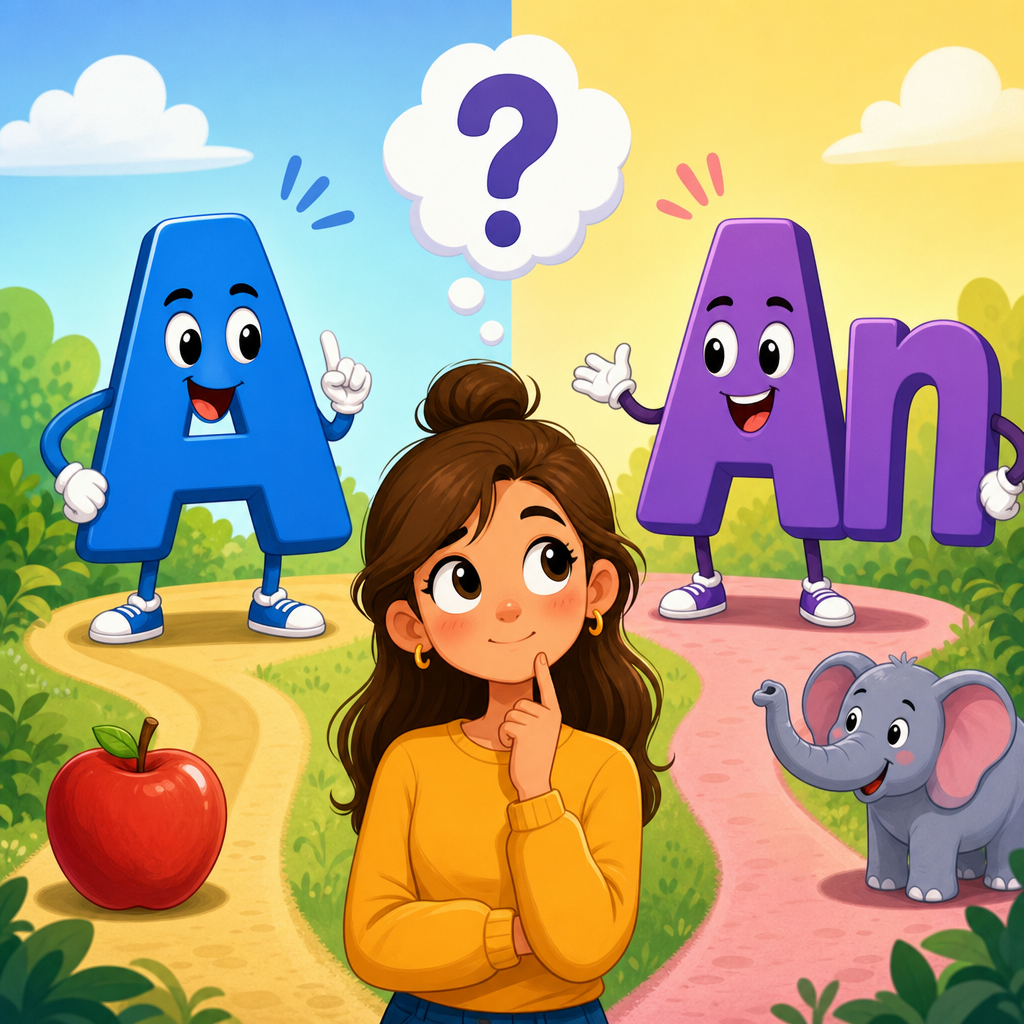
Articles and lessons about ESL grammar often spend pages on verbs and tenses, yet one of the most common grammar mistakes is far smaller: choosing between “a” and “an.” These two articles look simple, but they affect fluency, readability, pronunciation, and confidence in everyday English. I have taught this point to beginner and advanced learners alike, and I have seen the same pattern repeatedly: students memorize a rule based on letters, then make errors because English actually follows sound.
In plain terms, “a” and “an” are indefinite articles. They come before singular, countable nouns when the listener or reader does not know exactly which person, place, thing, or idea is being referenced. You say “a book” when the specific book is not identified, and “the book” when it is. The real decision between “a” and “an” depends on the sound that begins the next word. Use “a” before a consonant sound and “an” before a vowel sound. That is the core rule, and it explains most correct usage immediately.
This topic matters because article mistakes are highly visible. A sentence can have perfect vocabulary and still sound unnatural if the article is wrong. In exams such as IELTS, TOEFL, and Cambridge English tests, article choice influences grammatical accuracy scores. In professional writing, mistakes like “an university” or “a hour” can weaken credibility. This hub article explains the rule, the exceptions learners struggle with, and the related article system within common grammar mistakes, so you can use it as a reliable starting point for stronger ESL grammar overall.
The Core Rule: Sound, Not Spelling
The fastest correct answer to “a vs an” is this: listen to the first sound of the next word, not the first letter. Use “a” before words that begin with a consonant sound, such as “a car,” “a teacher,” and “a useful guide.” Use “an” before words that begin with a vowel sound, such as “an apple,” “an exam,” and “an old building.” When I train learners to pause and hear the opening sound, error rates drop quickly because they stop relying on spelling patterns that often mislead them.
This distinction exists for pronunciation efficiency. English articles help speech flow smoothly. Saying “an apple” is easier than “a apple” because the extra consonant sound /n/ creates a natural link between the words. Likewise, “a university” sounds smoother than “an university” because “university” begins with a /j/ sound, like the first sound in “yes,” which is a consonant sound. The rule is phonetic, not visual, and that is why it remains consistent even when spelling changes.
For learners, this is one of the best examples of why spoken English supports written grammar. If you are unsure, say the phrase aloud. “A honest answer” sounds awkward because “honest” begins with a vowel sound; the correct form is “an honest answer.” “An one-time fee” also sounds wrong because “one” begins with a /w/ sound; the correct form is “a one-time fee.” If you remember only one lesson from this hub, remember that article choice follows pronunciation first.
Why Learners Make A vs An Mistakes
Most article errors come from overgeneralizing a classroom shortcut. Many learners are taught “use an before vowels,” which is incomplete. It works for “an orange” and “an umbrella,” but it fails with “a European city,” “a union representative,” and “a useful tool.” Those words begin with vowel letters, yet their first sounds are /j/, /j/, and /j/. Because the sound is consonantal, “a” is correct in all three cases. Once students understand this, many long-standing mistakes disappear.
Another common source of confusion is silent letters. English has many words in which the first written consonant is not pronounced. Learners therefore produce forms like “a hour,” “a heir,” or “a MBA graduate.” In standard usage, the correct phrases are “an hour,” “an heir,” and “an MBA graduate” because the initial sounds are vowel sounds: /aʊər/, /er/, and /em/. Abbreviations are especially tricky because the spoken name of each letter determines the article, not the written appearance of the abbreviation itself.
First language transfer also plays a major role. Some languages do not use articles at all, while others use them differently. Students may omit articles completely, or they may treat them as spelling markers instead of pronunciation markers. In editing student essays, I often see correct noun choice but unstable article choice: “She is an university student,” then two lines later, “He waited for a hour.” This inconsistency shows that the learner knows the words, but not the sound-based system connecting article and noun phrase.
Common Patterns, Tricky Exceptions, and Reliable Examples
To master this point, learners need patterns they can trust. Words beginning with clearly pronounced vowel sounds take “an”: “an idea,” “an engineer,” “an interview,” “an octopus,” and “an umbrella.” Words beginning with clearly pronounced consonant sounds take “a”: “a dog,” “a teacher,” “a blue car,” and “a house.” Problems appear in edge cases, especially words beginning with h, u, eu, o, abbreviations, and numbers. Those are the forms teachers should practice repeatedly because they produce the highest number of errors in real writing.
With h-words, the key question is whether the h is pronounced. Use “a” when it is pronounced: “a history lecture,” “a hotel lobby,” “a helpful suggestion.” Use “an” when the h is silent: “an hour,” “an honest mistake,” “an honor.” Some older style guides once accepted “an historic event,” especially in British usage, but modern standard English usually prefers “a historic event” because the h is pronounced by most speakers. Teaching current pronunciation-based usage gives learners a more dependable standard.
With u- and eu-words, listen for the /juː/ sound. If the word begins like “you,” use “a”: “a university,” “a European policy,” “a eulogy,” “a user account,” “a uniform,” and “a unique approach.” If the word begins with a true vowel sound, use “an”: “an umbrella,” “an uncle,” or “an unusual result.” Number expressions follow the same principle. You write “an 18-year-old student” because “eighteen” begins with a vowel sound, but “a one-page summary” because “one” begins with a /w/ sound.
| Pattern | Correct Form | Why It Is Correct |
|---|---|---|
| Vowel letter, vowel sound | an apple | “Apple” begins with /æ/ |
| Vowel letter, consonant sound | a university | “University” begins with /j/ |
| Silent initial consonant | an hour | “Hour” begins with /aʊ/ |
| Abbreviation with vowel sound | an MBA | “M” is pronounced /em/ |
| Number phrase with consonant sound | a one-time fee | “One” begins with /w/ |
A vs An with Abbreviations, Acronyms, and Titles
Abbreviations create some of the most practical article questions in business English and academic English. The rule remains unchanged: choose the article based on how the abbreviation is pronounced. Use “an” before letters that begin with vowel sounds when spoken individually, including F, L, M, N, R, S, and X. That gives us “an FBI agent,” “an MBA program,” “an NGO worker,” and “an SQL error” in contexts where the letters are spoken one by one. The article reflects speech, not typography.
Acronyms pronounced as words follow the same logic. You say “a NASA engineer” because “NASA” begins with the consonant sound /n/. You say “a UNESCO report” because “UNESCO” begins with the /j/ sound, similar to “you.” But you say “an NHS appointment” in British English when the letters are spoken separately and “N” begins with /en/. This distinction matters in professional settings because learners increasingly write about technology, medicine, and international organizations where shortened forms appear constantly.
Titles and job descriptions also reveal article patterns clearly. We say “a CEO” if the speaker pronounces it “see-ee-oh”? No, we say “a CEO” would be wrong; the correct form is “a CEO” only if misheard, because “C” is pronounced /siː/, which begins with a consonant sound? Actually, this is where careful listening matters: /s/ is a consonant sound, so “a CEO” is correct. By contrast, “an HR manager” is correct because “H” is pronounced /eɪtʃ/, beginning with a vowel sound. These examples show why article accuracy improves when learners think phonetically rather than mechanically.
How A vs An Fits into Common Grammar Mistakes
As a hub within ESL grammar, this topic connects directly to other frequent problem areas. Learners who struggle with “a vs an” often also struggle with countable and uncountable nouns, singular and plural forms, and article choice more broadly. For example, “information” does not take “a” because it is uncountable in standard English; the problem is not “a vs an,” but whether an indefinite article is possible at all. Likewise, “advice,” “furniture,” and “equipment” raise article questions that belong to the same editing process.
This issue also links to adjective order and noun phrases. The article depends on the first sound of the word immediately following it, even if that word is an adjective rather than the noun. We say “a red apple” because “red” begins with a consonant sound, but “an old apple tree” because “old” begins with a vowel sound. In class, I often ask students to identify the full noun phrase first. That prevents mistakes like focusing on “apple” and missing the fact that the article must match “old.”
There is also a useful connection to pronunciation training. Weak forms, linking, and stress all influence how articles sound in natural speech. Learners who practice chunks such as “an interesting idea” and “a useful example” usually improve faster than learners who memorize isolated rules. That is why this hub should lead into deeper lessons on articles, determiners, countability, pronunciation, and editing strategies. Grammar accuracy improves most when learners see how small choices fit into larger sentence patterns rather than treating every mistake as unrelated.
Practical Editing Strategies for ESL Learners
The most effective correction method is a short three-step check. First, ask whether the noun is singular and countable; if not, “a” or “an” may be impossible. Second, identify the exact next spoken sound, including any adjective or abbreviation before the noun. Third, say the phrase aloud once. This process is fast enough for test conditions and reliable enough for workplace writing. I recommend it because it catches both obvious mistakes and less obvious ones, such as “a MBA,” “an user,” or “a honest reply.”
Reading aloud is especially powerful during revision. In silent reading, the eye often accepts familiar spelling and misses article errors. In spoken reading, awkward combinations stand out immediately. Tools such as Cambridge Dictionary and Merriam-Webster provide audio pronunciations that help confirm uncertain words. For more advanced learners, the International Phonetic Alphabet can be useful, but it is not required. What matters is hearing whether the phrase starts with a consonant sound or a vowel sound in standard pronunciation.
Teachers and self-study learners should also collect personalized error lists. If you repeatedly write about universities, European markets, hourly work, SQL databases, or MBA admissions, practice those phrases directly. Language improvement becomes faster when examples come from your real communication needs. That is how I usually coach learners: we do not just review the rule; we build a small bank of high-frequency phrases the learner actually uses. Repetition with relevant examples turns article choice from a confusing rule into an automatic habit.
Choosing between “a” and “an” is a small decision with a large impact on clear English. The governing rule is straightforward: use “a” before a consonant sound and “an” before a vowel sound. Most mistakes happen when learners follow spelling instead of pronunciation, especially with silent h, words beginning with /juː/, abbreviations, acronyms, and number phrases. Once you shift attention from letters to sounds, article choice becomes far more consistent in both speaking and writing.
As a hub for common grammar mistakes in ESL grammar, this topic opens the door to related article lessons on countable and uncountable nouns, definite and indefinite reference, noun phrase structure, and pronunciation-based editing. It is worth mastering because article errors are frequent, noticeable, and easily correctable with the right method. A brief sound check, supported by reading aloud and dictionary audio, solves most problems faster than memorizing long exception lists.
If you want stronger grammar that sounds natural to native and proficient speakers, start by reviewing your own common phrases and correcting article use one sound at a time. Then continue through the rest of this common grammar mistakes hub to strengthen the connected skills that make article choice easier and more accurate every day.
Frequently Asked Questions
What is the basic rule for using “a” and “an” in English?
The most important rule is this: use “a” before a consonant sound and “an” before a vowel sound. The key word is sound, not letter. That is where many learners get confused. They are often taught a simplified version of the rule that says “use an before vowels and a before consonants,” but English pronunciation does not always match spelling. For example, we say “an apple” because apple begins with a vowel sound, but we say “a university” because university begins with a “yoo” sound, which is a consonant sound. In the same way, we say “an hour” because the h is silent, so the word begins with a vowel sound. If you remember that your ears matter more than your eyes, you will make better choices. This small grammar point improves both natural pronunciation and overall fluency, because “a” and “an” are designed to make speech smoother and easier to say.
Why do learners often make mistakes with “a” and “an” even after learning the rule?
Most mistakes happen because learners memorize the rule by spelling instead of pronunciation. That approach works in some simple cases, but it breaks down quickly in real English. A student may learn “use an before a vowel,” then incorrectly say “an university” because the word starts with the letter u. Another learner may think “a hour” is correct because hour starts with the letter h. These are common mistakes because English spelling is not always a reliable guide to sound. Another reason learners struggle is that they often read more than they listen, so they recognize word forms visually but do not always connect them to spoken pronunciation. In fast speech, native speakers choose “a” or “an” automatically based on what sounds natural, not based on written rules in their heads. That is why practice with listening and speaking is so important. If you train yourself to notice the first sound of the next word, article choice becomes much easier. Over time, the goal is not to stop and analyze every sentence, but to develop an instinct for what sounds correct.
Why do we say “an hour” but “a house,” and “a university” but “an umbrella”?
These examples show exactly why pronunciation matters more than spelling. We say “an hour” because the word hour begins with a vowel sound. The h is silent, so the word is pronounced like it starts with ow. For the same reason, you also hear “an honest person” and “an honor”. In contrast, we say “a house” because the h is pronounced, so the word begins with a consonant sound. The same principle explains words that begin with u. We say “a university” because university starts with a “yoo” sound, not a true vowel sound. That “y” sound is treated as a consonant sound, so a is correct. But we say “an umbrella” because umbrella begins with a true vowel sound. This difference is one of the clearest illustrations of how English articles follow speech. If you are unsure, say the noun aloud and listen to its first sound. That quick pronunciation check will usually give you the right answer faster than looking at the first letter.
How do “a” and “an” work with abbreviations, acronyms, and initials?
With abbreviations and initials, the same sound-based rule applies, but you must think about how the letters are pronounced when spoken aloud. For example, we say “an MBA” because the letter M is pronounced “em,” which begins with a vowel sound. We also say “an FBI agent” and “an HTML tag” for the same reason: F is pronounced “ef,” and H is pronounced “aitch.” On the other hand, we say “a USB cable” because U here is pronounced “yoo,” which begins with a consonant sound. We also say “a UK company” for the same reason. Acronyms that are pronounced like words follow normal pronunciation rules as well. For instance, if an acronym is spoken as a word beginning with a consonant sound, it takes a; if it begins with a vowel sound, it takes an. This can feel tricky at first, but the method is consistent: do not focus on the written capital letters alone. Instead, ask yourself, “How would I say this out loud?” Once you use spoken pronunciation as your guide, article choice with abbreviations becomes much more predictable.
What is the best way to stop making “a” and “an” mistakes in speaking and writing?
The best way to improve is to combine rule awareness with pronunciation practice. First, replace the oversimplified “vowel letter versus consonant letter” rule with the more accurate version: choose the article based on the first sound of the next word. Second, practice with common exception patterns, such as silent h words like hour, pronounced h words like hotel and house, and u words that begin with a “yoo” sound like user, unit, and university. Third, read sentences aloud. This is especially effective because “a” and “an” are easier to choose when you hear the phrase naturally: an orange, a European country, an idea, a one-time fee. Notice that “a one-time fee” is correct because one begins with a “w” sound. Finally, review your own writing slowly and check article-noun combinations one by one. In speaking, do not worry if you need extra time at first; accuracy becomes speed with repetition. This may seem like a very small part of grammar, but using “a” and “an” correctly makes your English sound more natural, polished, and confident in both everyday conversation and formal writing.