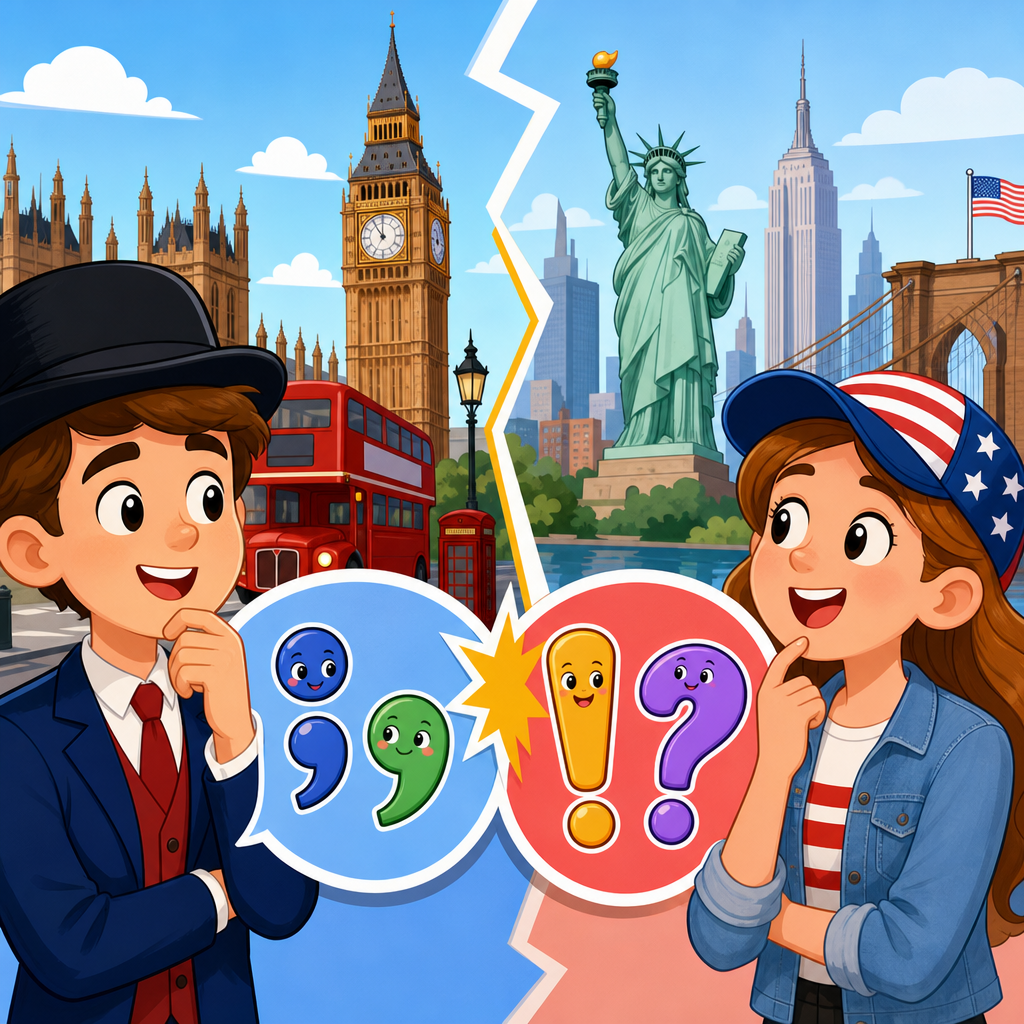
British and American punctuation differences matter because punctuation is not just decoration; it controls meaning, tone, and credibility in every sentence an English learner writes. In ESL Grammar, punctuation includes the marks that organize language on the page: full stops or periods, commas, quotation marks, apostrophes, colons, semicolons, dashes, question marks, exclamation marks, and brackets or parentheses. British English and American English use the same basic system, but they apply several rules differently, especially with quotation marks, punctuation placement, abbreviations, dates, titles, and lists. I have had to edit student essays, business emails, website copy, and exam responses across both standards, and the same pattern appears every time: learners usually understand grammar before they understand style conventions. That gap causes preventable errors.
This topic matters for three practical reasons. First, punctuation affects clarity. A misplaced comma or quotation mark can change whether a sentence reads as natural, confusing, or simply wrong to a native reader. Second, punctuation signals consistency. If a student writes colour, organise, and travelled but uses American punctuation patterns, the writing feels mixed and unpolished. Third, punctuation can affect assessment and professional trust. IELTS, Cambridge exams, university admissions essays, academic papers, and workplace documents all reward control and consistency. The goal is not to prove that one variety is better. The goal is to choose one standard, understand its rules, and apply them deliberately.
As a hub article for punctuation in ESL Grammar, this guide explains the major British vs American punctuation differences, shows where the standards overlap, and gives clear examples of how to avoid mixed-style writing. It also points to the larger principle behind every rule: punctuation follows conventions, not pure logic. Once learners understand which conventions belong to British English and which belong to American English, they can write with more precision and much less hesitation.
Quotation marks and punctuation placement
The most discussed difference between British and American punctuation is quotation mark style. American English usually prefers double quotation marks for primary quotations and single quotation marks for a quote inside a quote. British English often does the reverse in publishing, using single quotation marks first and double quotation marks second, although many British newspapers and modern style guides also use doubles. The deeper difference, however, is not just the shape of the marks. It is where commas and full stops or periods go.
In American English, commas and periods almost always go inside closing quotation marks: She called it “a good result.” He said, “We should leave now,” before the meeting started. In British English, punctuation usually goes inside quotation marks only if it belongs to the quoted material itself. Otherwise, it stays outside: She called it ‘a good result’. He said, ‘We should leave now’, before the meeting started. This is often called logical punctuation, and it is one of the clearest visible distinctions between the two systems.
Question marks and exclamation marks in both varieties generally follow meaning rather than a fixed inside rule. For example: Did she really say “I quit”? The whole sentence is a question, but the quoted words are not. By contrast: She asked, “Are you ready?” Here the quoted words are themselves a question. ESL writers often improve quickly once they stop memorizing isolated examples and start asking a simpler question: Does this punctuation belong to the quoted words or to the larger sentence?
Periods, abbreviations, and titles
American English uses periods more heavily in abbreviations. British English tends to use fewer. In American style, people commonly write Mr., Mrs., Dr., Prof., Jr., and St. In British style, many publishers write Mr, Mrs, Dr, Prof, Jr, and St without periods, especially when the abbreviation ends with the same letter as the full word. This is sometimes called the open punctuation preference. You can see it in everyday forms, school notices, and press writing across the UK.
The contrast also appears in Latin abbreviations and time markers. American writing often uses a.m. and p.m., while British writing may use am and pm. American academic prose may still prefer e.g., i.e., and etc., though British writers may reduce punctuation depending on house style. None of this means British English bans periods or American English requires them in every abbreviation. Style guides differ. The main lesson is consistency inside one document.
Title punctuation also differs. American books, articles, and school assignments more often capitalize major words in titles, while British publishers often use sentence case for headings outside formal titles. That is partly a capitalization issue, but it affects punctuation choices too, especially in subtitles separated by a colon. If you are preparing academic writing, check the target style guide first. The Chicago Manual of Style, APA, MLA, Oxford style, and major newspaper house styles do not always align perfectly.
Commas, serial commas, and list style
Commas are mostly shared across British and American English, but one difference appears constantly: the serial comma, also called the Oxford comma. American English generally uses it more often in formal writing: We bought apples, oranges, and pears. British English is more divided. Many British publications omit it unless needed for clarity: We bought apples, oranges and pears. Oxford University Press is famous for using the serial comma, which is why the term Oxford comma exists, but many UK newspapers do not.
The best practical rule for ESL writers is this: use the serial comma if your chosen style guide requires it, or when omission could create ambiguity. Consider the sentence: I thank my parents, Lady Gaga and Nelson Mandela. Without a serial comma, it can jokingly suggest that the parents are Lady Gaga and Nelson Mandela. With the serial comma, the list is clearer. In editing, I rarely object to either style if it is consistent, but I immediately change a document that switches back and forth.
| Feature | Typical British English | Typical American English | Example |
|---|---|---|---|
| Primary quotation marks | Single often preferred | Double preferred | ‘example’ vs “example” |
| Period/comma with quotes | Usually logical placement | Usually inside quotes | ‘word’, vs “word,” |
| Abbreviations | Fewer full stops | More periods | Dr vs Dr. |
| Serial comma | Optional more often | Common in formal style | a, b and c vs a, b, and c |
| Date format | Day-month-year | Month-day-year | 5 May 2025 vs May 5, 2025 |
Comma style also interacts with introductory phrases, nonrestrictive clauses, and direct address, but those core grammar rules are largely the same on both sides of the Atlantic. You still need commas after interrupters like however in many contexts, around nonessential information, and when addressing someone directly: Maria, please email the file. The international difference is less about grammar than about editorial preference.
Dates, time, numbers, and academic references
Dates create punctuation problems because formatting differs as much as grammar does. British English usually writes dates in day-month-year order: 5 May 2025 or 5/5/2025. American English usually writes month-day-year: May 5, 2025 or 5/5/2025. The punctuation inside the written form differs too. In American English, a comma normally follows the day when the year is included: May 5, 2025, was the deadline. British English generally does not use that comma: 5 May 2025 was the deadline.
Time and number punctuation can also vary. British English frequently uses a full stop in time expressions less often than older American business writing once did, and contemporary usage in both varieties now strongly favors 3:30 p.m. or 3.30 pm depending on house style. Decimal points and comma grouping in large numbers are broadly shared in modern English, but international students should be careful with spaces, especially in scientific and technical contexts. Many journals follow SI conventions rather than national punctuation habits.
Academic references deserve special attention. Citation systems such as APA, MLA, Chicago, and Harvard each impose punctuation patterns for titles, dates, page ranges, and quotation marks. A British university may require Harvard referencing but still expect British punctuation in the prose around the citations. An American university may require MLA or APA and expect American punctuation throughout. Learners who treat punctuation and referencing as separate topics often lose marks unnecessarily because citation punctuation is highly standardized.
Apostrophes, parentheses, dashes, and shared rules
Not every punctuation topic divides cleanly into British and American camps. Apostrophes, for example, are governed more by grammar than nationality. Both varieties use apostrophes for possession and contractions: the teacher’s notes, the students’ essays, don’t, it’s. The real ESL challenge is distinguishing it’s from its and knowing when plurals do not take apostrophes. Signs like Apple’s for sale are wrong in both varieties unless apples possess something. Where variation appears, it is usually stylistic, such as forming decades as the 1990s rather than the 1990’s, which most modern guides reject.
Parentheses and brackets are also similar, though terminology differs. British English often says brackets for what American English calls parentheses, and square brackets are named explicitly in both systems. Punctuation around parentheses usually follows the same logic in both varieties: if the parenthetical material sits inside a sentence, the sentence punctuation goes outside. If the entire sentence is in parentheses, the full stop or period goes inside.
Dashes reveal another style difference. American publishers often use the em dash without spaces—like this—while British publishers often prefer the en dash with spaces – like this – or an en dash closed up in some house styles. This is partly typography rather than grammar, but it strongly affects how polished writing looks. The same is true of ellipses, spaced or unspaced according to style guide, and of bullet punctuation in business documents.
The most important shared rule is that punctuation should help readers process structure quickly. If a mark slows the reader for the wrong reason, it is probably being used badly. When I edit ESL writing, I first check whether punctuation reflects meaning, then whether it follows the chosen national standard. That order matters. Correct style cannot rescue unclear thinking.
How ESL learners should choose a standard
For most learners, the best approach is not to memorize every national preference immediately. It is to choose a target variety based on purpose. If you are preparing for GCSEs, A-levels, Cambridge exams, or a UK university, follow British conventions. If you are applying to a US college, writing for an American company, or using APA in a US context, follow American conventions. If your audience is international, either standard can work, but mixed punctuation within the same text looks careless.
Build a simple editing checklist. Check quotation marks, punctuation with quotes, abbreviation periods, date format, and serial comma use. Then run a spelling and style review with tools such as Microsoft Editor, Grammarly, PerfectIt, or the language setting in Google Docs, but do not trust software blindly. These tools catch pattern inconsistencies well, yet they often miss context-sensitive punctuation, especially logical quotation punctuation in British English. The final review must be human.
This hub article is the foundation for punctuation in ESL Grammar because every subtopic connects back to consistency, readability, and audience expectation. Master the major British vs American punctuation differences, decide which standard you need, and apply it line by line. Your writing will read more clearly, your corrections will become easier to understand, and your work will appear more professional. Choose one style today, review your last page of writing, and fix every mixed punctuation signal you find.
Frequently Asked Questions
What are the main punctuation differences between British and American English?
The main punctuation differences between British and American English appear in a few high-visibility areas rather than in the entire system. Both varieties use the same core marks—commas, full stops or periods, question marks, quotation marks, apostrophes, colons, semicolons, dashes, and brackets or parentheses—but they do not always place them in the same way. One of the most noticeable differences involves quotation marks. American English typically favors double quotation marks first, while British English often prefers single quotation marks first, with double marks used for a quotation inside a quotation. Another common difference is where commas and full stops or periods go in relation to closing quotation marks. In American English, they usually go inside the quotation marks, while in British English they are often placed according to logic, meaning they go inside only if they are part of the quoted material.
There are also differences in punctuation around abbreviations and titles. American English is more likely to use periods in abbreviations such as “Mr.”, “Dr.”, and “U.S.”, while British English often omits them in forms like “Mr”, “Dr”, and “UK”. Date formatting can create punctuation confusion too, especially when commas appear in American dates such as “July 4, 2026,” while British usage often writes dates as “4 July 2026” without the same comma pattern. These differences may seem small, but they influence how natural, polished, and regionally appropriate a piece of writing sounds. For learners, the key is not to memorize random rules in isolation, but to choose one style—British or American—and apply it consistently throughout the text.
How do quotation marks differ in British and American punctuation?
Quotation marks are one of the clearest punctuation differences between British and American English. In American English, the standard practice is to use double quotation marks for primary quotations and single quotation marks for a quotation within a quotation. For example, an American writer might write: “She said, ‘I agree.’” In British English, that pattern is often reversed. A British writer may prefer single quotation marks for the main quotation and double quotation marks for a quote inside it, as in: ‘She said, “I agree.”’ This is not an absolute rule in every British publication, since some publishers and style guides choose double quotation marks, but the single-first style is widely recognized as a typical British convention.
Another important distinction involves punctuation placement with quotation marks. American English usually puts periods and commas inside the closing quotation mark, even when they do not logically belong to the quoted words. British English often follows logical punctuation, meaning the punctuation goes inside the quotation marks only if it is actually part of the original quoted material. For example, in British style, a writer might say that the word was ‘incorrect’, with the comma outside because it is not part of the quoted word itself. This difference matters in academic writing, journalism, and edited prose because it affects clarity and house style. For English learners, the safest approach is to study examples from the variety of English they are using and avoid mixing American quote placement with British quote style in the same document.
Do British and American English use commas and periods differently with quotation marks?
Yes, this is one of the most discussed punctuation differences between the two varieties. In American English, commas and periods are normally placed inside closing quotation marks as a matter of style. For example, an American sentence would usually read: She called it “essential,” and everyone agreed. Likewise, an American writer would typically write: He described the plan as “effective.” This rule applies even when the comma or period is not part of the original quoted material. It is a conventional practice rather than a purely logical one, and it is deeply established in American publishing, journalism, and formal writing.
British English more often uses what is called logical punctuation. That means commas and full stops go inside quotation marks only if they belong to the quoted words themselves. If they do not, they stay outside. For example, a British writer may write: She called it ‘essential’, and everyone agreed. If the entire original quotation ended with a full stop, that full stop might be kept inside, but if the writer is simply mentioning a word or short phrase, the sentence punctuation usually remains outside. This method can look more precise because it reflects meaning more directly. However, what matters most for learners and professionals is consistency. If you are writing for an American audience, use the American convention. If you are writing for a British audience, follow British logical placement unless the publication’s style guide says otherwise.
Are apostrophes, abbreviations, and dates punctuated differently in British and American English?
They can be, yes. Apostrophes themselves follow many of the same basic grammar rules in both British and American English, especially for possession and contractions. However, differences sometimes appear in style preferences and surrounding punctuation. One frequent area of variation is abbreviations. American English commonly includes periods in abbreviated titles and forms such as “Mr.”, “Mrs.”, “Dr.”, and “etc.” British English often drops the periods in many of these cases, especially when the abbreviation includes the first and last letter of the full word, resulting in forms like “Mr”, “Mrs”, and “Dr”. That said, usage can vary by publisher, institution, and level of formality, so not every British source will look identical.
Dates are another area where punctuation and formatting differ noticeably. American English typically writes dates in month-day-year order, such as “July 4, 2026,” and often uses a comma after the day when the sentence continues. British English usually writes day-month-year, as in “4 July 2026,” and generally does not use the same comma structure. This difference is not just stylistic—it can prevent misunderstandings, especially with purely numerical dates like 03/04/2026, which may mean March 4 in American English but 3 April in British English. For learners and international writers, spelling out the month is often the clearest solution. Overall, punctuation around abbreviations and dates reflects broader national style patterns, so writers should match the format to the audience they expect to read their work.
Why is it important to stay consistent with either British or American punctuation?
Consistency matters because punctuation does more than decorate writing—it shapes meaning, rhythm, tone, and reader trust. When a piece of writing shifts randomly between British and American punctuation, it can feel unpolished or confusing. For example, using British single quotation marks in one paragraph and American comma placement in the next makes the text look inconsistent, even if the grammar is technically understandable. In academic, business, and professional settings, this inconsistency may suggest carelessness. Readers often notice punctuation patterns subconsciously, and when those patterns keep changing, the writing loses some of its authority and smoothness.
Choosing one system also makes editing much easier. If you decide at the beginning that you are writing in British English, you can consistently use forms such as single quotation marks, logical punctuation, “full stop,” and British date order. If you choose American English, you can consistently use double quotation marks, periods and commas inside quotation marks, and American date formatting. This does not mean one system is better than the other. Both are correct within their own standards. The real goal is clarity, credibility, and audience awareness. For ESL learners in particular, mastering one variety at a time is often more effective than trying to blend both. Once the patterns become familiar, writers can adapt their punctuation style confidently depending on whether they are writing for British or American readers.