Punctuation is the system of marks that organizes written language, guiding readers through meaning, tone, emphasis, and structure. For ESL learners, punctuation is not a cosmetic finishing step; it is a core grammar skill that changes how sentences are understood. A missing comma can create ambiguity, a misplaced apostrophe can signal the wrong meaning, and incorrect capitalization can make polished writing look careless. In classrooms, business emails, university essays, and English proficiency exams, punctuation directly affects clarity, credibility, and scores.
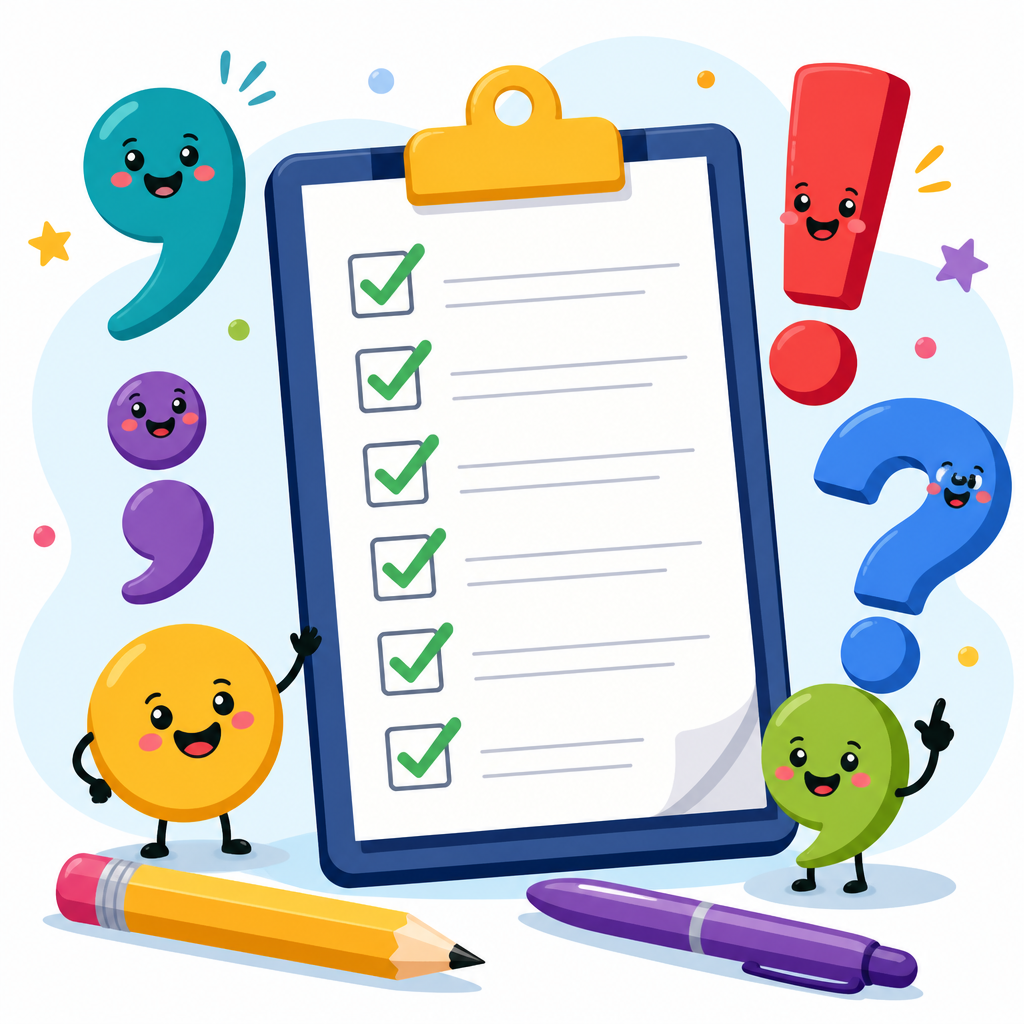
A practical punctuation checklist for writing helps learners review the marks that appear most often: periods, commas, question marks, exclamation points, colons, semicolons, apostrophes, quotation marks, parentheses, hyphens, dashes, and capitalization. It also helps writers decide when not to use a mark. That matters because strong punctuation is not about adding more symbols. It is about making sentence boundaries clear, connecting ideas accurately, and signaling relationships between words. I have found that many ESL writers know the names of punctuation marks but still struggle to apply them consistently when writing under time pressure.
Why does punctuation matter so much in ESL grammar? English relies heavily on word order and sentence-level signals. Unlike some languages that use richer inflection or more flexible structure, English often depends on punctuation to separate clauses, mark direct speech, and distinguish restrictive from nonrestrictive information. Compare these examples: “Let’s eat, Maria” and “Let’s eat Maria.” The vocabulary is nearly identical, but the comma changes the message completely. In professional contexts, punctuation mistakes can also affect tone. “Thanks.” can sound neutral, while “Thanks!” sounds warmer and more energetic.
This hub article covers punctuation comprehensively so learners can review the full system in one place. It defines the main marks, explains common rules in plain language, highlights frequent ESL errors, and offers a checklist that can be used during drafting and editing. Think of this page as the central guide for punctuation in English writing: broad enough to orient beginners, detailed enough to help intermediate and advanced learners fix recurring mistakes, and practical enough to support daily writing tasks.
Sentence-ending marks: periods, question marks, and exclamation points
The first punctuation check is simple: does every sentence end correctly? In standard English, a statement ends with a period, a direct question ends with a question mark, and an exclamation point shows strong emotion or emphasis. ESL writers sometimes use these marks interchangeably, especially when translating tone from texting or informal social media habits. In formal writing, however, the choice should match the sentence function.
Use a period for statements: “The meeting starts at nine.” Use a question mark for direct questions: “What time does the meeting start?” Do not use a question mark after an indirect question: “She asked what time the meeting starts.” That distinction appears often in academic and workplace writing. Exclamation points should be limited. They work in dialogue, marketing copy, or friendly messages, but overusing them can make writing seem immature or overly emotional. One exclamation point is enough; multiple marks are rarely appropriate outside informal chat.
Also check sentence boundaries. Run-on sentences and sentence fragments are common punctuation problems in ESL writing. If two independent clauses are joined without proper punctuation, the result is a run-on: “The report was late the client complained.” It needs a period, semicolon, or comma with a coordinating conjunction. Clear sentence endings are the foundation of readable English.
Comma rules that cause the most confusion
Commas are the most frequently misused punctuation marks in English. A useful checklist asks five questions: Is there a list? Is there an introductory element? Are two independent clauses joined by a coordinating conjunction? Is the information nonessential? Is the sentence using a direct address or interrupter? If the answer to one of these is yes, a comma may be needed.
Use commas in a series: “We bought notebooks, pens, folders, and tape.” Style guides differ on the final serial comma, but major guides such as The Chicago Manual of Style recommend it because it prevents ambiguity. Use a comma after many introductory words or phrases: “After the lesson, we reviewed the quiz.” Use a comma before coordinating conjunctions like and, but, or, so, yet, for, nor when they join two independent clauses: “The data was complete, but the summary was weak.”
Nonessential information also requires commas: “My manager, who previously worked in Singapore, speaks three languages.” Here, the clause adds extra detail. If the information is essential to identify the noun, commas are usually omitted: “Students who revise carefully improve faster.” Direct address takes commas too: “Professor Lee, could you review this?” Common interrupters such as however, for example, and in fact may need commas depending on placement.
The biggest ESL comma mistake is inserting commas where a natural speaking pause occurs. English punctuation is based more on grammar than breathing. Another common error is the comma splice: “The presentation was clear, the slides were crowded.” A comma alone cannot join two complete sentences.
Semicolons, colons, and linking ideas precisely
Semicolons and colons often seem advanced, but their functions are precise and learnable. A semicolon joins closely related independent clauses without a coordinating conjunction: “The forecast was accurate; the farmers changed their plans.” It can also separate complex list items that already contain commas, which improves readability in addresses, dates, or grouped details.
A colon introduces something that explains, lists, defines, or illustrates what comes before it. “The recipe requires three staples: rice, beans, and onions.” The clause before the colon should usually be complete on its own. This is a key editing check because many learners place colons after verbs or prepositions, producing incorrect structures such as “The reasons are: cost and time.” Standard edited English usually prefers “The reasons are cost and time” or “There are two reasons: cost and time.”
When used well, semicolons and colons create logical flow. They are especially useful in academic writing, reports, and exam essays because they show control over sentence relationships. Still, they should not be forced into every paragraph. A period is often the clearest choice. Good punctuation supports meaning rather than displaying complexity for its own sake.
Apostrophes, quotation marks, and ownership versus omission
Apostrophes cause persistent trouble because they serve two main functions: showing possession and marking omitted letters in contractions. For possession, add apostrophe plus s to singular nouns: “the teacher’s desk.” For regular plural nouns ending in s, add only an apostrophe: “the students’ books.” Irregular plurals take apostrophe plus s: “the children’s jackets.” A common mistake is using apostrophes to form plurals, as in “apple’s” for more than one apple. That is incorrect in standard English.
Contractions use apostrophes to show missing letters: don’t, it’s, we’re, they’ve. One of the most frequent ESL errors is confusing “its” and “it’s.” “Its” is possessive; “it’s” means “it is” or “it has.” The same kind of confusion appears with “whose” and “who’s.” Because these pairs sound identical, they require careful proofreading.
Quotation marks enclose direct speech and exact wording: “I will send the file tonight,” Ana said. In American English, periods and commas usually go inside the closing quotation mark. Single quotation marks are generally reserved for a quote inside a quote. For article titles or unfamiliar terms, style depends on the context, but consistency matters. In digital workplaces, I often see quotation marks used for emphasis, as in a sign advertising “fresh” bread; this can accidentally suggest irony instead of importance.
Capitalization, parentheses, hyphens, and dashes
Capitalization is often taught separately from punctuation, but in editing practice it belongs on the same checklist because it shapes sentence boundaries and proper naming. Capitalize the first word of a sentence, the pronoun I, proper nouns, days, months, nationalities, languages, and official names. Do not capitalize common nouns just because they seem important. “English” is capitalized; “grammar” is not unless it starts a sentence or appears in a title according to title case rules.
Parentheses add extra information that is useful but not central: “The conference begins on Monday (not Tuesday).” If an entire sentence is inside parentheses, the sentence-ending period goes inside. If the parenthetical material is part of a larger sentence, the period belongs outside. Hyphens join words that function together as a modifier before a noun, as in “well-known author” or “full-time job.” Many compound modifiers need hyphens before the noun but not after it: “The author is well known.”
Dashes, especially the em dash, create stronger interruption or emphasis than commas or parentheses. “The result was clear—the team needed more training.” They are effective, but overuse can make writing feel dramatic or fragmented. In formal ESL writing, learners should master commas and periods first, then use dashes selectively.
A practical punctuation checklist for ESL writing
The most effective way to improve punctuation is to apply the same review sequence every time you edit. That reduces missed errors and helps build automatic habits. I recommend checking sentence endings first, then commas, then clause linking, then apostrophes and quotation marks, and finally capitalization and minor marks. This mirrors how experienced editors move from large structural issues to small surface details.
| Checklist Item | What to Check | Example of Correct Use |
|---|---|---|
| Sentence ending | Every sentence ends with the right mark | We finished the project. |
| Comma use | Lists, introductions, joined clauses, nonessential details | After lunch, we revised the draft. |
| Clause connection | No run-ons or comma splices | The draft was strong, but the conclusion was short. |
| Apostrophes | Possession and contractions only | The company’s policy changed. |
| Quotation marks | Direct speech and exact wording are enclosed correctly | “Please email me,” he said. |
| Capitalization | Sentence starts and proper nouns are capitalized | Maria studied English in Canada. |
For exam preparation, this checklist is especially helpful. On IELTS and TOEFL writing tasks, punctuation errors may not always be scored separately, but they affect coherence, grammar control, and reader confidence. In business communication, a cleanly punctuated email is easier to scan and less likely to create misunderstandings. In academic settings, punctuation supports citation, quotation, and argument structure.
One final point matters for all learners: punctuation conventions vary slightly by style guide and regional standard. American and British English differ in some quotation and punctuation practices. The best approach is not to memorize every rare exception. Instead, choose a standard, follow it consistently, and master the high-frequency rules first. Clear sentences, accurate commas, correct apostrophes, and logical clause boundaries will improve most writing more than any advanced mark used occasionally.
A strong punctuation checklist for writing gives ESL learners a repeatable method for producing clearer, more professional English. Start with the essentials: end every sentence correctly, use commas for real grammatical reasons, avoid run-ons, and distinguish possession from contraction with apostrophes. Then build confidence with semicolons, colons, quotation marks, hyphens, dashes, and capitalization. Each mark has a job, and the goal is not decoration but precision.
The main benefit of mastering punctuation is better reader comprehension. When punctuation is correct, ideas connect smoothly, tone becomes more accurate, and meaning is easier to trust. That applies whether you are writing an essay, an email, a report, or an exam response. Small marks create big differences in how your English is received.
Use this hub as your starting point for punctuation study, then review each mark in your own writing samples. Edit one paragraph today with this checklist beside you, and you will begin turning punctuation from a weak point into a reliable grammar skill.
Frequently Asked Questions
Why is punctuation so important in writing, especially for ESL learners?
Punctuation is essential because it helps readers understand exactly what a writer means. It separates ideas, shows relationships between words and clauses, signals pauses, and clarifies tone. For ESL learners, punctuation is especially important because it works closely with grammar. A sentence with correct vocabulary but poor punctuation can still confuse the reader or even change the meaning entirely. For example, a missing comma may make a sentence ambiguous, and a misplaced apostrophe can turn a plural noun into a possessive form. In practical settings such as school assignments, business communication, test writing, and formal emails, punctuation affects how polished and credible the writing appears. Strong punctuation habits help learners express ideas more accurately, avoid misunderstandings, and build confidence in both academic and professional English.
What should be included in a basic punctuation checklist for writing?
A useful punctuation checklist should cover the marks writers use most often and the errors that appear most frequently. Start with end punctuation: make sure every sentence ends with a period, question mark, or exclamation point as appropriate. Next, check commas to see whether they are used to separate items in a list, introduce dependent clauses when needed, and prevent confusion in longer sentences. Review apostrophes carefully for possession and contractions, making sure they are not incorrectly used to form plurals. Look at quotation marks if dialogue or cited language appears, and confirm that commas and periods are placed correctly with them according to the style being used. Include capitalization in the checklist as well, since sentence beginnings, proper nouns, days, months, and the pronoun “I” must be capitalized properly. Finally, check for sentence boundaries: run-on sentences, comma splices, and sentence fragments are often signs that punctuation needs improvement. A good checklist is simple enough to use every time but detailed enough to catch the most common mistakes before the writing is submitted or shared.
How do commas cause confusion, and how can writers use them correctly?
Commas are one of the most common punctuation problems because they do many different jobs. Writers use commas to separate items in a series, set off introductory words or phrases, connect independent clauses with coordinating conjunctions, and add clarity to complex sentences. Confusion happens when commas are either missing or overused. A missing comma can cause the reader to misread the sentence structure, while too many commas can make writing feel broken or unnatural. For example, in a sentence with an introductory phrase, a comma often helps the reader move more easily into the main idea. In compound sentences, a comma before words like “and,” “but,” or “so” is often needed when both parts could stand alone as complete sentences. At the same time, writers should avoid inserting commas randomly just because a sentence feels long. The best approach is to understand the grammatical structure of the sentence rather than relying only on pauses in speech. When editing, writers should look at each comma and ask what job it is doing. If the comma has a clear purpose, it likely belongs there. If not, it may need to be removed.
What are the most common apostrophe mistakes in English writing?
The most common apostrophe mistakes involve confusing possession, contractions, and plurals. Apostrophes are used to show ownership, as in “the student’s notebook,” or to show missing letters in contractions, as in “don’t” or “it’s.” They are not usually used to make a noun plural, so forms like “apple’s” when the writer simply means more than one apple are incorrect. Another frequent mistake is confusing “its” and “it’s.” “Its” is the possessive form, while “it’s” means “it is” or “it has.” Writers also make errors with plural possessives, such as forgetting that “teachers’ lounge” refers to a lounge belonging to multiple teachers, while “teacher’s lounge” refers to one teacher. These distinctions matter because apostrophe errors can make writing look careless and can sometimes change the meaning. A strong editing habit is to check every apostrophe individually and decide whether it shows ownership or replaces missing letters. If it does neither, it may be unnecessary.
How can writers proofread punctuation more effectively before submitting their work?
Effective punctuation proofreading requires a slow, deliberate review rather than a quick final glance. One of the best strategies is to read the writing sentence by sentence and check each sentence boundary first. Make sure every sentence is complete and ends with the correct punctuation mark. Then review specific marks one category at a time: commas, apostrophes, quotation marks, colons, semicolons, and capitalization. This method is often more effective than trying to catch every problem at once. Reading the text aloud can also help, especially for noticing awkward sentence structure, missing pauses, or places where ideas run together. Another useful technique is to read the writing backward sentence by sentence, which helps the writer focus on form instead of content. ESL learners may benefit from keeping a personal error list based on patterns they commonly repeat, such as comma splices or missing apostrophes. It is also wise to use grammar and spell-checking tools carefully, but not depend on them completely, because automated tools do not catch every punctuation issue and sometimes suggest incorrect changes. The most reliable proofreading combines grammar knowledge, a clear checklist, and enough time to review the writing carefully before it is sent, submitted, or published.