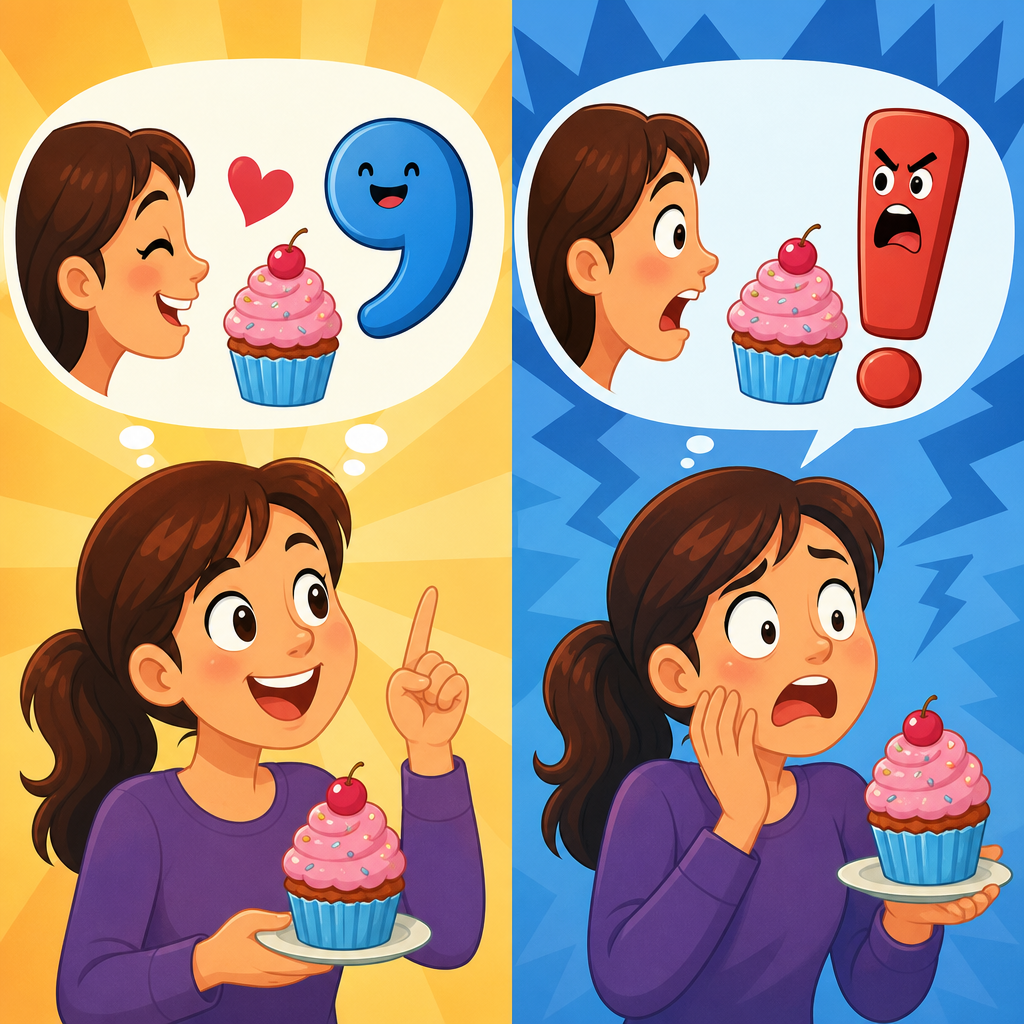
Punctuation changes meaning because it tells readers where ideas begin, pause, connect, and stop. In ESL grammar, punctuation is not a cosmetic finishing step; it is part of meaning itself. A comma can separate equal ideas or prevent a dangerous misunderstanding. A question mark can turn a statement into a request for confirmation. Quotation marks can show exact speech, signal irony, or identify a title, depending on context and style. When I teach punctuation to English learners, I start with one practical truth: the same words can communicate different intentions when the marks change. Compare “Let’s eat, Grandma” with “Let’s eat Grandma.” The vocabulary is identical, but the comma completely changes the message.
For learners of English, punctuation matters in every setting: email, academic writing, texting, tests, workplace communication, and online forms. It affects clarity, politeness, tone, and even credibility. Readers often forgive a minor spelling mistake if the message is clear, but weak punctuation can make a sentence feel confusing, abrupt, or unprofessional. In standardized writing, punctuation also signals grammatical relationships. It shows whether a clause is essential or extra, whether items belong in a list, whether possession is singular or plural, and whether a sentence is complete. That is why punctuation belongs at the center of ESL grammar, not at the edge.
This hub article covers punctuation comprehensively by explaining the marks English learners use most, the meaning changes those marks create, and the common errors that lead to confusion. It also connects punctuation to sentence structure, tone, and reading comprehension. If you understand how periods, commas, apostrophes, semicolons, colons, dashes, parentheses, quotation marks, exclamation points, and question marks work, you write more clearly and read more accurately. The goal is not to memorize isolated rules. The goal is to see punctuation as a system that guides meaning, helps readers process information, and makes your English more precise.
Why punctuation is a meaning system, not decoration
Punctuation is a meaning system because it marks relationships between words and clauses. In speech, listeners hear pauses, stress, rhythm, and intonation. In writing, punctuation carries much of that job. A period closes a complete thought. A comma shows a lighter boundary. A colon announces what comes next. A semicolon links closely related independent clauses without using a coordinating conjunction. These are not stylistic ornaments. They are signals that shape interpretation.
Consider restrictive and nonrestrictive information. In “My brother who lives in Seoul is visiting,” the clause “who lives in Seoul” identifies which brother. In “My brother, who lives in Seoul, is visiting,” the commas show the clause is extra information, implying the writer has one brother or that the identity is already clear. The punctuation changes the logic of the sentence. This is one reason punctuation is essential in academic writing, contracts, news reporting, and instructions, where tiny shifts can alter meaning significantly.
I have also seen punctuation change perceived attitude. “Send the report when you can” sounds neutral. “Send the report. When you can.” feels more abrupt because the period creates a sharper rhythm. In digital communication, “Thanks.” can sound colder than “Thanks!” even when both are grammatically correct. ESL learners need this awareness because punctuation affects not only grammar but also interpersonal tone.
Sentence-ending punctuation: periods, question marks, and exclamation points
Sentence-ending punctuation tells readers what kind of move the sentence makes. A period marks a statement, command, or indirect question: “Please sit down.” “I wonder where he went.” A question mark marks a direct question: “Where did he go?” An exclamation point signals strong emotion, urgency, surprise, or emphasis: “Watch out!” Because these marks frame the whole sentence, they often create the first layer of meaning a reader notices.
English learners commonly confuse direct and indirect questions. “Do you know where the station is?” takes a question mark because the whole sentence is a direct question. “I know where the station is.” takes a period because it is a statement. This distinction matters on exams and in formal writing. Overusing exclamation points is another issue. In business English, one exclamation point may communicate warmth; several can look unprofessional. “Thank you!” is normal in email. “Thank you!!!” usually is not.
Writers should also avoid comma splices when a period is needed. “The meeting ended, everyone left” joins two independent clauses incorrectly. The correct options are “The meeting ended. Everyone left,” “The meeting ended, and everyone left,” or “The meeting ended; everyone left.” In each case, the punctuation clarifies where one complete thought ends and the next begins.
Comma rules that most often change meaning
The comma is the punctuation mark that causes the most trouble for ESL learners because it serves several functions. It separates items in a list, joins clauses with coordinating conjunctions, sets off introductory elements, marks nonessential information, and can prevent misreading. The challenge is that commas are not inserted simply where a speaker pauses. They reflect grammar and meaning.
List commas are the easiest place to begin. “We bought apples, oranges, and pears” is clear. Without commas, readers process the list more slowly. The final comma before “and,” often called the serial comma, is required in some style guides and optional in others, but it often prevents ambiguity. “I thank my parents, Oprah Winfrey and my teacher” suggests the parents are Oprah and the teacher. “I thank my parents, Oprah Winfrey, and my teacher” removes that reading.
Commas after introductory words and phrases also protect meaning. “After lunch, we reviewed the contract” is easier to read than “After lunch we reviewed the contract,” especially in longer sentences. A comma after an introductory dependent clause is standard: “Although the price was high, we ordered the part.” Without it, the boundary is weaker and readers may need to reread.
The most important comma rule for meaning is the distinction between essential and nonessential information. Use commas around nonessential details: “The Eiffel Tower, which attracts millions of visitors each year, is in Paris.” Do not use commas around essential details: “Students who arrive late must sign in.” In the second sentence, the clause defines which students. If you add commas, the sentence suggests all students must sign in, which changes the rule.
Apostrophes, quotation marks, and ownership of meaning
Apostrophes are small, but they create major differences in meaning. In standard English, apostrophes mark possession and contractions. “The manager’s office” means one manager owns the office. “The managers’ office” means multiple managers share it. “Its” is possessive; “it’s” means “it is” or “it has.” This pair causes constant errors because the apostrophe appears where learners expect possession, but English treats personal pronoun possessives differently: his, hers, yours, ours, theirs, and its have no apostrophe.
Contractions also affect tone. “I am writing to inform you” sounds formal. “I’m writing to inform you” sounds slightly more conversational. In academic essays, contractions may be limited depending on the style guide or instructor. In emails and general business writing, they are common and natural. The punctuation choice shapes voice as much as grammar.
Quotation marks identify exact words, dialogue, and sometimes titles of short works such as articles, poems, or songs. They can also signal that a word is being discussed as a word: “Their” is a possessive determiner. Problems arise when writers use quotation marks for emphasis, as in a shop sign offering “fresh” bread. Readers may interpret the quotes as doubt, sarcasm, or irony. In professional English, quotation marks should clarify source language, not create unintended skepticism.
| Mark | Core function | Meaning change example |
|---|---|---|
| Comma | Separates or sets off elements | “Let’s eat, Grandma” vs. “Let’s eat Grandma” |
| Apostrophe | Shows possession or contraction | “its color” vs. “it’s colorful” |
| Question mark | Marks a direct question | “You’re leaving.” vs. “You’re leaving?” |
| Semicolon | Links related independent clauses | “The test was hard; everyone noticed” |
| Colon | Introduces explanation or list | “She brought one thing: evidence” |
Semicolons, colons, dashes, and parentheses
These marks help writers manage complex information. A semicolon joins two independent clauses that are closely related: “The forecast was poor; the flight left on time.” This punctuation tells the reader the ideas belong together without the full stop of a period. It can also separate complicated list items containing commas: “The conference included speakers from Lagos, Nigeria; Lima, Peru; and Busan, South Korea.”
A colon points forward. It introduces a list, explanation, summary, or quotation after an independent clause. “The committee reached one conclusion: the budget must increase.” What follows explains the first clause. A colon should not come directly after a verb or preposition in a sentence fragment such as “The items are: paper, pens, and tape.” In most edited prose, “The items are paper, pens, and tape” is better, unless layout or style specifically calls for the colon.
Dashes create strong emphasis or interruption. “The answer was obvious—at least to the engineers.” They are useful for inserting afterthoughts or dramatic turns, but overuse makes writing feel scattered. Parentheses add background information in a quieter way: “The answer was obvious (at least to the engineers).” The words are similar, but the punctuation changes the weight. Dashes highlight; parentheses downplay. Good writers choose between them based on rhetorical purpose.
Punctuation, style, and common ESL mistakes
Many punctuation errors come from transferring rules from another language into English. Spanish uses inverted question marks and exclamation marks; English does not. Some languages place spaces before colons or semicolons; standard English usually does not. In several languages, comma rules depend more heavily on speech pauses than on clause structure. ESL learners improve faster when they compare systems directly instead of assuming punctuation works the same across languages.
Another common issue is run-on writing. Learners may produce long sentences connected only by commas because the ideas feel linked in speech. English requires clear boundaries between independent clauses. If each part can stand alone, use a period, semicolon, or comma plus coordinating conjunction. Editing for clause boundaries is one of the fastest ways to improve readability.
Writers should also follow a consistent style guide when stakes are high. Academic writing often uses MLA, APA, or Chicago conventions. Journalism often follows AP style. These systems differ on details such as the serial comma, title formatting, and punctuation placement with quotation marks. The key point is consistency. If you are preparing essays, reports, or website content, match the conventions expected by your audience.
To build punctuation accuracy, read edited English closely, then practice revising your own sentences. Ask direct questions: Is this a complete sentence? Is the clause essential? Am I showing possession or a contraction? Do I need a softer break, a stronger break, or no break at all? Punctuation improves when learners connect marks to sentence structure and communicative purpose.
Punctuation changes meaning in sentences because it organizes grammar, guides reading, and signals tone. For ESL learners, that makes punctuation one of the most practical parts of grammar to study. Strong punctuation helps readers understand your message the first time. It clarifies whether information is essential, whether ideas are separate or linked, whether language is exact quotation or paraphrase, and whether a sentence is a statement, question, or exclamation.
The most useful approach is to learn punctuation as a connected system. Start with sentence endings, then master commas, apostrophes, and quotation marks. After that, add semicolons, colons, dashes, and parentheses to express more complex relationships. Use model sentences, read professionally edited writing, and revise your own work with attention to clause boundaries and tone. Over time, punctuation stops feeling like a list of rules and starts functioning as a tool for precision.
As the hub page for punctuation in ESL grammar, this guide gives you the foundation for every related topic, from comma rules and apostrophes to dialogue punctuation and sentence boundaries. Review each mark with examples, apply the rules in real writing, and keep editing with the reader in mind. If you want clearer English, better grades, and more professional communication, make punctuation a daily practice.
Frequently Asked Questions
Why does punctuation change the meaning of a sentence so much?
Punctuation changes meaning because it gives structure to the words on the page. In spoken English, listeners can hear pauses, emphasis, tone, and emotion. In writing, punctuation helps replace those signals. It shows where one idea ends and another begins, whether a thought is complete, whether two ideas are closely connected, or whether the writer is asking, explaining, warning, or quoting someone directly. Without punctuation, readers have to guess the relationships between words, and that guesswork can easily lead to misunderstanding.
For English learners, this is especially important because punctuation is not just decoration added at the end of writing. It is part of grammar and meaning. A comma can separate items in a list, but it can also prevent confusion between the person being addressed and the action being described. A period can make an idea sound firm and complete, while a question mark can turn the same words into a request for confirmation. Even a small mark can change whether a sentence sounds polite, serious, uncertain, or urgent. That is why punctuation should be taught and learned as meaning-based, not as a cosmetic editing step.
How can a comma completely change what a sentence means?
A comma can change meaning because it controls grouping. Readers understand sentences by seeing which words belong together, and commas help show those relationships. For example, in the sentence “Let’s eat, Grandma,” the comma tells us that “Grandma” is the person being spoken to. Without the comma in “Let’s eat Grandma,” the meaning becomes shocking because it sounds like Grandma is the thing being eaten. This is a classic example, but it clearly shows how one punctuation mark can change the entire message.
Commas also matter when separating equal ideas, introductory phrases, extra information, and direct address. Compare “After dinner, we studied” with “After dinner we studied.” In some cases, both may be readable, but the comma makes the time phrase easier to process. Now compare “My brother, who lives in Toronto, is visiting” with “My brother who lives in Toronto is visiting.” The first suggests I have one brother, and the phrase about Toronto is extra information. The second suggests I may have more than one brother, and the Toronto detail identifies which one. In other words, commas do more than create pauses. They help define exactly what the writer means.
What is the difference between a period and a question mark in meaning?
A period and a question mark may seem simple, but they shape the purpose of a sentence. A period signals that the writer is making a statement, giving information, or finishing a complete thought. A question mark signals that the writer is asking something, checking information, or inviting a response. Even when the words are almost identical, the ending punctuation changes how the reader interprets the sentence. “You finished the report.” sounds like a statement of fact. “You finished the report?” sounds like surprise, doubt, or a request for confirmation.
This difference matters in everyday communication, especially in email, messaging, and formal writing. A sentence with a period can sound confident, final, or neutral. The same sentence with a question mark can sound uncertain, curious, skeptical, or polite depending on context. For ESL learners, learning this contrast improves both grammar accuracy and social meaning. It helps them understand not only what a sentence says, but also what the writer is trying to do with it. That is a major part of clear communication in English.
How do quotation marks affect meaning in English sentences?
Quotation marks affect meaning by telling readers how to interpret specific words. Most commonly, they show exact speech: “I will call you later,” she said. In this use, quotation marks tell the reader that the words inside are being repeated directly, not summarized. That makes them essential when accuracy matters, such as in dialogue, interviews, news writing, or classroom examples. Without quotation marks, readers may not know whether the words are the speaker’s exact words or the writer’s paraphrase.
Quotation marks can also signal other meanings depending on context. They may identify titles of shorter works in some style systems, such as articles, poems, or songs. They can also show that a word is being mentioned as a word rather than used normally, as in The word “affect” is often confused with “effect.” Sometimes writers use quotation marks to suggest distance, irony, or skepticism, as in He is an “expert.” In that case, the punctuation tells the reader not to take the word at face value. Because quotation marks can indicate exact speech, technical reference, or implied doubt, learners need to pay close attention to why they are being used in a sentence.
What is the best way for English learners to improve punctuation and avoid changing meaning by accident?
The best approach is to learn punctuation through sentence meaning, not through memorizing isolated rules alone. Start by noticing what each punctuation mark does in real sentences. Ask practical questions: Does this sentence make a statement or ask a question? Am I separating items, adding extra information, or speaking directly to someone? Am I showing exact words, connecting closely related ideas, or ending a complete thought? When learners connect punctuation to purpose, they make better decisions and remember patterns more effectively.
It also helps to study short pairs of sentences where punctuation changes interpretation. Compare “Let’s eat, Grandma” and “Let’s eat Grandma.” Compare “You’re coming.” and “You’re coming?” Compare “My friend said, ‘Leave now.’” and “My friend said leave now.” These comparisons train learners to see punctuation as part of the message. Reading well-edited English, reading sentences aloud, and revising with attention to pauses and structure are also useful habits. Most importantly, learners should slow down during editing and check whether their punctuation matches their intended meaning. That final review can prevent confusion, embarrassment, and serious misunderstanding.