Running errands is one of the most practical parts of daily life, and it is also one of the richest sources of useful English vocabulary for learners. If you can talk about going to the bank, picking up groceries, dropping off a package, making a return, or stopping by the pharmacy, you can handle many real conversations that happen outside the classroom. In plain terms, errands are short tasks you do during the day, usually outside your home, to manage everyday responsibilities. Common English phrases for running errands help learners ask for directions, explain plans, request services, and respond naturally in shops, offices, and public places.
This topic matters because daily life vocabulary is the language people use constantly, not occasionally. In my work with English learners, I have seen the same pattern repeatedly: students may know grammar rules and textbook words, yet still feel stuck when they need to say, “I need to pick up my prescription,” or “I’m going to stop at the post office on the way home.” These are high-frequency phrases. They appear in casual conversation, workplace small talk, listening exams, and real service interactions. Mastering them improves fluency because learners stop translating word by word and begin using ready-made expressions.
As a hub within ESL vocabulary building, this article covers daily life vocabulary through the lens of errands. It connects actions, places, service encounters, and everyday planning language. You will learn what common errands people talk about, which verbs and phrases sound natural, how conversations usually unfold, and where learners often make mistakes. You will also see practical examples in plain English. The goal is not to memorize long lists but to build a usable system: what errands are, where they happen, what you say before, during, and after them, and how to describe them clearly in conversation.
What “running errands” means in everyday English
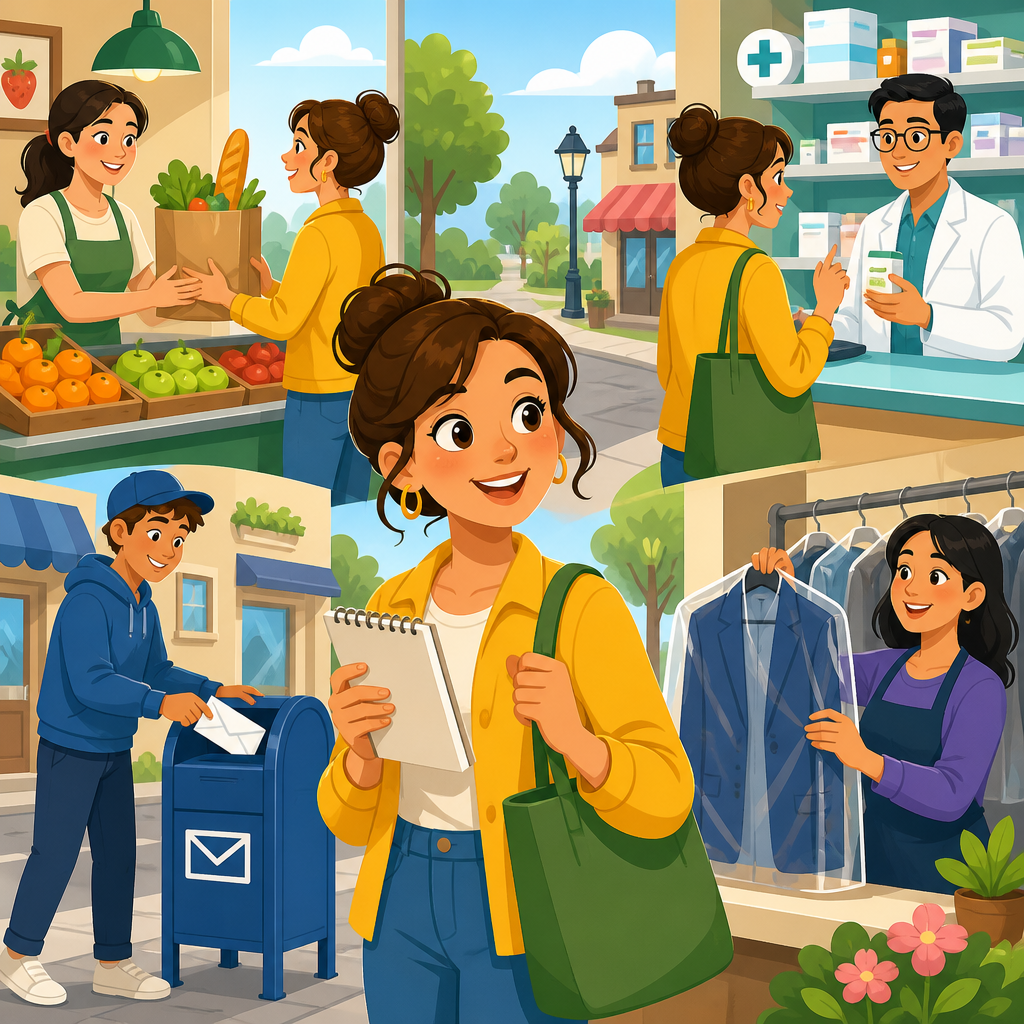
“Running errands” means going out to complete several small tasks, often in one trip. Native speakers use this phrase broadly. It can include grocery shopping, mailing letters, returning items, paying bills, going to the dry cleaner, picking up takeout, or getting a haircut. The key idea is efficiency: errands are routine tasks that keep daily life moving. If someone says, “I’m out running errands,” they usually mean they are busy visiting a few places, not doing one major event.
Learners should know the most common verb patterns. People say “run errands,” “do errands,” or “take care of a few errands.” All three are natural, though “run errands” is especially common in American English. You also hear useful supporting phrases such as “stop by,” “pick up,” “drop off,” “head to,” “swing by,” and “take care of.” For example: “I need to stop by the bank,” “I’m picking up a few things at the store,” and “I have to drop off a package.” These phrasal verbs matter because everyday English relies on them heavily.
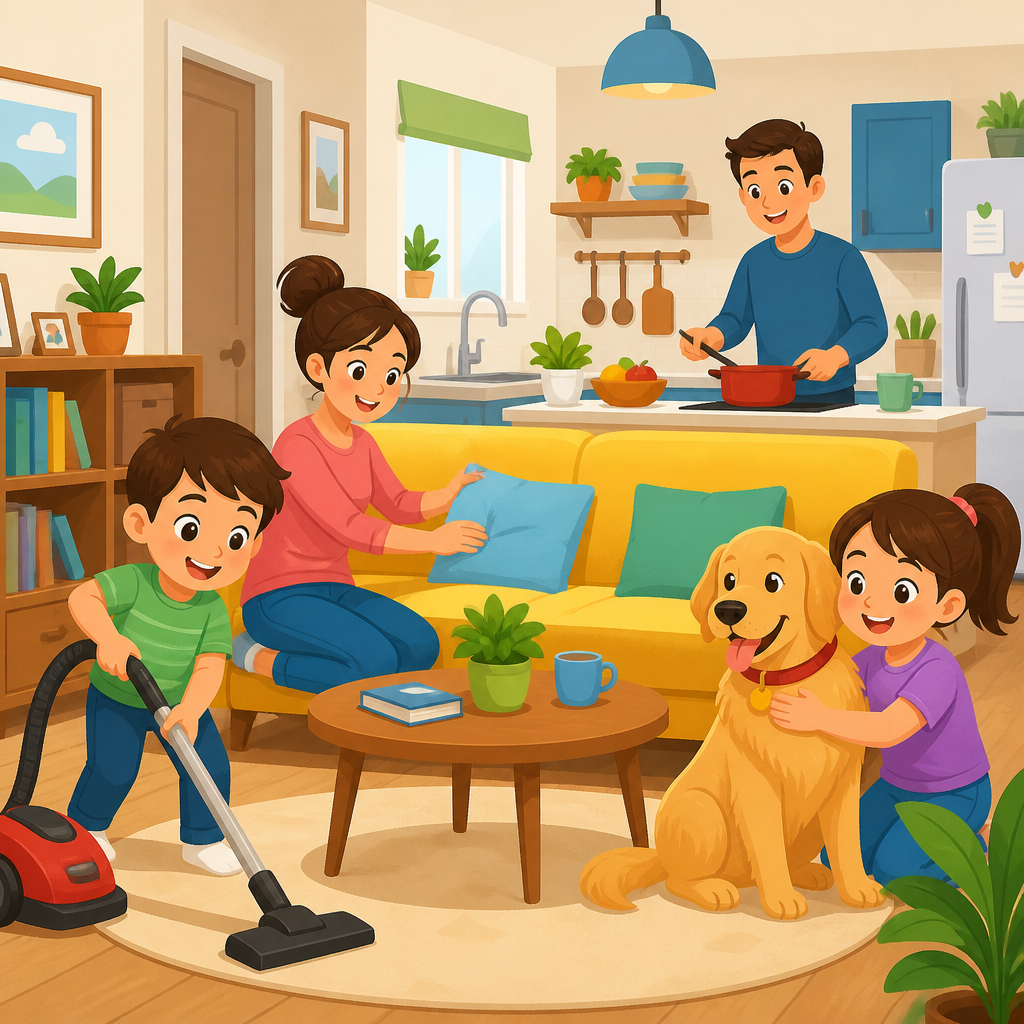
Another important distinction is between an errand and a chore. A chore is usually a household task like washing dishes, vacuuming, or doing laundry. An errand usually involves going somewhere. There is overlap, but the location often changes the word choice. Buying detergent at the supermarket is an errand; using it to wash clothes at home is a chore. This distinction helps learners sound precise and understand native speakers more easily.
Essential verbs and phrases for common errands
The fastest way to improve daily life vocabulary is to learn the core verbs that combine with common errands. “Pick up” means collect something that is ready: pick up a prescription, pick up dry cleaning, pick up the kids, pick up an order. “Drop off” means leave something somewhere: drop off a return, drop off documents, drop off a package. “Stop by” means visit briefly. “Run to” is a casual way to say go quickly somewhere, as in “I need to run to the store.” “Take care of” means complete a responsibility, as in “I have to take care of some paperwork.”
These phrases are powerful because they fit many situations. I encourage learners to build phrase families rather than isolated words. For instance, with “pick up,” practice “pick up groceries,” “pick up a prescription,” “pick up my order,” and “pick up my suit from the dry cleaner.” With “return,” practice both the noun and verb forms: “I need to return this shirt,” “I’m making a return,” and “What is your return policy?” This approach reflects how fluent speakers store language. They do not create every sentence from zero; they reuse familiar chunks.
| Errand | Common Phrase | Example Sentence |
|---|---|---|
| Grocery shopping | pick up a few things | I need to pick up a few things for dinner. |
| Pharmacy visit | pick up a prescription | I’m stopping by the pharmacy to pick up a prescription. |
| Post office trip | drop off a package | Can you drop off this package on your way? |
| Bank visit | deposit a check | I have to go to the bank to deposit a check. |
| Store return | make a return | I’m going back to the mall to make a return. |
| Dry cleaner | pick up the dry cleaning | Don’t let me forget to pick up the dry cleaning. |
Notice that many of these phrases are more natural than direct dictionary equivalents. A learner might say, “I will collect my medicine,” which is understandable, but “pick up my prescription” is what most people actually say. Likewise, “send a parcel” is correct, but in daily North American conversation, “mail a package” or “drop off a package” is often more common. Choosing the phrase people expect makes listening and speaking much easier.
Places, services, and the language used there
Running errands vocabulary is closely tied to places. At the grocery store, common phrases include “I’m looking for…,” “Where can I find…?,” “Do you have this in stock?,” and “I’d like to check out.” At the pharmacy, people say “I’m here to pick up a prescription,” “Is it ready yet?,” and “Do I need ID?” At the bank, useful phrases include “I’d like to deposit this check,” “I need to withdraw cash,” and “What are the fees?” At the post office or shipping counter, you hear “I need to mail this,” “How much is shipping?,” “Do I need tracking?,” and “When will it arrive?”
Each location also has its own nouns. In supermarkets, learners should know aisle, cart, basket, checkout, receipt, coupon, and out of stock. In pharmacies, important words include prescription, refill, over-the-counter medicine, dosage, side effects, and insurance card. In banks, common vocabulary includes account, balance, statement, direct deposit, transfer, withdrawal, and debit card. At shipping counters, key words are package, envelope, label, tracking number, postage, delivery, and signature confirmation. These words are not advanced; they are essential daily life vocabulary.
Context changes meaning, so examples help. “Refill” at a café may mean more coffee, but at a pharmacy it means getting more of a medicine you already use. “Statement” in general English can mean something you say, but at a bank it often means a record of account activity. Learners gain confidence when vocabulary is learned in setting-based groups like these. That is why errands are such an effective organizing theme for this hub page.
Useful conversation patterns before, during, and after errands
Most errand conversations follow predictable patterns. Before the errand, people explain purpose and sequence: “I need to run a few errands,” “I’m going to the store first,” “Then I have to stop by the bank,” and “After that, I’m heading to the post office.” During the errand, they ask for help, confirm details, and make polite requests: “Could you help me find this?,” “Is this on sale?,” “Can I return this without a receipt?,” and “I’m here to pick up an online order.” After the errand, they report results: “I got everything I needed,” “The line was long,” “They were out of stock,” or “I still need to go back tomorrow.”
These patterns are useful for both speaking and listening. In workplace conversations, for example, coworkers often say, “I’ll be back in thirty minutes; I need to run to the bank.” Friends might say, “I’m out doing errands, so I can meet you later.” Parents commonly say, “I spent the morning running errands.” Because these expressions are so frequent, they function like social glue. They explain availability, time, and routine responsibilities in a compact way.
One detail learners often miss is that native speakers soften requests and sound less direct in service settings. Instead of saying, “Give me stamps,” they say, “Could I get a book of stamps?” Instead of “I want to return this,” they often say, “I’d like to return this item.” This is standard pragmatic English. It is not just about grammar; it is about tone, politeness, and successful interaction.
Everyday errands in real-world situations
To make these phrases stick, connect them to realistic routines. Imagine a Saturday morning plan: “I’m going to pick up groceries, return a shirt, drop off a package, and get my car washed.” Each part activates a different set of vocabulary. At the store, you may need “produce,” “frozen food,” and “self-checkout.” At the clothing store, you may hear “exchange,” “store credit,” and “original payment method.” At the shipping counter, you may need “fragile,” “express shipping,” and “tracking.” At the car wash, you may hear “basic wash,” “interior cleaning,” and “vacuum service.”
Here is another common scenario: after work, someone says, “I need to swing by the pharmacy, grab some toothpaste, and pick up my dry cleaning.” This sentence shows how errands are often bundled together in casual speech. “Swing by” suggests a quick stop. “Grab” informally means buy or get. “Pick up” signals that the item is already prepared or waiting. Learners who understand these subtle meanings sound more natural and also understand fast spoken English more easily.
Digital life has changed errand language too. People now say “pick up an online order,” “curbside pickup,” “scan the QR code,” “track the shipment,” and “schedule a delivery window.” These phrases are now part of basic daily life vocabulary, not specialist terminology. If this article serves as a hub for daily life vocabulary, these modern service phrases must be included because they reflect how people actually manage errands today.
Common learner mistakes and how to sound more natural
The most common mistake is translating directly from another language and choosing words that are correct but uncommon. For example, “I must go make many commissions” may reflect a literal translation of “errands” from another language, but it sounds unnatural in English. “I need to run a few errands” is the natural version. Another frequent issue is article use. Learners may say “go to pharmacy” or “go to bank” when standard everyday English usually needs an article: “go to the pharmacy” or “go to the bank,” unless speaking in a headline-like style.
Phrasal verbs are another challenge. Learners often know “collect,” “deliver,” and “visit,” but not “pick up,” “drop off,” and “stop by.” In real conversations, the phrasal verb is often the default choice. Pronunciation matters too. In connected speech, “pick up a prescription” can sound compressed, and “I’m gonna stop by the store” may be hard to catch. Listening practice should include natural speed audio from retail, transportation, and customer service contexts.
Finally, avoid overusing formal language in routine situations. “I intend to purchase household necessities” is grammatically fine, but “I need to pick up some groceries” is what people say. The best strategy is to learn short, repeatable phrases tied to specific tasks. Build your own errand script for places you actually visit, then practice it until it feels automatic.
Common English phrases for running errands give learners immediate, practical speaking power because they cover the language of real life. When you know how to describe where you are going, what you need to do, what help you want, and what happened afterward, everyday English becomes much easier to manage. This daily life vocabulary is not extra language around the edges of fluency; it is central language that supports independence, listening comprehension, and confident conversation.
The key takeaways are clear. First, learn errands as situations, not random words. Group phrases by task: grocery shopping, banking, pharmacy visits, returns, shipping, and pickups. Second, focus on natural verb combinations such as “pick up,” “drop off,” “stop by,” and “take care of.” Third, practice polite service phrases like “Could I get…?” and “I’d like to return this.” Fourth, add modern vocabulary for online orders, curbside pickup, tracking, and delivery windows. These patterns reflect how English is actually used today.
Use this hub as your starting point for building stronger daily life vocabulary. Review the phrases, create example sentences from your own routine, and practice them aloud before your next errand. The more you connect English to real tasks, the faster it becomes usable. Start with the places you visit most, and turn every errand into a vocabulary lesson.
Frequently Asked Questions
What does “running errands” mean in everyday English?
“Running errands” means going out to do several small but necessary tasks as part of daily life. These tasks are usually practical responsibilities, such as going to the bank, buying groceries, mailing a package, picking up dry cleaning, returning an item to a store, or stopping by the pharmacy. In natural conversation, native speakers use this phrase to describe a group of short activities rather than one major event. For example, someone might say, “I’m running errands this afternoon,” which suggests they will be visiting a few different places to take care of routine matters. For English learners, this phrase is especially useful because it connects directly to real-world conversations and helps describe common actions in a simple, natural way.
It is also helpful to understand that “errands” usually involve leaving home and handling practical tasks in public places. People do not normally use the phrase for hobbies or social activities. Meeting a friend for coffee is not usually considered an errand, but going to the post office before work probably is. Learning this phrase can make your English sound more natural because it allows you to summarize many daily tasks in one expression. Instead of listing everything one by one, you can simply say you are “out running errands,” which is a very common and fluent way to speak.
What are some common English phrases used when running errands?
There are many useful English phrases connected to errands, and learning them can make everyday communication much easier. Some of the most common include “go to the bank,” “pick up groceries,” “drop off a package,” “make a return,” “stop by the pharmacy,” and “run to the store.” Each phrase describes a simple action that people often do during the day. For example, “pick up groceries” means to go and get food items from a store, while “drop off a package” means to take a parcel somewhere, such as a post office or delivery location. “Make a return” is often used when you bring back something you bought because it was damaged, the wrong size, or no longer needed.
Other very practical phrases include “I need to grab a few things,” “I’m going to take care of some errands,” “I have to stop by the bank,” and “I need to mail this.” These expressions are common because they are short, clear, and natural in spoken English. In stores and service locations, you may also hear phrases like “I’m here to pick up my prescription,” “I’d like to return this item,” “Can I get a receipt?” or “Where can I ship this package?” These are useful because they help learners not only describe errands but also interact successfully with workers in real situations. The more of these phrases you know, the easier it becomes to manage everyday tasks confidently in English.
How can English learners talk naturally about errands in conversation?
To talk naturally about errands, English learners should focus on simple sentence patterns that native speakers use every day. A very common structure is “I need to…” followed by the task, such as “I need to go to the bank,” “I need to pick up some groceries,” or “I need to drop off a package.” Another natural pattern is “I’m going to…” as in “I’m going to stop by the pharmacy” or “I’m going to make a quick return at the mall.” These patterns are useful because they are flexible and easy to remember. They also sound very normal in both casual and practical conversation.
It also helps to use time expressions and linking phrases to describe a sequence of errands. For example, you can say, “First, I’m going to the post office, then I’m stopping by the bank, and after that I’m picking up groceries.” This kind of language is common when people explain their plans. Learners can also use short conversational responses like “I’m just out running errands,” “I have a few things to take care of,” or “I’m doing some shopping and a couple of quick stops.” These expressions sound smooth and natural because they reflect how people really speak in everyday life. The key is not to make sentences too complicated. Clear, practical English is often the most effective when discussing errands.
What is the difference between “pick up,” “drop off,” and “stop by”?
These three phrases are extremely common when talking about errands, but they each have a different meaning. “Pick up” usually means to collect or get something. For example, “pick up groceries” means to go get food from the store, and “pick up a prescription” means to collect medicine from the pharmacy. It can also mean collecting a person, as in “I need to pick up my son from school.” In errand-related English, “pick up” often suggests that something is already waiting for you or that you are going somewhere specifically to get it.
“Drop off” means to take something or someone to a place and leave it there. For instance, “drop off a package” means taking it to the post office or shipping center, and “drop off the dry cleaning” means leaving clothes at the cleaner’s. This phrase is the opposite of “pick up” in many situations. “Stop by,” on the other hand, means to visit a place briefly, usually for a short and practical reason. If someone says, “I need to stop by the bank,” they mean they are going there for a quick visit, not a long stay. Understanding these differences is important because these phrases appear constantly in real-life English. They are short, natural, and especially useful for describing movement and purpose during daily tasks.
Why is learning errand-related vocabulary important for everyday English?
Learning errand-related vocabulary is important because it prepares English learners for some of the most common real-world interactions. Many conversations outside the classroom happen in places like supermarkets, banks, pharmacies, post offices, and department stores. If you know the language used in these settings, you can ask questions, explain what you need, understand instructions, and solve small problems more easily. This type of vocabulary is practical, high-frequency, and immediately useful. Unlike more abstract language, errand-related English can be applied right away in daily life, which makes it especially valuable for learners who want confidence in everyday situations.
It also helps build general fluency because these phrases appear in many forms of spoken English. When people talk about their day, weekend plans, busy schedules, or daily responsibilities, errands often come up naturally. Expressions like “I have to run a few errands,” “I’m picking up a few things,” or “I need to return something” are part of normal conversation. By learning these phrases, students improve not only their vocabulary but also their listening and speaking skills in practical contexts. In short, mastering the language of errands helps learners function more independently, communicate more naturally, and feel more comfortable in everyday English-speaking environments.