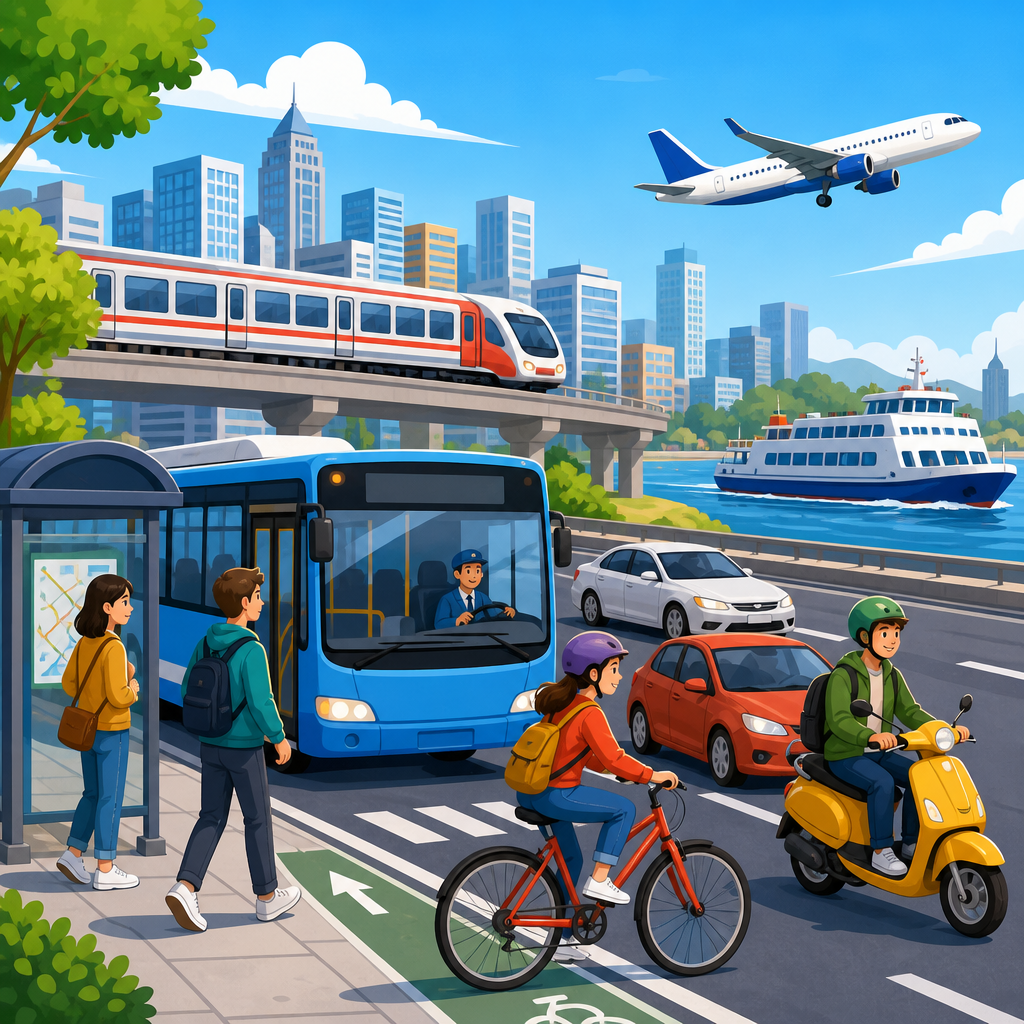
English vocabulary for transportation and commuting gives learners the words they need to describe how people move through daily life, from walking to the bus stop to catching a delayed train after work. In ESL teaching, this topic sits inside daily life vocabulary because travel to school, work, shops, and appointments happens almost every day. I have taught this unit to beginner and intermediate learners many times, and the same pattern appears in every class: students may know isolated words like car or bus, but they struggle when they need fuller language such as commute, transfer, rush hour, platform, fare, route, or traffic jam. Building this vocabulary matters because it supports speaking, listening, reading signs, asking for help, understanding announcements, and handling real situations with confidence.
Transportation vocabulary includes the names of vehicles, places, tickets, actions, problems, and directions related to travel. Commuting vocabulary focuses more narrowly on regular travel between home and work or school. The difference is useful. A learner might use transportation English on vacation, but commuting English is essential for routine life in an English-speaking city. When learners can say, “I take the subway, then transfer to a bus,” or “My commute takes forty minutes because of congestion,” they move beyond survival English and start communicating naturally. This article serves as a hub for daily life vocabulary by organizing the most important transportation and commuting terms into practical groups, showing how they are used, and explaining the context that native speakers expect.
Just as important, transportation vocabulary changes by region. In the United States, people often say subway, truck, and gas station. In the United Kingdom, common choices are underground, lorry, and petrol station. A train station may also be called a railway station. These differences can confuse learners unless they see vocabulary in clear categories. The goal is not to memorize random lists. The goal is to build a flexible word bank that helps with common daily tasks: buying a ticket, reading a timetable, asking which platform to use, explaining why you are late, or discussing whether it is better to drive, cycle, or take public transit. Once learners master this core language, they can connect it to related daily life topics such as time, directions, jobs, neighborhood places, and travel planning.
Core transportation words every learner needs
The first layer of English vocabulary for transportation and commuting is the names of transport types. Learners should know private transportation words such as car, motorcycle, scooter, bicycle, and van, along with public transportation words such as bus, train, subway, tram, ferry, and taxi. In many cities, ride-share is also common, so words like driver, app, pickup point, and drop-off point are now practical daily vocabulary. Walking also belongs in this topic. Many learners forget that on foot, pedestrian, sidewalk, crosswalk, and intersection are all essential words because commuting often includes short walking stages before and after a ride.
Verbs are equally important. Students often know the noun bus but not the verb patterns around it. In real speech, people say take the bus, catch the train, miss the bus, board the plane, get on the bus, get off the train, drive to work, cycle to school, and walk home. The distinction between get in and get on matters. Native speakers usually say get in a car or taxi, but get on a bus, train, plane, bike, or subway. This small grammar pattern appears constantly in spoken English. When learners internalize it, their speech becomes more accurate immediately.
Another core set includes route words: stop, station, terminal, platform, gate, line, route, lane, exit, entrance, and transfer. These terms let learners understand movement through a transport system. For example, in a subway system, a rider may enter through the main entrance, buy a fare card, wait on the platform, and transfer to another line downtown. In bus travel, stop and route are often more useful than platform or gate. Teaching vocabulary in these practical clusters helps learners remember meaning through use rather than through translation alone.
Vocabulary for commuting routines and schedules
Commuting language becomes more useful when learners can describe routine. The central noun is commute, meaning the regular trip between home and work or school. The common collocations are long commute, daily commute, morning commute, and return commute. People also say commuter for a person who travels this way regularly. In office English, “My commute is about an hour each way” is a standard sentence pattern. Each way means the duration in one direction, not for the full round trip. That phrase appears frequently in real conversation, job interviews, and workplace small talk.
Time vocabulary is closely connected to commuting. Learners need schedule, timetable, departure, arrival, delay, cancellation, frequency, on time, early, late, peak hours, and rush hour. Rush hour refers to the busiest travel times, usually early morning and late afternoon on weekdays. Peak hours is similar, though it is often used in transport notices and pricing. For example, some rail systems charge off-peak fares outside the busiest times. In class, I have found that learners quickly understand delay and cancel, but they need repeated exposure to departure and arrival because those words appear more often on signs and announcements than in casual speech.
Adverbs and prepositions also shape commuting English. People say I leave at 7:30, arrive by 8:15, change trains at Central Station, and get to work before nine. The phrasal verb set off appears in formal or written English, while head to is common in conversation. A commuter may say, “I head to the station at six thirty.” These are high-value expressions because they combine time, movement, and purpose in one natural phrase. Learners who can describe a routine commute clearly are better prepared for conversations about lifestyle, housing, punctuality, and work arrangements.
Public transportation vocabulary in real situations
Public transportation requires a distinct vocabulary set because systems have rules, payment methods, and passenger information. Essential payment words include fare, ticket, pass, card, single, return, monthly pass, top up, and contactless payment. In London, for instance, riders often top up a travel card or tap a bank card at the gate. In New York, riders may use a contactless payment system at subway turnstiles. Learners should also know conductor, driver, inspector, and attendant, though the exact role varies by system. A bus driver sells or checks fares in some places, while a conductor may assist passengers on a train.
Announcements add another challenge. Common phrases include “The next stop is…,” “Please stand clear of the doors,” “This service is delayed,” and “Track change.” These messages are formulaic, so learners benefit from hearing and repeating them as fixed expressions. Safety vocabulary is also necessary: mind the gap, emergency exit, priority seating, and no smoking. Priority seating refers to seats reserved for elderly passengers, pregnant riders, or people with disabilities. Understanding these words is part of functional language use, not just vocabulary growth.
| Situation | Useful vocabulary | Example sentence |
|---|---|---|
| Buying a ticket | fare, single, return, pass, top up | I need a return ticket to the city center. |
| Waiting for transport | platform, stop, gate, delayed, on time | The train on platform 4 is delayed by ten minutes. |
| Changing routes | transfer, line, route, terminal | You need to transfer to the green line at the next station. |
| Asking for help | direction, entrance, exit, timetable | Excuse me, where is the entrance for the bus terminal? |
One common learner mistake is confusing station and stop. A station is a larger facility for trains, subways, or sometimes buses, while a stop is usually a simpler place where a bus or tram picks up passengers. Another common issue is the word line. In transportation, line means a service route, as in the red line. In everyday American English, line can also mean a queue, while British English usually prefers queue for people waiting. These small distinctions matter because transport English is full of compact, high-frequency words with multiple meanings.
Driving, traffic, and road vocabulary
Not all commuting happens on public transit. Many learners need English for driving, traffic reports, and road conditions. The foundation vocabulary includes road, street, avenue, highway, freeway, motorway, lane, intersection, roundabout, bridge, tunnel, exit, and parking lot. Regional differences matter here too. Americans usually say parking lot and freeway, while British speakers often say car park and motorway. Learners who consume international media should know both forms because maps, job discussions, and local conversations may use either one.
Traffic vocabulary becomes important very quickly in daily conversation. Common terms include traffic jam, congestion, bumper-to-bumper traffic, roadwork, detour, accident, breakdown, speed limit, and commute time. Congestion is especially useful because it appears in news reports, city planning documents, and workplace conversations. Someone might say, “There is heavy congestion on the ring road,” or “My commute has improved since the city opened a new bus lane.” A breakdown refers to a vehicle that stops working. A detour is an alternative route used when a usual road is closed.
Practical action verbs include park, reverse, overtake, brake, accelerate, signal, merge, and yield. In North American English, gas and gas station are standard, while petrol and petrol station are common in British English. For learner confidence, it is worth pairing nouns with actions: fill up at a gas station, pull over on the shoulder, turn at the intersection, and merge into traffic. These combinations sound natural because native speakers store vocabulary in chunks, not as isolated single words. That is why effective daily life vocabulary study always emphasizes collocations and common sentence frames.
Problems, delays, and useful commuter phrases
Real commuting is rarely perfect, so learners need language for disruptions. The most useful problem words are late, delayed, canceled, crowded, packed, stuck, closed, suspended, and rerouted. The nuance matters. A delayed train will still come later; a canceled train will not come at all. A suspended service is temporarily stopped, often because of weather, technical issues, or strikes. Rerouted means the vehicle is using a different path than usual. In many cities, these words appear in station announcements, app alerts, and customer service messages every day.
Commuters also need survival phrases that solve immediate problems. Examples include: “Is this seat taken?” “Does this bus go downtown?” “Where do I change for the airport?” “How much is the fare?” “Can I pay by card?” and “What time is the last train?” These are not tourist-only questions. Workers, students, and new residents use them constantly. Another practical set involves explaining delays: “I’m running late,” “My train was canceled,” “There was a lot of traffic,” and “I missed my connection.” In professional life, these short explanations are often enough, and they sound more natural than overly detailed stories.
Weather is another source of commuting vocabulary. Rain, fog, snow, ice, flooding, and strong winds all affect transport systems. A commuter may say, “Buses are running slowly because of ice,” or “The ferry service is suspended due to high winds.” The phrase due to appears regularly in formal notices. In conversation, because of is more common. Learners who recognize both forms can understand official messages and everyday speech without confusion.
How to learn and retain transportation vocabulary
The fastest way to learn English vocabulary for transportation and commuting is to study it through routines, maps, and real tasks. I recommend grouping words into five categories: vehicles, places, actions, time words, and problems. Then build mini-dialogues around them. For example, a learner can practice: “I walk to the bus stop, catch the 8:10 bus, and arrive at the office at 8:45.” This method develops speaking fluency because it mirrors real sequences. It also improves listening because the same vocabulary appears in announcements, podcasts, and workplace conversations.
Use authentic materials whenever possible. Transit maps, timetable apps, Google Maps directions, station photos, and recorded announcements are excellent study tools. Learners can compare the language in an app with the language they need to speak aloud. If an app says service disruption, they can practice saying, “There is a disruption on my line.” If a map shows transfer points, they can describe the route in full sentences. Spaced repetition tools such as Anki or Quizlet help with memory, but the cards should contain phrases, not just single words. “Miss the bus,” “heavy traffic,” and “monthly pass” are more useful than bus, traffic, and pass alone.
As a hub topic within daily life vocabulary, transportation and commuting should connect to related study areas. Learners benefit when they link this page with vocabulary for telling time, asking for directions, workplace English, city places, and travel emergencies. That network makes recall faster because the words appear in meaningful contexts. Mastering this vocabulary gives learners immediate independence: they can plan routes, understand delays, ask clear questions, and describe their routines naturally. Start by learning the terms you use every day, then add route words, problem phrases, and regional variations until commuting English feels automatic.
Frequently Asked Questions
What transportation and commuting vocabulary should English learners study first?
English learners should begin with the most common words they will hear and use in everyday life. Start with basic transportation nouns such as bus, train, car, taxi, subway, bicycle, motorcycle, and truck. Then add simple movement verbs like walk, drive, ride, take, catch, get on, and get off. These words help learners describe how they go to work, school, or other regular destinations. For example, a beginner can quickly build useful sentences such as “I take the bus to work,” “She walks to school,” or “We got off the train at the next station.”
After that, learners should study important commuting places and objects, including bus stop, station, platform, ticket, fare, schedule, route, traffic, and intersection. These words appear in real conversations, travel signs, and public announcements. They also help learners ask for and understand directions. Once students know these core terms, it becomes much easier to expand into more specific vocabulary such as rush hour, delay, transfer, commuter, and carpool. In practice, the best first vocabulary is not the most advanced vocabulary. It is the language that learners can use immediately in daily routines.
What is the difference between common transportation verbs like “go,” “take,” “ride,” “drive,” and “catch”?
These verbs are all common in commuting English, but they are used in different ways. Go is the most general verb. It focuses on movement from one place to another, as in “I go to work by train.” Take is used when someone uses a form of transportation, especially public transportation: “I take the bus every morning.” Ride is often used for bicycles, motorcycles, horses, and also buses or trains in some contexts: “She rides her bike to school” or “We rode the subway downtown.” Drive is used when a person controls a car, bus, or other vehicle: “He drives to the office.” Catch is commonly used when someone reaches transportation in time, especially a bus, train, or flight: “Hurry up or we’ll miss the train,” or “I caught the 8:15 bus.”
This is an area where learners often make mistakes because one verb may cover several meanings in their first language. A very useful teaching pattern is to connect each verb to a typical sentence frame. For example: “I go to work by ___,” “I take the ___,” “I ride my ___,” “I drive a ___,” and “I catch the ___ at 7:30.” It is also helpful to teach contrast. You drive a car, but you usually take a bus. You can ride a bike, but you do not usually say ride a car in normal commuting English. Learners who practice these verbs in realistic daily-life sentences usually become more accurate much faster than learners who only memorize word lists.
How can learners talk about daily commuting problems in natural English?
To talk about commuting problems naturally, learners need vocabulary for delays, timing, traffic, and inconvenience. Some of the most useful expressions include traffic jam, delayed, cancelled, crowded, late, missed the bus, broke down, road construction, and rush hour. These words help learners explain common situations clearly. For example: “The train was delayed,” “My bus was crowded this morning,” “There was a traffic jam on the highway,” or “I missed my stop because I was tired.” This type of language is especially important because commuting problems are a regular topic in casual conversation, workplace talk, and daily explanations.
Natural English also depends on using complete, realistic phrases instead of isolated words. A learner may know the word delay, but it is much more useful to be able to say, “There was a 20-minute delay on the subway,” or “My commute took longer than usual because of traffic.” Other strong examples include “The bus never came,” “I had to transfer to another line,” “My car wouldn’t start,” and “The station was packed during rush hour.” These sentence patterns give learners confidence in real communication. They can use them to explain why they are late, describe their day, or understand what other people say about transportation problems.
What words and phrases are most useful for using public transportation in English-speaking environments?
When using public transportation, learners should know the vocabulary needed to buy tickets, find the right route, and understand instructions. Essential words include ticket, pass, one-way, round-trip, fare, line, route, schedule, platform, stop, station, transfer, and terminal. Learners should also understand simple public questions such as “Where can I buy a ticket?” “Does this bus go downtown?” “Which platform do I need?” and “Do I need to transfer?” These are high-value phrases because they can be used immediately in real-world situations.
It is also important to learn the language of public announcements and signs. Common expressions include next stop, final destination, now boarding, service delay, track change, and stand clear of the doors. In conversation, learners should practice short interaction patterns such as “Excuse me, is this seat taken?” “How many stops until Central Station?” and “What time is the last train?” These phrases are practical, polite, and easy to reuse. In my experience, students become much more comfortable with public transportation once they move beyond single vocabulary items and start practicing these complete, situation-based expressions.
What is the best way to learn and remember English vocabulary for transportation and commuting?
The most effective way to learn transportation and commuting vocabulary is to study it in meaningful groups and use it in real-life contexts. Instead of memorizing random lists, learners should organize words by category: types of transportation, places, verbs, problems, and travel phrases. For example, one study set might include bus, bus stop, take the bus, miss the bus, and bus fare. Another could include train, platform, schedule, delayed, and transfer. This grouping method helps the brain connect words naturally, which improves recall and speaking fluency.
Learners also remember vocabulary better when they use it actively. A strong practice routine includes speaking about a real commute, writing short daily examples, listening to transportation announcements, and role-playing common situations. For instance, a learner can describe a normal weekday: “I leave home at 7:00, walk to the bus stop, take the number 12 bus, and arrive at work at 7:45.” That kind of personal practice is much more powerful than repeating words without context. Repetition matters, but meaningful repetition matters more. When students hear, say, read, and write transportation vocabulary in realistic daily patterns, they stop seeing the words as isolated items and start using them as part of natural English communication.