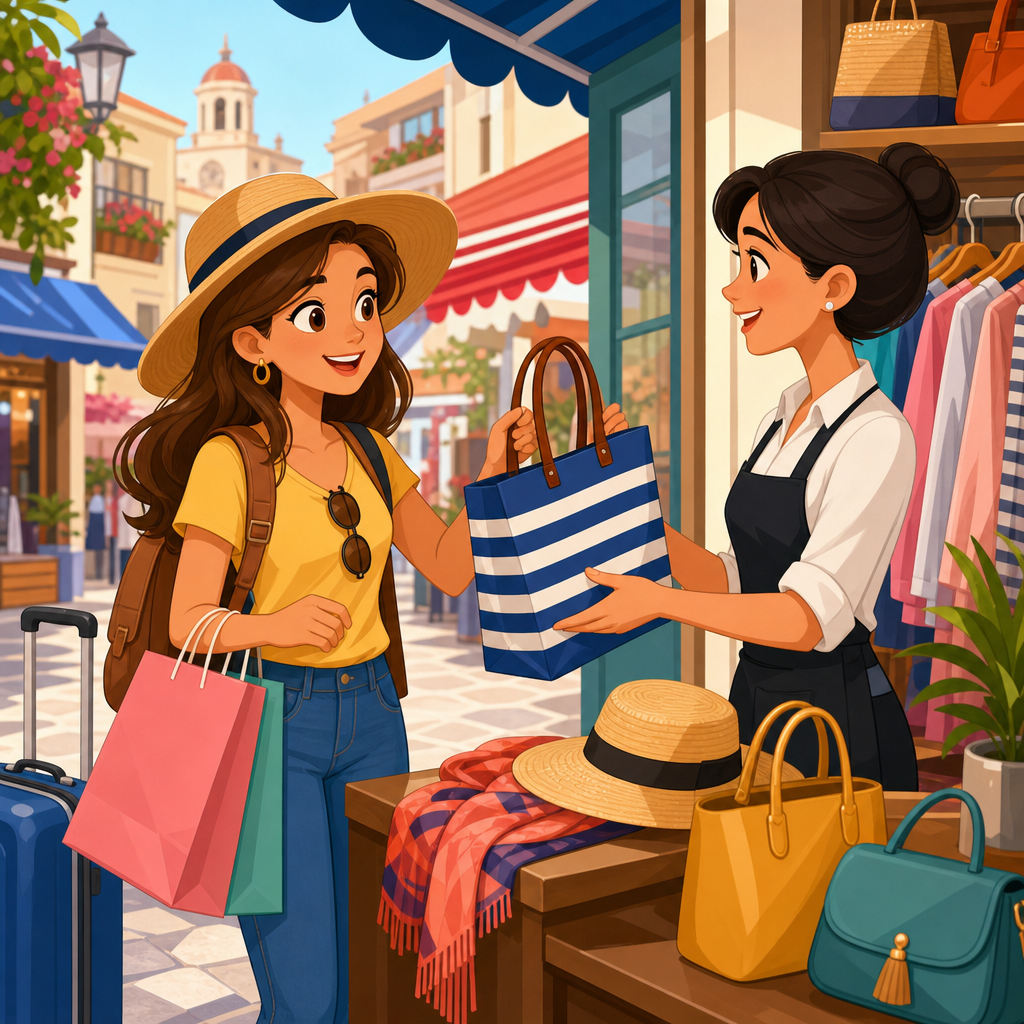
English for shopping while traveling is one of the most practical parts of English for travel because it combines everyday conversation, money, directions, problem-solving, and cultural awareness in situations that happen almost every day on a trip. For English learners, shopping is not only about buying souvenirs or necessities; it is often the moment when language becomes immediately useful, whether you are asking for a size in London, comparing prices in Singapore, confirming a return policy in New York, or understanding a street market negotiation in Marrakech. In this hub article, I will cover the core English you need for shopping abroad, explain the difference between formal and casual retail language, and show how shopping vocabulary connects to the wider English for travel topic.
Shopping English includes the words, phrases, listening skills, and social habits used when you enter stores, browse products, ask for help, pay, and deal with problems after a purchase. It matters because retail interactions happen in airports, pharmacies, clothing stores, supermarkets, convenience shops, department stores, local markets, and hotel gift shops. In my experience teaching travelers and preparing adults for international trips, shopping scenarios consistently reveal the same needs: understanding prices, asking precise questions, clarifying product details, and responding politely under time pressure. A traveler who can say, “I’m just looking, thank you,” “Do you have this in a medium?” and “Could I get a receipt, please?” avoids confusion and sounds confident immediately.
This article serves as a hub for English for travel by organizing shopping language into clear subtopics you can build on later: store navigation, clothing and sizes, food shopping, payment, bargaining, returns, and safety. If you are studying English for specific goals, shopping is a high-value subtopic because it reinforces countable and uncountable nouns, polite requests, numbers, currency, comparatives, conditionals, and common service encounters. It also prepares you for related travel situations such as eating out, checking into hotels, using transportation, and handling emergencies. Master shopping English first, and many other travel conversations become easier.
Essential Shopping English for Travelers
The foundation of shopping English is knowing how to start, continue, and end a retail conversation naturally. In many English-speaking stores, staff open with phrases like “Can I help you?” “Are you looking for anything in particular?” or “Let me know if you need anything.” The safest responses are simple and direct: “I’m just looking, thanks,” “Yes, I’m looking for a phone charger,” or “Do you sell travel adapters?” These short exchanges matter because they set the tone. If your first answer is clear, the rest of the interaction usually becomes smoother.
Travelers should learn product vocabulary by category rather than as one long list. In clothing stores, common words include size, fitting room, sleeve, waist, refund, exchange, receipt, and sale. In supermarkets, you need aisle, basket, trolley, checkout, dairy, frozen food, expiry date, and ingredients. In pharmacies, essential terms include prescription, pain relief, allergy medicine, cold medicine, and dosage. I always advise learners to prepare the vocabulary that matches their trip. Someone backpacking through Europe may need laundromat and prepaid SIM card, while a family visiting the United States may need stroller, sunscreen, snacks, and over-the-counter medicine.
Numbers are especially important in shopping situations. You need to understand prices, discounts, weights, quantities, and dates. Many misunderstandings come from listening, not speaking. For example, learners may confuse fifteen and fifty, or hear “three for two” without recognizing it as a promotion. Retail English also uses fixed phrases such as “buy one, get one free,” “cash only,” “final sale,” and “out of stock.” If you learn these chunks as complete units, you process them faster in real life. That is why strong shopping English depends as much on listening patterns as on vocabulary lists.
Navigating Different Types of Stores and Markets
Shopping while traveling changes depending on where you are. A chain pharmacy, a luxury department store, and a street market all use different styles of English. In a supermarket or department store, interactions are usually predictable. Signs guide you to sections, prices are fixed, and staff can answer direct questions such as “Where can I find bottled water?” or “Is there a tax-free counter here?” In open-air markets, the language is often faster, more informal, and sometimes negotiable. You may hear “Special price for you,” “Cash only,” or “How many would you like?”
Understanding store layout language saves time. Useful phrases include “Where is the checkout?” “Is there an ATM nearby?” “Do you have this on the second floor?” and “Which aisle is the baby food in?” In large stores, staff may answer with directional language: “It’s at the back,” “Take the escalator up one level,” or “It’s next to home goods.” These phrases overlap directly with general travel English because they train you to follow spoken directions accurately. This is one reason shopping is an effective hub topic: it naturally connects retail vocabulary with movement, location, and public interaction.
Travelers should also recognize the difference between browsing language and buying language. Browsing language is exploratory: “I’m comparing prices,” “I’m looking for something lightweight,” and “Do you have other colors?” Buying language is decisive: “I’ll take this one,” “Can I pay by card?” and “Could you gift-wrap it?” In tourist areas, staff may speak quickly because they handle international customers all day. If you miss something, ask for repetition directly: “Sorry, could you say that again more slowly?” This is better than pretending to understand and making an expensive mistake.
Useful Phrases for Common Shopping Situations
Most travel shopping situations fall into a small number of repeatable patterns. If you can master these patterns, you can handle most stores confidently. For asking about products, use: “Do you have this in a different size?” “Is this available in black?” “What’s the difference between these two?” and “Which one is better for travel?” For checking details, use: “Is this waterproof?” “Does it come with a charger?” “How long does it last?” or “Is it safe for children?” Good shopping English is specific. The more exact your question, the more useful the answer.
When trying on or inspecting items, practical phrases include “Can I try this on?” “Where are the fitting rooms?” “This is too tight around the shoulders,” and “Do you have a larger size?” Clothing shopping often creates stress because sizing systems differ by country. A US size 8, a UK size 12, and a European size 40 are not intuitive for most travelers. Staff may also use terms like slim fit, regular fit, true to size, or oversized. If you are unsure, ask for measurement-based help: “What waist measurement is a medium?” That question is clearer than relying only on labels.
For food and daily necessities, clear questions prevent waste and health problems. You may need to ask, “Does this contain nuts?” “Is this vegetarian?” “Is this bottled water still?” “How much is this per kilo?” or “What time does the store close?” Travelers with medical or dietary needs should prepare exact wording before the trip. I have seen learners avoid simple but important questions because they feared sounding impolite. In retail settings, direct and polite is the standard. Staff usually prefer a clear question over vague language.
Paying, Receipts, Refunds, and Consumer Protection
Payment English is essential because the final stage of a purchase is where misunderstandings become expensive. The key phrases are “Can I pay by card?” “Do you accept contactless payment?” “Could I have a receipt, please?” “Is tax included?” and “Can you break a large bill?” In some countries, the displayed price includes tax; in others, sales tax is added at checkout. Travelers in the United States often notice this immediately because shelf prices and final prices differ. In the United Kingdom and much of Europe, displayed consumer prices are usually tax-inclusive. Knowing this prevents confusion when you compare totals.
Refund and exchange language is equally important. Before buying, ask “What is your return policy?” “Can I exchange this if the size is wrong?” or “Is this a final sale item?” The words refund, exchange, store credit, defective, unopened, and proof of purchase appear often. Consumer rights also vary widely. European Union consumer law gives strong protection for many purchases, especially online, but in-store returns still depend partly on store policy. In the United States, return policies vary by retailer, with companies like Costco and Nordstrom historically known for flexible returns, while discount outlets often restrict them. Do not assume the same rules apply everywhere.
| Situation | Useful English | Why It Matters |
|---|---|---|
| Paying by card | “Do you accept Visa or Mastercard?” | Some shops take only local cards or cash |
| Checking tax | “Is tax included in the price?” | Prevents surprise at checkout |
| Asking for a receipt | “Could I get an itemized receipt?” | Needed for returns, expenses, or customs |
| Requesting an exchange | “Can I exchange this for a different size?” | Useful when sizing systems differ |
| Reporting a problem | “This item is damaged. What can you do?” | Direct language speeds resolution |
Tax-free shopping is another important topic for international travelers. In some destinations, non-residents can claim a refund on value-added tax if they meet spending thresholds and complete paperwork correctly. The process usually requires your passport, receipts, and forms stamped before departure. The English you need includes “Do you offer tax-free shopping?” “Where do I get the customs stamp?” and “Which documents do I need at the airport?” This is a good example of why shopping English extends beyond the store itself into airports, customs, and travel planning.
Bargaining, Culture, and Politeness Across Countries
One of the biggest mistakes travelers make is using the same shopping behavior everywhere. In fixed-price stores, bargaining is inappropriate. In some markets, it is expected. Good shopping English includes not only words but social judgment. In London, Toronto, Sydney, or most branded retail chains worldwide, the normal pattern is fixed pricing. In many street markets in Asia, North Africa, Latin America, and parts of the Middle East, negotiation may be part of the transaction. The right English phrases are “Is that your best price?” “Could you do any better?” “If I buy two, can you give me a discount?” and “That’s more than I wanted to spend.”
Politeness matters because retail English is shaped by tone as much as grammar. “I want this” is understandable, but “I’d like this one, please” is better. “Too expensive” can sound blunt, while “That’s a bit above my budget” sounds cooperative. I have coached many travelers who knew enough vocabulary but created friction because they translated directly from their first language. English retail culture often values softening language with could, would, a bit, and please. These small changes make interactions smoother without making you sound weak or uncertain.
Culture also affects small talk, personal space, and decision speed. In some countries, staff will follow up often; in others, they will give you space. In tourist markets, sellers may use strong sales language. You do not need a complex response. A calm “No, thank you, I’m just looking” works almost everywhere. If pressure continues, repeat it and walk away. That is not rude; it is efficient. Confident shopping English helps you stay polite while protecting your budget and boundaries.
How to Practice Shopping English Before Your Trip
The best way to improve shopping English is to rehearse real interactions, not memorize isolated words. Start with role-plays: entering a store, asking about a product, checking the price, paying, and solving a problem. Use actual travel items such as adapters, rain jackets, medicine, or train snacks. Record yourself asking ten common questions and listen for speed, pronunciation, and clarity. Tools like Google Translate, DeepL, YouGlish, and the Cambridge Dictionary can help with pronunciation and usage, but they should support practice, not replace it.
Next, build a personal shopping phrase bank based on your trip. Create categories for clothing, food, pharmacy, souvenirs, electronics, and payment. Add three questions and three likely answers for each category. Then practice listening with authentic material such as store walkthrough videos, airport shopping clips, or supermarket vlogs from your destination. This exposes you to accents, background noise, and natural speech rate. In class, I often simulate a busy checkout line because learners need to process English under mild pressure, not only in quiet study conditions.
Finally, connect shopping English to the rest of your travel preparation. Review numbers, currency, directions, sizes, food labels, and polite requests together instead of treating them as separate topics. Shopping is a hub skill within English for travel because it integrates vocabulary, grammar, listening, and culture in a form you can practice almost anywhere, even at home. Visit a local store, switch your phone language to English, read product labels, and ask yourself the questions you would ask abroad. Consistent practice turns memorized phrases into usable travel English.
English for shopping while traveling gives you much more than the ability to buy things. It teaches you how to ask clear questions, understand real-world answers, compare options, solve problems, and interact politely in unfamiliar places. Those are core travel skills, which is why shopping belongs at the center of any serious English for travel study plan. When you can navigate a supermarket, clothing store, pharmacy, market, or airport shop confidently, you also become better prepared for restaurants, hotels, transportation counters, and service desks.
The key takeaways are straightforward. Learn high-frequency shopping phrases in complete chunks. Practice numbers, prices, sizes, and payment language until they feel automatic. Understand the differences between fixed-price stores and bargaining environments. Ask directly about returns, tax, ingredients, and product details. Most importantly, adapt your English to the situation: simple for quick purchases, specific for technical questions, and polite when you need help. Effective shopping English is not about sounding advanced; it is about being clear, accurate, and comfortable.
Use this hub as your starting point for English for travel, then continue into focused practice on food shopping, clothing and sizes, pharmacy English, bargaining, and payment problems. If you are preparing for a trip, choose five shopping situations you are likely to face and rehearse them today. That small step will make your next journey easier, cheaper, and far less stressful.
Frequently Asked Questions
1. What are the most useful English phrases for shopping while traveling?
The most useful shopping phrases are the ones that help you ask clear, polite, everyday questions. In most travel situations, you will need English for four main tasks: finding an item, checking the price, asking about size or color, and paying. Helpful phrases include, “How much is this?”, “Do you have this in a different size?”, “Can I try this on?”, “Where can I find ___?”, “Is this on sale?”, and “Can I pay by card?” If you are shopping for food or essentials, you may also need phrases like, “Is this fresh?”, “What do you recommend?”, or “Do you have anything cheaper?” These simple questions are easy to remember and work in many countries where English is used as a common language between travelers and shop staff.
It is also important to know polite expressions that make interactions smoother. Saying “Excuse me,” before a question and “Thank you” after the answer creates a better experience and often leads to more helpful service. If you do not understand something, you can say, “Could you say that again, please?” or “Sorry, I didn’t catch that.” When you are traveling, confidence matters more than perfect grammar. Even short, direct questions are effective if your meaning is clear. Learning a small set of practical shopping phrases before your trip can make buying clothes, groceries, medicine, gifts, or travel supplies much easier and less stressful.
2. How can I ask about prices, discounts, and payment methods in English?
When shopping abroad, understanding money-related English is essential because prices, taxes, and payment options can vary from country to country. The most direct question is, “How much is this?” If you are comparing products, you can ask, “What’s the price of this one?” or “Which one is cheaper?” In places where bargaining is common, you might ask, “Is this the best price?” or “Can you give me a discount?” In fixed-price stores, discount questions may sound more natural as, “Is this item on sale?” or “Do you have any promotions today?” These phrases help you communicate clearly without sounding rude.
Payment is another key area. Useful questions include, “Can I pay by card?”, “Do you accept cash only?”, “Do you take contactless payment?”, and “Can I get a receipt, please?” In some destinations, taxes may not be included in the displayed price, so it can help to ask, “Is tax included?” If you are worried about exchange rates or tourist pricing, you can say, “What currency is this in?” or “Can you show me the final total?” Asking these questions protects you from confusion and helps you stay within your budget. For English learners, practicing money vocabulary such as total, change, receipt, discount, sale, refund, and cash register can make shopping conversations much easier to follow.
3. What should I say if I need help finding the right size, color, or product?
Shopping for clothing, shoes, cosmetics, or electronics while traveling often requires more specific vocabulary, especially when you need help choosing the right item. If you are looking for clothing, common questions include, “Do you have this in a medium?”, “Do you have a larger size?”, “Can I try this on?”, and “Where is the fitting room?” If you want another option, you can ask, “Do you have this in black?” or “Do you have a different color?” For shoes, you might say, “Do you have these in size 39?” or “These are too small. Do you have a bigger size?” These are some of the most practical English expressions for travelers because they are useful in department stores, markets, malls, and small local shops.
If you are not shopping for clothes, the same structure still works. You can ask, “Do you have this brand?”, “I’m looking for a phone charger,” “Which one is better for travel?”, or “Can you recommend something similar?” In supermarkets or pharmacies, you may need to say, “I need something for a headache,” or “Where can I find shampoo?” The key is to combine simple product words with clear question patterns. If you do not know the name of an item, pointing and saying, “I’m looking for something like this,” can be very effective. English for shopping is often about being flexible and using simple language creatively, not about speaking in long, perfect sentences.
4. How do I handle problems such as returns, damaged items, or misunderstandings in a store?
Problems can happen in any country, so it is very helpful to know the English you need for returns, exchanges, and complaints. If something is wrong with a product, you can say, “This item is damaged,” “I bought this today, but it doesn’t work,” or “There is a problem with this.” If you want to return or exchange something, useful questions include, “Can I return this?”, “Can I exchange this for another size?”, and “What is your return policy?” These phrases are especially important when buying clothes, electronics, or souvenirs that may have quality issues. If you have a receipt, showing it and saying, “Here is my receipt,” can make the process much smoother.
Misunderstandings are also common, especially when accents, pricing systems, or store rules are unfamiliar. If you are confused, say, “Could you explain that, please?” or “I thought this was a different price.” If the issue is about payment, you might say, “I think I was charged twice,” or “Can you check the total again?” Staying calm and polite usually gets better results than sounding angry. In international travel, many store employees are used to helping non-native speakers, so simple, respectful English works well. It is also wise to ask about store policies before buying expensive items, especially by saying, “Can I return this if it doesn’t fit?” or “Is there a warranty?” That small question can save time, money, and frustration later.
5. Why is learning shopping English so important for travelers, and how can I improve quickly?
Learning English for shopping while traveling is important because shopping is not just about buying things; it is one of the most common real-life situations where language becomes immediately useful. On a trip, you may need to buy water, food, medicine, clothes, transport cards, electronics, gifts, or emergency items. In each of these situations, you are using more than just shopping vocabulary. You are also using numbers, money, directions, social manners, and problem-solving language. That is why shopping English is such a practical part of travel English. It teaches you how to interact naturally in daily life, and it often gives you confidence that carries over into restaurants, hotels, airports, and public transportation.
If you want to improve quickly, focus on short phrases you can use immediately instead of trying to memorize long dialogues. Practice essential questions such as “How much is this?”, “Do you have this in my size?”, “Can I pay by card?”, and “Can I return this?” Listen to how these phrases sound, say them out loud, and use them in role-play before your trip. You can also study common shopping signs like sale, out of stock, fitting room, cashier, refund, and exchange. Watching travel videos, reading store websites in English, and practicing with a friend can help you build confidence fast. The goal is not to sound perfect. The goal is to communicate clearly, solve everyday problems, and feel comfortable shopping wherever you travel.