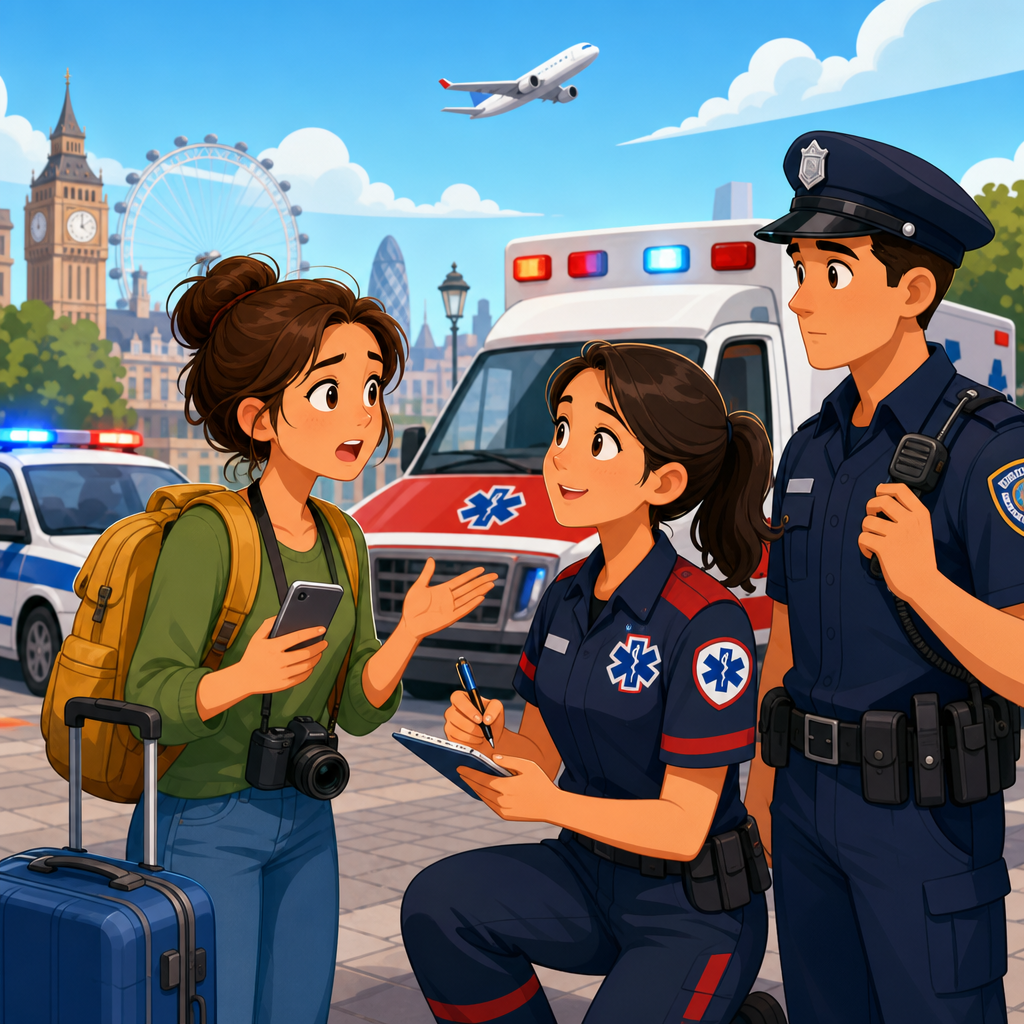
Travel emergencies feel overwhelming because they combine stress, unfamiliar systems, and the pressure to communicate clearly in a second language. English often becomes the shared language in airports, hotels, train stations, hospitals, police desks, and insurance hotlines, even when you are not in an English-speaking country. That is why learning how to handle emergencies in English while traveling is not just useful vocabulary practice; it is a practical safety skill. I have worked with adult English learners preparing for international trips, and the biggest improvement never comes from memorizing long word lists. It comes from knowing what to say first, what details to give, and how to ask for help in simple, direct sentences.
In travel contexts, an emergency is any situation that requires urgent assistance, fast decision-making, or official reporting. Common examples include medical problems, lost passports, stolen bags, missed connections, road accidents, natural disasters, hotel safety issues, and getting lost without phone service. Travel English for emergencies focuses on high-frequency phrases, listening for key questions, and understanding the process used by frontline staff. You do not need perfect grammar to succeed. You need functional communication: state the problem, give your location, identify yourself, describe urgency, and confirm the next step. That pattern works across most emergency situations.
This article is the hub for English for Travel within a broader practical ESL pathway, so it covers the core language and decision framework that supports more specific lessons on airports, hotels, transportation, restaurants, sightseeing, and business trips. If you can manage emergencies confidently, your general travel English becomes stronger too. You learn to ask clear questions, understand instructions, and stay calm when plans change. Those abilities matter whether you are speaking to a paramedic, a taxi driver, a hotel receptionist, or an embassy officer. The goal is not advanced fluency. The goal is being understood quickly when it matters most.
A useful principle is this: in emergencies, shorter English is better English. Native speakers in urgent situations also simplify their language. Instead of long explanations, say, “I need a doctor,” “My passport was stolen,” “I’m allergic to peanuts,” or “I can’t find my child.” These sentences are direct, easy to pronounce, and hard to misunderstand. Then add details in order: who, what, where, when, and what help you need. This structure reduces panic, helps the other person take action, and gives you a reliable communication routine you can use anywhere.
The Core Emergency English You Need First
The fastest way to improve emergency travel English is to master a small set of phrases that work in many settings. Start with alert phrases: “Help, please,” “This is an emergency,” “Please call the police,” “Please call an ambulance,” and “I need a doctor.” Then learn information phrases: “My name is…,” “I am staying at…,” “I am at the train station,” “I lost my phone,” “My bag was stolen,” and “I do not understand. Please speak slowly.” In real incidents, these basic lines do more work than complicated language because they trigger action.
Location language is especially important. If you can say where you are, responders can find you and staff can direct you correctly. Practice saying addresses, landmarks, room numbers, flight numbers, platform numbers, and nearby shops or stations. For example: “I am outside Terminal 2 near the taxi stand,” or “I’m in Room 814 at the City Central Hotel.” On guided trips, I tell learners to save hotel details in both the local language and English on their phone and on paper. If your battery dies, a printed card can still help a driver or police officer assist you.
Pronunciation matters most with numbers, names, and medical terms. If you say your passport number, date of birth, allergy, or medication unclearly, delays follow. Practice common numbers slowly: fifteen versus fifty, thirteen versus thirty, and room numbers like eight-oh-four. The NATO phonetic alphabet can also help with names and booking codes. Saying “B as in Bravo, M as in Mike” is standard in aviation and customer service. Travelers do not need to memorize the entire system, but knowing a few letter clarifiers prevents mistakes with surnames, addresses, and reservation references.
Another essential skill is repair language, meaning phrases that fix communication problems. Use “Can you repeat that?” “Please write it down,” “Can you show me on the map?” “What does that mean?” and “Did you say gate fifteen or fifty?” These are not minor phrases; they are safety tools. In emergency travel English, misunderstanding is often more dangerous than limited vocabulary. People usually want to help, but they need permission to slow down or change how they speak. Asking directly creates that opening and keeps the conversation useful.
Medical Emergencies: What to Say and What Staff Will Ask
Medical situations are the most important area of travel emergency language because they can escalate quickly. If someone is seriously ill or injured, the first message should be simple and urgent: “I need an ambulance,” “My friend is unconscious,” “She is having trouble breathing,” or “I think he broke his leg.” Those statements immediately communicate severity. Avoid long background stories at the start. Emergency operators, hotel staff, or bystanders first need the medical problem and the location. After that, they will ask follow-up questions about age, symptoms, consciousness, allergies, and medication.
Travelers should prepare a short medical profile in English before departure. Include allergies, regular medication, chronic conditions, blood type if known, and emergency contacts. I strongly recommend carrying this in your wallet and phone. The most useful phrases are: “I am allergic to penicillin,” “I have asthma,” “I have diabetes,” “I take blood pressure medication,” “I am pregnant,” and “I need an interpreter.” In clinics abroad, staff often use intake forms based on internationally recognized symptom language such as fever, rash, swelling, chest pain, vomiting, dizziness, and dehydration. Knowing these words saves time.
Healthcare workers commonly ask direct questions that travelers can practice in advance: “Where does it hurt?” “When did it start?” “How severe is the pain from one to ten?” “Do you have allergies?” “Are you taking any medication?” and “Have you eaten anything unusual?” A clear answer looks like this: “It started two hours ago. The pain is sharp and about eight out of ten. It is on the right side of my stomach.” That answer is much more useful than saying only, “I feel bad.” Specificity improves triage decisions and treatment speed.
Insurance language also appears quickly in medical emergencies. You may hear “travel insurance,” “coverage,” “claim,” “pre-authorization,” “out-of-pocket expense,” and “reimbursement.” If you need time, say, “This is my insurance card,” “Please tell me the cost before treatment if possible,” and “Can you give me a medical report for my insurer?” In many countries, even good hospitals require payment guarantees or identity documents. Keep digital and printed copies of your passport, policy number, and emergency contact information. English fluency helps, but organized documents often matter just as much when treatment starts.
Lost Passports, Theft, and Police Reports
Losing a passport or having property stolen is one of the most common serious travel disruptions. The key English phrases are straightforward: “My passport was lost,” “My passport was stolen,” “My wallet is missing,” “Someone took my bag,” and “I need to file a police report.” Use “lost” when you do not know where the item is and “stolen” when you believe someone took it. Officials treat these differently, and travel insurance companies often require exact wording in reports. If you are unsure, say, “I think it may have been stolen, but I am not certain.”
At a police station or airport desk, officers usually ask when and where the incident happened, what the item looks like, and what was inside it. Prepare to answer: “It happened on the subway around 6 p.m.,” “The suitcase is black, medium-sized, with a red tag,” or “The bag contained my passport, bank cards, and prescription medicine.” If your phone is stolen, also say, “Please note that my phone was in the bag,” because this affects identity security. Then contact your bank, mobile provider, and embassy or consulate as soon as possible.
Embassy communication requires another set of practical phrases: “I need an emergency travel document,” “My passport was stolen,” “I have a police report,” “My flight is on Friday,” and “What documents do you need from me?” Requirements vary by country, but many embassies ask for a report, passport photos, proof of identity, itinerary details, and fees. A photocopy of the lost passport speeds the process significantly. That is why experienced travelers keep encrypted cloud copies and paper copies stored separately from the original documents.
Travelers also need the language of fraud prevention after theft. Say, “Please block my cards,” “I need to freeze my account,” “There are unauthorized charges,” and “Can you email written confirmation?” If you used a hotel safe or airport locker, report that detail clearly because insurers may ask where valuables were stored. Accuracy matters. Do not exaggerate losses, and do not guess at timelines if you are unsure. In reports, precise facts are more credible than emotional explanations. Good emergency English is calm, factual, and chronological.
Transport Problems, Natural Disasters, and Staying Reachable
Transportation emergencies range from minor disruption to genuine danger. A delayed flight is inconvenient; a canceled flight after midnight in an unfamiliar city can become a safety issue. Essential phrases include “My flight was canceled,” “I missed my connection because of the delay,” “Where is the transfer desk?” “I need a safe place to stay tonight,” and “Can you rebook me on the next available flight?” Airlines use standard terms like boarding pass, itinerary, voucher, standby, gate change, baggage claim, and final call. Understanding them helps you move faster through crowded systems.
Ground travel brings different risks. On trains and buses, you may need to say, “I got on the wrong train,” “I left my bag on the bus,” “This stop is unsafe for me,” or “There has been an accident.” If you are in a taxi or rideshare and feel unsafe, direct language works best: “Please stop here,” “I want to get out,” “Take me to the police station,” or “I am sharing my location now.” Most safety guidance from major platforms emphasizes verifying the license plate, sharing trip details, and sitting in the rear seat when traveling alone.
Natural disasters and civil emergencies require listening for official instructions in English. Common words include evacuation, shelter, severe weather warning, aftershock, flood zone, curfew, emergency exit, and assembly point. If you do not understand announcements, ask immediately: “Is this an evacuation order?” “Where is the nearest shelter?” “Is it safe to stay here?” and “What should tourists do now?” Hotels, airports, and cruise operators usually have printed or digital emergency procedures. Read them when you arrive, not only after something goes wrong. Preparation reduces language pressure later.
| Situation | Best first sentence | Critical detail to add |
|---|---|---|
| Medical problem | I need an ambulance. | Exact location and main symptom |
| Lost passport | My passport was stolen. | When and where it happened |
| Flight disruption | My connection was missed بسبب delay. | Booking reference and destination |
| Unsafe taxi | Please stop here. I want to get out. | Vehicle number or app trip details |
| Natural disaster | Is this an evacuation order? | Nearest shelter or safe route |
Staying reachable is part of emergency communication, not a separate technical issue. Before any trip, set up roaming or an eSIM, save offline maps, download airline and rail apps, and store embassy, hotel, insurer, and emergency numbers. In Europe, 112 works across many countries; in the United States and Canada, 911 is standard; other destinations use different numbers. Do not assume your home emergency number works abroad. I advise travelers to keep a one-page emergency sheet in plain English with contacts, allergies, medications, and accommodation details. In a stressful moment, that sheet becomes your script.
How to Practice Travel Emergency English Before You Go
The best preparation method is scenario practice, not vocabulary cramming. Choose five high-risk situations for your itinerary and rehearse them aloud: illness, theft, missed flight, getting lost, and contacting your hotel late at night. Speak in full mini-dialogues, not isolated words. For example, one person asks, “What happened?” and you answer, “My wallet was stolen on the bus about twenty minutes ago. I need to cancel my cards and file a report.” This kind of role-play builds automaticity, which is what you need under stress when memory becomes less reliable.
Use authentic tools rather than only textbook exercises. Read airline disruption emails, embassy lost-passport pages, hospital intake forms, and travel insurance instructions. Listen to airport announcements on YouTube, practice speaking with voice notes, and check your pronunciation with speech tools in Google Translate or major dictionary apps. If you study with a teacher, ask for drills on numbers, addresses, medication names, and emergency questions. If you study alone, build a personal phrase bank in your notes app. Keep the sentences short, high-value, and directly connected to your actual trip plans.
Confidence comes from repetition and preparation, not from speaking perfect English. When emergencies happen, your task is simple: say the problem clearly, give the location, answer direct questions, and confirm the next step. That approach works in hospitals, police stations, airports, hotels, and on the street. As the hub page for English for Travel, this guide gives you the foundation for every related skill: asking for directions, handling check-in issues, talking to transport staff, managing restaurant allergies, and dealing with unexpected changes. Review these phrases before every trip, save them on your phone, and practice them aloud until they feel automatic. That small habit can make travel safer, calmer, and far more manageable.
Frequently Asked Questions
1. What English phrases should I learn first for travel emergencies?
The most important phrases are the ones that help you get immediate attention, explain the problem clearly, and ask for the next step. Start with simple, direct sentences such as: “I need help,” “This is an emergency,” “Please call an ambulance,” “I need the police,” “I need a doctor,” “I lost my passport,” “My bag was stolen,” and “I don’t understand—please speak slowly.” These phrases work because they are short, specific, and easy to remember under stress. In a real emergency, perfect grammar matters far less than being understood quickly.
It also helps to learn useful follow-up questions, including “Where is the hospital?”, “Can you help me contact my embassy?”, “What should I do now?”, “Can you write that down for me?”, and “Do you speak simpler English?” If you have a medical condition, memorize a sentence that explains it clearly, such as “I have diabetes,” “I am allergic to penicillin,” or “I need this medicine every day.” If you travel with children, learn family-related phrases like “My child is missing,” “My child is sick,” or “My child needs a doctor.” The goal is not to memorize dozens of complex sentences. It is to build a small emergency vocabulary set that you can use confidently in airports, hotels, train stations, hospitals, police desks, and on the phone.
2. How can I stay calm and communicate clearly in English during an emergency?
The first step is to slow down and focus on the essential information. In stressful situations, many travelers try to explain everything at once, which can make communication harder. A better strategy is to give the most urgent facts first: what happened, where you are, and what you need. For example: “My friend fell and hit his head. We are at Gate 12 in the airport. Please send medical help.” Or: “My passport was stolen. I am staying at the Central Hotel. I need police assistance.” These short, structured statements are much easier for the listener to understand and act on quickly.
If your English feels limited, use very basic words and repeat key details. Speak in short sentences instead of long explanations. It is completely acceptable to say, “Please speak slowly,” “Please repeat that,” or “I don’t understand this word.” You can also ask the other person to write down names, addresses, phone numbers, or instructions. If you are on a phone call, confirm important information by repeating it back: “The hospital is on King Street, correct?” or “You need my policy number, right?” In emergencies, clarity is more important than sounding natural or advanced. Staying calm does not mean feeling relaxed; it means organizing your message so people can help you faster.
3. What should I say in English if I need medical help while traveling?
If you need medical help, begin by stating the urgency and the main symptom as clearly as possible. Useful opening sentences include: “I need a doctor,” “I need an ambulance,” “I am injured,” “I have severe pain,” “I cannot breathe well,” “I feel dizzy,” “I have a high fever,” or “My friend is unconscious.” If the problem involves timing, add that too: “This started 20 minutes ago,” or “The pain is getting worse.” Medical staff and hotel workers often need direct information quickly, so simple symptom-based language is extremely effective.
After the first statement, share practical medical details. Say, “I am allergic to…,” “I take this medicine every day,” “I have asthma,” “I have heart problems,” or “I am pregnant,” if relevant. If you are helping someone else, say, “He is bleeding,” “She cannot stand up,” or “They are having trouble breathing.” You should also be ready to answer basic questions such as your name, age, current location, when the symptoms started, and whether you have insurance. If possible, keep a note on your phone with your blood type, allergies, regular medications, emergency contact, and insurance information in English. This can save time and reduce misunderstandings when you are too sick, frightened, or tired to explain everything clearly.
4. What do I do if my passport, wallet, or phone is lost or stolen?
If an important item goes missing, act quickly and use direct language. Start by reporting the problem to the nearest relevant authority. In a hotel, speak to the front desk first. In an airport or train station, go to security, lost and found, or an information desk. If theft is possible, contact the police. Useful phrases include: “My passport is missing,” “I think my wallet was stolen,” “I lost my phone,” “I need to file a police report,” and “Can you tell me where the nearest police station is?” If you know when and where the item disappeared, say that clearly: “I last had it on the train at 3 p.m.” or “It was in my backpack at the hotel lobby.”
After the first report, move to practical recovery steps. Cancel bank cards immediately if your wallet is gone. Use another device or ask hotel staff for help contacting your bank, mobile provider, travel insurer, and embassy or consulate if your passport is missing. In English, you may need to say: “I need to block my cards,” “I need a replacement passport,” “I need proof for my insurance claim,” or “Can you help me make an international call?” It is wise to keep digital and paper copies of your passport, visa, insurance policy, flight details, and emergency contacts before you travel. Those copies make it much easier to identify yourself, complete forms, and explain your situation in English if the originals are lost. In many cases, the language you need is less about emotion and more about procedure, so focus on dates, locations, item descriptions, and the exact help you need next.
5. How can I prepare my English before traveling so I can handle emergencies more confidently?
The best preparation is practical, not academic. You do not need to study advanced grammar to be safer while traveling. Instead, prepare a short list of emergency situations and practice the exact English you would use in each one. For example, rehearse what you would say if you needed a doctor, if your bag was stolen, if you missed a flight because of an emergency, or if you had to call your insurance company. Speaking these phrases out loud is especially important because emergencies are spoken situations, not written exercises. The more familiar the words feel in your mouth, the easier they will come when you are under pressure.
You should also build a personal emergency toolkit in English. Save key phrases in your phone, along with your hotel address, embassy contact details, insurance number, allergies, medications, and emergency contacts. Learn the local emergency number for every country you visit and note where English is likely to be used, such as international airports, large hotels, clinics, and tourist information centers. If possible, practice role-plays with a teacher or language partner using realistic travel scenarios. Adult learners often improve fastest when they train for situations they might actually face. Confidence in emergency English does not come from knowing every word. It comes from having a small, reliable set of phrases, understanding how emergency conversations usually work, and being ready to communicate the essentials clearly when it matters most.