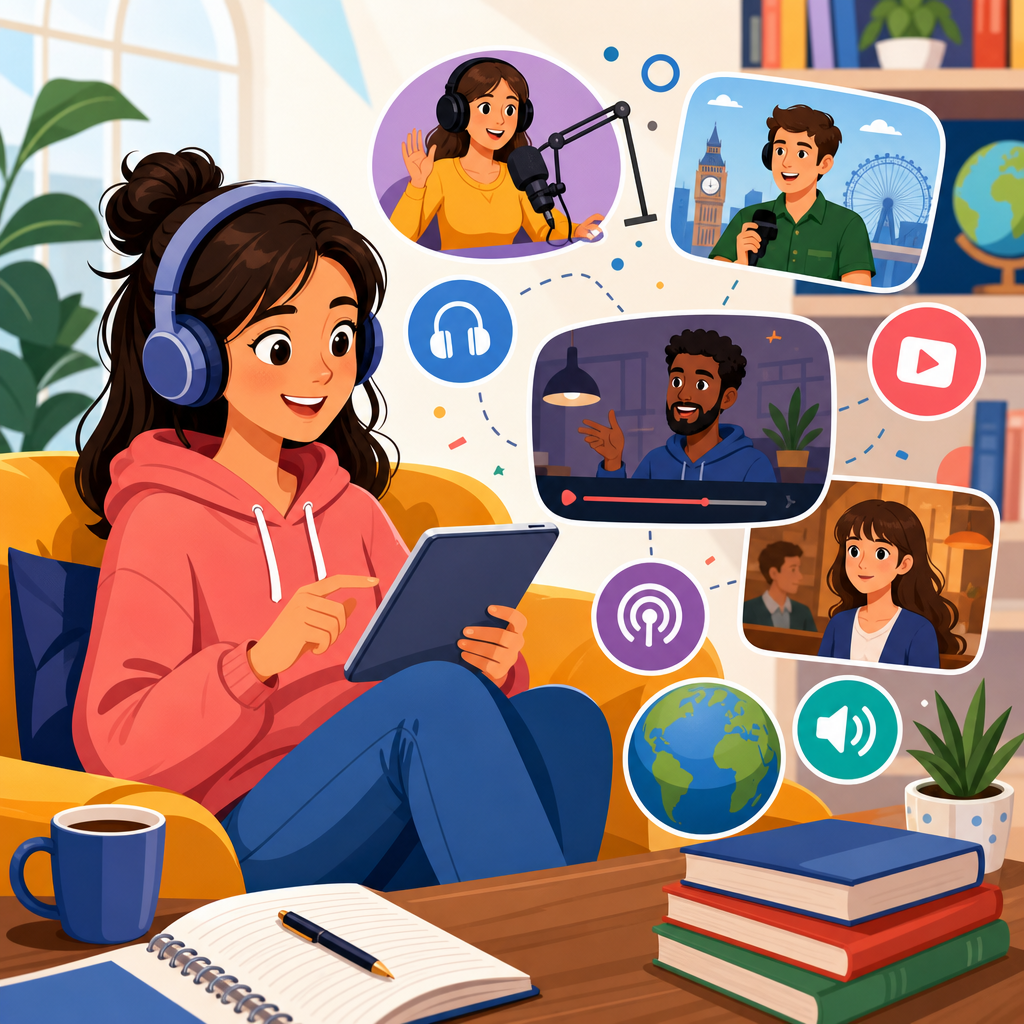
Learning English with podcasts and media is one of the fastest ways to build real listening skill, natural vocabulary, and cultural understanding at the same time. For learners focused on Pop Culture English, this approach matters even more because movies, streaming shows, music, interviews, YouTube clips, and podcasts carry the slang, humor, references, and conversational patterns that textbooks often miss. When students ask me how to sound less translated and more natural, I rarely start with grammar drills. I start with media habits. The reason is simple: language lives inside context, and pop culture provides a steady stream of context that people actually want to follow.
In practical terms, podcasts are audio programs built around conversation, storytelling, interviews, or commentary. Media is broader: TV, film, social video, music, news segments, celebrity interviews, late-night clips, sports commentary, gaming streams, and fan communities. Pop Culture English refers to the vocabulary, idioms, pronunciation patterns, memes, references, and shared cultural knowledge that appear in entertainment and online conversation. It includes phrases like “spoiler alert,” “binge-watch,” “plot twist,” “go viral,” and “main character energy,” but it also includes subtler features such as sarcasm, callbacks, understatement, and tone shifts.
This topic matters because many English learners can pass tests yet still struggle in everyday conversation about what people are watching, listening to, or discussing online. That gap becomes obvious at work, in school, and in social settings. A colleague mentions a documentary, a friend quotes a sitcom, or a podcast host uses a casual idiom, and the learner understands the individual words but misses the meaning. I have seen this repeatedly with upper-intermediate students who know grammar well but freeze when conversation turns to celebrities, trending shows, sports culture, internet jokes, or spoken commentary.
Used correctly, podcasts and media solve several problems at once. They expose learners to connected speech, reductions, accents, pacing, and emotional tone. They teach what people really say instead of what course books prefer to print. They also improve cultural literacy, which is essential for understanding references and joining conversations confidently. Most important, they are sustainable. People keep listening to podcasts and watching media because they enjoy it. That makes consistent practice more realistic than relying only on formal study plans.
Why podcasts and media work better than isolated study
Podcasts and media work because they train comprehension under realistic conditions. In real conversation, nobody speaks in neat, separated textbook sentences. People interrupt each other, soften opinions, trail off, joke, exaggerate, and react emotionally. Audio and video expose you to these patterns repeatedly. Over time, your brain begins to predict chunks instead of decoding word by word. That shift is crucial. Fluent listeners do not process every sound individually; they recognize common phrases, discourse markers, and structures instantly.
I have found that learners who spend four weeks doing active listening with a single podcast improve faster than learners who spend the same time memorizing long vocabulary lists. The difference is retrieval in context. When a host repeatedly says “to be fair,” “here’s the thing,” or “I’m not buying that,” those phrases become usable. The learner hears pronunciation, rhythm, and purpose together. The same is true with shows and interviews. A late-night interview teaches turn-taking and humor; a recap podcast teaches opinion language; a sports clip teaches fast commentary and emotional emphasis.
Media also delivers repetition without feeling repetitive. A fan of superhero films will hear origin story language, fan reactions, review vocabulary, and internet commentary again and again. A music fan will absorb genre terms, interview questions, and emotional adjectives through artists they already follow. This repeated exposure builds durable vocabulary because the words stay attached to memorable people, scenes, and stories.
How to choose the right podcasts, shows, and channels
The best content is not the hardest content. It is the content you can follow with effort and return to consistently. For most learners, the ideal level is material where you understand about 70 to 85 percent on the first pass. Below that, frustration rises quickly. Above that, progress slows because the language is too familiar. Start with topics you already know well in your first language. Existing knowledge reduces cognitive load and helps you infer unfamiliar vocabulary.
For Pop Culture English, choose media by function. Use conversational podcasts for natural dialogue, interview shows for question patterns, review channels for opinion language, scripted series for repeated character voices, and recap videos for fast summary language. If you like celebrity culture, entertainment podcasts are useful because hosts often explain references. If you like sports or gaming, commentary channels teach reaction language and spontaneous speech. If you prefer stories, documentary podcasts and behind-the-scenes interviews provide richer vocabulary with clearer structure.
Subtitles and transcripts matter. When available, they turn listening into a measurable study tool. Spotify, Apple Podcasts, YouTube, Netflix, and many news apps now offer captions or transcripts for some content. Use them strategically, not constantly. First listen without text to test comprehension. Then review with captions to catch missed phrases. Finally, listen again without support. This three-pass method consistently improves retention. For difficult clips, I recommend slowing audio to 0.9x or 0.8x, then returning to normal speed once meaning is clear.
| Media type | Best for | Common language gains | Good starting example |
|---|---|---|---|
| Conversational podcasts | Natural listening practice | Fillers, discourse markers, everyday idioms | Light interview or culture podcast with transcripts |
| Sitcoms and scripted series | Repeated phrases in context | Humor, timing, relationship language | Twenty-minute episodes with subtitles |
| YouTube commentary | Opinion and reaction language | Agreement, disagreement, emphasis, slang | Pop culture review channels |
| Celebrity interviews | Question-and-answer patterns | Anecdotes, softening, conversational storytelling | Late-night or festival interview clips |
| Music and lyric content | Pronunciation awareness and metaphor | Colloquial expressions, cultural references | Clean lyric videos plus artist interviews |
A step-by-step method for learning English from pop culture content
The most effective method is active, not passive. Watching or listening casually has value, but structured repetition produces stronger results. I use a five-step cycle with learners. First, choose a short segment, ideally three to eight minutes. Second, listen once for the main idea only. Third, listen again and write down key phrases, not every word. Fourth, check the transcript or subtitles and mark what you missed. Fifth, repeat the audio and shadow important lines aloud, copying stress and intonation.
This process works because it trains several skills at once: gist listening, detailed listening, vocabulary extraction, pronunciation, and recall. For example, a learner listening to a film review podcast may notice phrases such as “the pacing felt off,” “the ending didn’t land,” or “the cast had great chemistry.” These are not random words; they are high-value chunks used repeatedly in real conversation. After shadowing them, the learner can use them in speaking or writing about other shows and films.
Keep a media notebook or digital document organized by theme. Create categories such as reviews, music, celebrity interviews, streaming culture, internet slang, and fan reactions. Under each category, record useful chunks, a short definition, one example sentence, and one note about tone. Tone matters. “That episode was wild” sounds different from “That episode was poorly structured.” One is informal and emotional; the other is analytical. Pop Culture English depends heavily on this distinction.
Building vocabulary, pronunciation, and cultural literacy together
One reason media study is so powerful is that it combines language knowledge with cultural knowledge. If a podcast host says a movie “lived up to the hype,” understanding the phrase is only part of the job. You also need to understand hype culture: anticipation, promotion, fan expectations, online reaction, and comparison with previous releases. The same applies to words like reboot, franchise, cameo, viral, fandom, spoiler, canon, remake, and algorithm. These terms carry cultural meaning beyond dictionary definitions.
Pronunciation improves through imitation, especially with connected speech. Native speakers compress language constantly: “going to” becomes “gonna” in casual speech, “did you” often sounds like “didja,” and “what are you” can sound like “whatcha.” Learners who only read formal English are often shocked by these reductions. Podcasts reveal them clearly because the speech is spontaneous. By shadowing short clips, you learn where speakers stress words, where they reduce sounds, and how intonation changes meaning. Sarcasm, excitement, disbelief, and hesitation are often communicated more through melody than vocabulary.
Cultural literacy grows when you follow recurring public conversations. Award shows, major streaming releases, viral songs, sports finals, and celebrity controversies all produce shared vocabulary. You do not need to care deeply about every trend, but knowing the language around them helps you function socially. In my experience, learners become more confident when they can say, “I have not seen it yet, but I heard the finale was divisive,” or “The soundtrack blew up online.” Those are real, usable bridges into conversation.
Avoiding common mistakes when learning from entertainment
The biggest mistake is treating all media language as safe for all situations. Pop culture is rich in slang, irony, profanity, and highly informal expressions. Learners sometimes repeat a phrase from a comedian, rapper, or streamer without understanding its register. That can sound rude, childish, or inappropriate in academic or professional settings. The solution is to label expressions by context: casual, very casual, internet-specific, sarcastic, regional, dated, or offensive. Good learning is not only about what a phrase means, but where it belongs.
Another mistake is consuming too much difficult content too quickly. A two-hour movie with dense accents can feel productive, but many learners retain little from it. Short clips with repetition usually produce better results. It is also a mistake to chase single words instead of learning chunks. “Steal the show,” “under the radar,” “mixed reviews,” and “for the plot” are more useful than isolated dictionary items. Chunks reflect real usage and are easier to remember because they appear as complete units.
Finally, do not ignore speaking and writing. Input alone is not enough. After listening to a podcast episode or watching a review, summarize it aloud in one minute. Then write three opinion sentences using new phrases. If possible, discuss it with a tutor, language partner, or online community. Productive use turns recognition into control.
Creating a weekly routine that actually lasts
A sustainable routine beats an ambitious plan that collapses after five days. I recommend four kinds of practice across a normal week. First, do short active listening sessions three times a week, around fifteen to twenty minutes each. Second, include one longer enjoyment session where you simply watch or listen for pleasure. Third, review your notes and phrases at the end of the week. Fourth, produce something small: a voice note, paragraph, or conversation about the content.
A sample routine works well. On Monday, listen to a five-minute entertainment podcast clip and extract five phrases. On Wednesday, watch a subtitled interview and shadow thirty seconds of speech. On Friday, listen again without subtitles and summarize it aloud. Over the weekend, watch one episode of a series or a film segment just for enjoyment, then write a brief reaction using your vocabulary notebook. This balance keeps motivation high while still building skill systematically.
Track progress with simple measures: how much you understand on first listen, how many useful phrases you can recall, and how confidently you can discuss a show, song, or interview without translating. Improvement is often gradual, then suddenly obvious. One day you stop hearing noise and start hearing patterns. That is when media becomes more than practice. It becomes participation.
Learning English with podcasts and media is effective because it teaches the language people actually use while also teaching the culture that gives that language meaning. For anyone exploring Pop Culture English, it is the most practical bridge between classroom knowledge and real conversation. You develop listening accuracy, stronger pronunciation, richer vocabulary, and better social awareness at the same time. Just as important, you build habits that are enjoyable enough to continue for months, which is what real progress requires.
The core strategy is simple. Choose content at the right level, study short segments actively, collect useful chunks instead of random words, pay attention to tone and context, and use what you learn in speaking and writing. Podcasts sharpen your ear. Shows and interviews reveal natural interaction. Music, commentary, and online clips expose trends, references, and emotional language. Together, they create the kind of repeated, meaningful exposure that fluent listening depends on.
If you want better English for real-world interaction, start with one podcast, one show, and one weekly routine you can keep. Follow topics you genuinely enjoy, especially in entertainment, music, streaming, sports, gaming, and celebrity culture. Then build from there. The more consistently you listen, notice, and respond, the more natural English will feel. Pick a clip today, replay it carefully, and turn pop culture into daily language practice.
Frequently Asked Questions
1. Why are podcasts and media such effective tools for learning English?
Podcasts and media help learners develop English in a way that feels much closer to real life than traditional study materials alone. Instead of practicing isolated grammar points or memorizing vocabulary lists without context, you hear how English is actually spoken by native and fluent speakers in natural situations. That means you are exposed to real pronunciation, connected speech, rhythm, intonation, filler words, humor, emotional tone, and everyday phrasing. Over time, this builds listening stamina and makes spoken English feel less surprising.
For learners interested in Pop Culture English, this matters even more. Movies, TV shows, celebrity interviews, YouTube content, music, and podcasts are full of the slang, references, jokes, and conversational habits that shape modern communication. Textbooks often teach correct English, but they do not always teach current English. Media fills that gap by showing how people react, interrupt, agree, disagree, soften opinions, tell stories, and express personality. That is often the difference between sounding technically correct and sounding natural.
Another major advantage is repetition with meaning. When you hear phrases repeated across different shows, podcast episodes, and speakers, your brain starts recognizing patterns automatically. Expressions like “That makes sense,” “I’m not really into that,” “You know what I mean?” or “It depends” become familiar because you hear them in context again and again. This kind of exposure improves both comprehension and speaking fluency because you are not just learning words, you are learning ready-to-use language chunks.
Media also improves cultural understanding. English is deeply connected to context, and many conversations include references to trends, social behavior, humor styles, and public figures. If your goal is to understand people more easily and participate in modern conversation, podcasts and media give you access to the cultural layer of the language, not just the vocabulary layer. That is why they are among the fastest tools for building practical listening skill, natural vocabulary, and confidence in real-world communication.
2. What kind of podcasts and media should I choose if I want to improve my English faster?
The best content is not necessarily the most advanced content. The best content is material you can follow well enough to stay engaged while still being challenged. If the audio is so difficult that you understand almost nothing, progress will be slow because your brain has too little structure to work with. On the other hand, if the content is too easy, you may not grow much. A strong target is material where you understand the general topic and can catch key words, even if you miss some details.
Start by matching content to your current level and your interests. If you enjoy entertainment, celebrity culture, film reviews, storytelling, or interviews, use those topics as your entry point. Motivation matters. Learners are far more likely to stay consistent when they genuinely want to know what happens next or what the speaker is going to say. For Pop Culture English, excellent choices often include interview podcasts, recap videos, behind-the-scenes clips, talk shows, reaction channels, and conversational YouTube content. These formats expose you to casual English, modern expressions, and authentic speaking speed.
It also helps to choose content with support features. Podcasts with transcripts are especially useful because they allow you to compare what you heard with what was actually said. Streaming shows with subtitles can also help, although it is best to use them strategically rather than depend on them constantly. Short clips are ideal for intensive study because you can replay them several times, while longer episodes are useful for building listening endurance and overall comprehension.
A smart approach is to create a balanced media mix. For example, you might use one easier podcast for consistent listening, one interview-based show for natural conversation, one TV series for pop culture vocabulary, and short social media or YouTube clips for current slang and reactions. This combination gives you exposure to different accents, speaking styles, and communicative situations. The goal is not to consume random English. The goal is to choose media that gives you repeated, understandable, and relevant exposure to the type of English you actually want to use.
3. How can I use podcasts and media actively instead of just listening passively?
Passive exposure has value, but active use is what turns input into noticeable improvement. If you only let English play in the background, you may become more familiar with the sound of the language, but your progress in listening accuracy, vocabulary retention, and speaking ability will be limited. To learn faster, you need to interact with what you hear. That means noticing phrases, checking meaning, repeating key lines, and testing your understanding.
One of the most effective methods is the listen-pause-repeat approach. Choose a short section of audio, listen carefully, pause, and repeat what the speaker said. Try to copy the pronunciation, rhythm, and emotion, not just the words. This is often called shadowing, and it is powerful because it trains both listening and speaking at the same time. You begin to notice reductions, linking, stress patterns, and natural phrasing that are easy to miss when you listen casually.
Another excellent strategy is to keep a media vocabulary notebook, but make it practical. Do not just write single words. Write complete expressions and short sentences from the content. For example, instead of writing only the word “awkward,” write “That was so awkward,” or “I felt awkward asking.” This helps you remember how vocabulary behaves in real conversation. It is also useful to organize expressions by function, such as agreeing, disagreeing, reacting, buying time, joking, or changing topics. That is how fluent speech is built.
You can also summarize what you watched or heard. After a podcast episode or scene, explain it out loud in simple English. Say what happened, what the speakers were talking about, what surprised you, and what phrases you noticed. This forces your brain to retrieve language and strengthens comprehension. If possible, record yourself and compare your summary over time. Even a one-minute recap a day can produce strong results.
Finally, rewatch and relisten on purpose. Many learners underestimate repetition because they think progress means always moving to new content. In reality, repeated exposure is where a lot of learning happens. The first time, you catch the main idea. The second time, you notice details. The third time, you start hearing language patterns clearly. Active listening is less about consuming more and more content and more about noticing more from the content you already have.
4. How do I learn slang, humor, and natural expressions from movies, shows, and pop culture without getting confused?
This is one of the biggest benefits of learning through media, but it needs to be done carefully. Slang, humor, and pop culture references are highly contextual. A phrase that sounds great in one scene may sound strange, outdated, too informal, or even rude in another situation. That is why the goal is not just to collect cool expressions. The goal is to understand who says them, when they say them, and what social effect they create.
Start by observing context before imitation. Ask yourself: Who is speaking? Are they friends, coworkers, strangers, or family? Is the tone playful, sarcastic, emotional, aggressive, or relaxed? Is the phrase common, trendy, exaggerated, or tied to a specific group or generation? These questions protect you from using expressions in the wrong setting. For example, some phrases are natural in a comedy clip or among close friends but would sound unprofessional in class, at work, or in formal conversation.
It is also important to verify expressions before adopting them. If you hear a slang term in a song, reality show, or viral video, check whether it is still current and how people really use it. Online dictionaries, corpus examples, transcript searches, and multiple media sources can help confirm meaning and tone. If you see the same phrase used naturally by different speakers in different contexts, it is probably more reliable. If it appears only once in a dramatic or highly stylized scene, use caution.
Humor deserves special attention because jokes often depend on timing, shared knowledge, wordplay, or cultural reference. You do not need to understand every joke immediately. In fact, part of becoming more fluent is learning to recognize why something is funny, not just what the words mean. As you spend more time with interviews, late-night clips, sitcoms, and online commentary, your cultural understanding grows, and humor becomes easier to follow. This is one reason Pop Culture English learners often improve so quickly in real conversation: they are not just learning language forms, they are learning how meaning works socially.
A practical rule is to first understand, then recognize, then test, then use. Understand the phrase and its tone, recognize it in other content, test it by writing or saying it in a low-risk setting, and only then use it naturally in conversation. That sequence helps you sound current and confident without sounding forced or inappropriate.
5. What is the best routine for learning English with podcasts and media consistently?
The best routine is one you can actually maintain. Consistency matters more than intensity. A learner who studies with media for twenty focused minutes a day will often improve more than someone who does three hours once a week and then stops. The key is to build a repeatable system that includes listening, noticing, review, and speaking. When those elements work together,