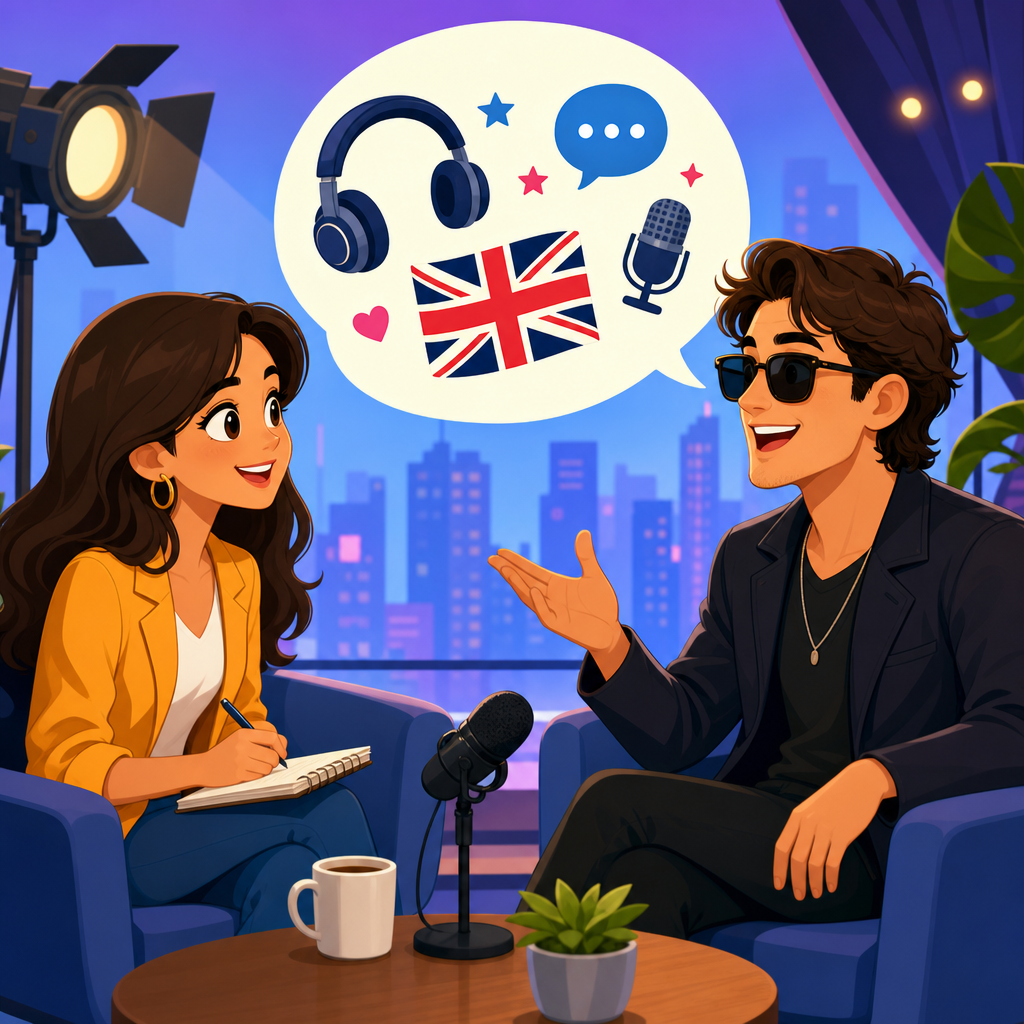
Learning English with celebrity interviews turns pop culture into a practical language lab, giving learners authentic speech, current vocabulary, and real-world listening practice in one format. In ESL teaching, “pop culture English” refers to the words, expressions, references, humor, and speaking styles that appear in entertainment media and shape everyday conversation. Celebrity interviews are especially useful because they combine unscripted answers, interviewer prompts, storytelling, opinions, and emotional reactions. That mix mirrors the English learners hear outside textbooks. I have used interview clips in mixed-level ESL classes and with private students for years, and they consistently produce stronger engagement than isolated grammar drills because learners immediately hear how English sounds in natural conversation.
This topic matters because many learners can pass grammar exercises yet still struggle when a native speaker speaks quickly, interrupts, jokes, or references a movie, award show, viral moment, or music release. Interviews expose learners to those patterns safely. A student listening to Zendaya discuss a film role, Ryan Reynolds joke with a host, or BTS answer questions on American television hears hesitation, emphasis, fillers, turn-taking, and culture-specific vocabulary in context. That context helps learners infer meaning faster. It also builds confidence. When students understand a celebrity interview without subtitles, they feel they are participating in contemporary English rather than studying a distant academic system. As a hub topic within cultural English, pop culture English connects listening, speaking, vocabulary, pronunciation, media literacy, and intercultural competence.
Celebrity interviews also solve a practical problem: authenticity without total chaos. Films and podcasts can be linguistically dense. Social media clips are often too short or fragmented. Interviews usually follow a recognizable structure: introduction, current project, personal anecdote, opinion, reaction, and closing. That predictability supports comprehension while still exposing learners to natural language. For teachers, self-study learners, and content creators building an ESL cultural English pathway, celebrity interviews are one of the most efficient bridges between classroom English and public English. They help learners understand not just what words mean, but when they are used, how tone changes meaning, and why cultural references matter in real communication.
Why celebrity interviews are effective for learning pop culture English
Celebrity interviews work because they present high-frequency spoken English in a memorable setting. Learners hear common structures such as “I was like…,” “to be honest,” “it was surreal,” “we really clicked,” and “that was a huge turning point.” These phrases appear repeatedly across entertainment journalism, social conversation, and workplace storytelling. In my experience, students retain them better after hearing them attached to a celebrity’s story than after reading a vocabulary list. The combination of face, voice, emotion, and narrative improves recall.
Interviews are also ideal for training listening at natural speed. Real speakers reduce sounds, restart sentences, overlap with hosts, and soften statements with hedging language such as “kind of,” “pretty much,” or “I guess.” Textbooks often clean this up, but real communication does not. When learners practice with interview clips from shows such as The Tonight Show, Hot Ones, Vogue, or the BBC, they become better at parsing connected speech. They learn that “going to” becomes “gonna,” “want to” becomes “wanna,” and “did you” may sound like “didja.” This is not sloppy English; it is standard conversational reduction.
Another advantage is cultural relevance. Pop culture is a shared reference system. If a learner hears repeated terms like “box office,” “streaming release,” “fan base,” “award season,” “spoiler,” or “red carpet,” those words become useful far beyond entertainment news. They appear in casual conversation, online discussions, and even marketing or media work. Interviews therefore provide language input that is both current and socially valuable.
What learners can study in a single interview clip
One strong interview clip can support multiple language goals at once. First is listening comprehension: identifying the main idea, supporting details, attitude, and implied meaning. Second is pronunciation: noticing stress, intonation, linking, and rhythm. Third is vocabulary: collecting idioms, slang, collocations, and topic words. Fourth is speaking: retelling the interview, giving an opinion, or role-playing an interviewer and guest. Fifth is writing: summarizing the clip, comparing two interviews, or responding to a quote.
For example, a five-minute interview with Emma Stone discussing a role might include descriptive adjectives, emotional vocabulary, narrative sequencing, and humor. A learner can practice expressions such as “I had to figure out,” “the challenge was,” “what surprised me most,” and “I definitely learned a lot.” A music interview with Billie Eilish may add creative process language such as “we wrote it in one night,” “the song came from,” or “I didn’t expect that reaction.” A sports celebrity interview may introduce resilience vocabulary like “comeback,” “pressure,” “discipline,” and “perform under stress.” The format is flexible enough to support beginner through advanced study if the clip is chosen carefully.
The key is to study interviews actively, not passively. Watching ten clips without pausing is entertaining, but it produces weaker results than studying one clip with a transcript, repeating key lines, and using new vocabulary in your own speech. This hub topic should lead learners toward that active method every time.
How to choose the best celebrity interviews for your level
The best interview is not always the most famous one. It is the one that matches a learner’s level, goals, and attention span. Beginners do better with short interviews, clear audio, one speaker at a time, and concrete topics such as daily routines, favorite foods, training, or a recent project. Talk shows with clean editing are often easier than red-carpet interviews, where background noise and rushed questions reduce clarity. Intermediate learners can handle humor, anecdotes, and light cultural references. Advanced learners should work with longer-form interviews, podcasts, panel discussions, and press conferences where the language is less controlled.
I usually evaluate interviews using five filters: speech speed, accent clarity, topic familiarity, transcript availability, and cultural density. A learner who already knows the celebrity or film has an easier entry point because background knowledge reduces cognitive load. Official YouTube channels, Netflix promotional interviews, late-night show channels, and magazine series often provide reliable audio and captions. Captions are helpful, but they should support listening rather than replace it. Auto-generated subtitles frequently mishear names, slang, and reduced forms, so learners need to compare them carefully.
| Learner Level | Best Interview Type | What to Focus On | Good Sources |
|---|---|---|---|
| Beginner | Short talk show clips | Key words, gist, repeated phrases | Official late-night channels, magazine shorts |
| Intermediate | Promotional interviews | Idioms, opinions, storytelling language | Studio press clips, entertainment channels |
| Advanced | Long-form interviews and podcasts | Tone, nuance, interruption, cultural references | BBC, NPR, podcast channels, festival panels |
This selection process matters because difficulty should be challenging but not overwhelming. If learners miss more than half the clip, they stop noticing useful patterns and start guessing. The right material creates repeated success, which is essential for sustained progress.
Vocabulary, slang, and cultural references in celebrity interviews
Pop culture English is not just slang. It includes layered vocabulary that shifts by industry, generation, and platform. In celebrity interviews, learners hear entertainment terminology such as “cast,” “premiere,” “script,” “chemistry,” “franchise,” “tour,” “single,” “headline,” and “viral.” They also hear evaluative language like “iconic,” “underrated,” “chaotic,” “grounded,” “relatable,” and “overhyped.” These words carry cultural meaning, not just dictionary meaning. Calling a performance “iconic” signals strong admiration and social recognition. Saying a moment “went viral” implies rapid online circulation and public visibility.
Slang requires extra care because it changes quickly and depends on audience. A learner might hear “I’m obsessed,” “that was wild,” “we had a blast,” “it was awkward in the best way,” or “she absolutely nailed it.” These expressions are common and useful. But highly temporary internet slang may become outdated within months. That is why learners should prioritize durable conversational phrases over trend-dependent terms. In class, I often separate interview vocabulary into three categories: evergreen spoken English, entertainment-industry terms, and fast-moving internet slang. That helps learners decide what to memorize actively.
Cultural references are equally important. A celebrity may mention the Met Gala, the Oscars, Coachella, Broadway, Marvel, the Grammys, Saturday Night Live, or a viral meme. Without context, learners may understand the sentence but miss the significance. Pop culture English study should therefore include short background reading or discussion. Understanding why an interviewer asks about an award, controversy, fandom, or comeback changes the meaning of the answer. Language and culture are inseparable in this format.
Listening and pronunciation gains from real interview speech
Celebrity interviews are a powerful tool for pronunciation because they reveal how fluent English actually sounds. Learners often know individual words but cannot recognize them in connected speech. Interviews solve that gap. When a host says, “Whaddaya think?” instead of “What do you think?” or a guest says, “I was kinda nervous,” learners hear reduction, assimilation, and weak forms in action. Repeated exposure improves decoding, which then improves speaking.
Intonation is another major benefit. Celebrities use rising tones for uncertainty, falling tones for certainty, extra stress for emphasis, and contrastive stress to correct assumptions. Compare “I liked the script” with “I liked the script.” The same words can signal sincerity, surprise, or polite restraint depending on stress and facial expression. Interview footage gives learners access to that full communicative package. Audio-only practice helps, but video adds mouth movement, gesture, and timing.
Shadowing is one of the best techniques here. Learners listen to one short line, pause, and repeat it with matching rhythm and intonation. I have seen this work especially well with interviews because the lines are short, expressive, and socially realistic. A learner can practice “It was honestly one of the hardest things I’ve done” until the stress pattern feels natural. Over time, this builds fluency that sounds less translated and more conversational.
Using celebrity interviews for speaking, discussion, and writing
Interviews become even more valuable when learners turn input into output. After watching a clip, they should answer direct questions: What was the main point? What surprised you? Did the guest sound confident, nervous, grateful, or defensive? Which expressions would you use yourself? These responses move language from recognition to production. In group classes, celebrity interviews are excellent discussion starters because they create immediate opinions. Students compare communication styles, react to jokes, and debate cultural expectations around fame, privacy, fashion, or public image.
For speaking practice, role-play works well. One student becomes the host, another becomes the celebrity, and both must use target vocabulary from the clip. This develops question formation, follow-up questions, and spontaneous answers. It also teaches discourse management: how to expand an answer, redirect a question, or acknowledge an interviewer politely. Those skills transfer directly to job interviews, presentations, and social conversation.
Writing tasks should stay practical. Learners can produce a 100-word summary, a reaction paragraph, a quote analysis, or a comparison between two interview styles. More advanced students can examine media framing: How did the interviewer guide the conversation? Which questions invited real answers, and which promoted a film or album? This level of analysis strengthens both English and critical media literacy.
Common mistakes and the smartest way to build a study routine
The most common mistake is treating celebrity interviews as pure entertainment. Enjoyment matters, but progress comes from repetition, note-taking, and recycling language. Another mistake is copying slang without understanding tone or register. Some expressions fit casual conversation but sound unprofessional in academic or workplace settings. Learners should always ask: Who says this, to whom, and in what context? A third mistake is depending completely on subtitles. If subtitles stay on from the first second, listening muscles develop slowly.
A smarter routine is simple. Choose one interview clip each week. First, listen once for the main idea. Second, listen again and note five useful phrases. Third, check the transcript or captions. Fourth, shadow three lines aloud. Fifth, summarize the interview orally and in writing. Sixth, use at least two new expressions in your own sentences the next day. This cycle is efficient because it combines comprehension, pronunciation, memory, and production. Learners who follow it consistently see measurable improvement in listening speed and spoken confidence within weeks.
As a hub within ESL cultural English, this topic should connect naturally to related study areas: idioms in entertainment media, American and British talk show language, red-carpet vocabulary, humor and sarcasm, fan culture terminology, and media interview skills. Celebrity interviews are not a side activity. They are a central resource for mastering how English is actually used in public, modern, culturally loaded conversation.
Learning English with celebrity interviews works because it combines authentic language, cultural context, and repeatable study methods in a format learners genuinely want to watch. It helps students hear real pronunciation, understand current vocabulary, and follow the references that shape modern conversation. More importantly, it teaches English as interaction rather than as isolated rules. That is the core value of pop culture English: learners do not just decode sentences; they understand how people present themselves, tell stories, joke, soften opinions, and respond in public.
The biggest advantage is transfer. The phrases, listening skills, and cultural knowledge gained from celebrity interviews carry into everyday conversations, classroom discussions, workplace communication, and online media. A learner who can follow a fast, humorous interview is better prepared for natural English anywhere. Start with one short clip, study it actively, and build a weekly routine around it. If you are creating an ESL cultural English pathway, make celebrity interviews your pop culture hub and branch outward from there.
Frequently Asked Questions
Why are celebrity interviews effective for learning English?
Celebrity interviews are effective because they expose learners to English as it is actually spoken, not just as it appears in textbooks. In most interviews, celebrities respond spontaneously, react to follow-up questions, tell personal stories, and express opinions in ways that reflect real conversation. This gives learners access to natural pronunciation, connected speech, fillers, pauses, humor, and everyday vocabulary. Instead of studying isolated grammar points, learners hear how English works in context, including how speakers introduce ideas, soften opinions, emphasize emotions, and respond under pressure.
They are also especially valuable for learning pop culture English. That includes references, idioms, slang, trending expressions, and conversational styles that are common in entertainment media and often spill into daily life. Because many learners are already interested in music, film, sports, or online personalities, celebrity interviews can feel more engaging than traditional listening exercises. Motivation matters in language learning, and content that feels familiar or exciting often leads to better focus, more repetition, and stronger retention. In short, celebrity interviews combine authentic listening, cultural relevance, and learner interest in one practical resource.
What kind of English can learners pick up from celebrity interviews?
Learners can pick up a wide range of useful English from celebrity interviews, far beyond simple vocabulary lists. One major area is conversational language. Interviews are full of common expressions used to agree, disagree, hesitate, clarify, joke, and transition between ideas. Learners hear phrases such as “to be honest,” “I mean,” “you know,” “that was kind of crazy,” or “what happened was,” all of which are common in spoken English but not always emphasized in formal lessons. These recurring patterns help learners sound more natural and understand others more easily.
Another important area is listening to different speaking styles. Celebrities come from different countries, regions, and professional backgrounds, so learners may encounter a variety of accents, speech speeds, and communication styles. Interviews also contain storytelling language, emotional language, and opinion-based language, which are all essential for real-world communication. In addition, learners gain cultural literacy by hearing references to events, trends, social media, entertainment, and public life. This matters because understanding English is not only about knowing words; it also involves understanding the context behind those words. Celebrity interviews help bridge that gap by showing how language and culture work together in everyday speech.
How can ESL learners study celebrity interviews without getting overwhelmed?
The best approach is to work with short, manageable clips and have a clear goal for each session. Rather than watching a full 30-minute interview from start to finish, learners should begin with a one- to three-minute segment. On the first listen, focus only on the main idea: who is speaking, what topic is being discussed, and what the speaker’s general message is. On the second listen, pay attention to keywords, repeated phrases, and tone. On the third listen, use subtitles or a transcript if available to confirm meaning and notice what was missed. This layered method reduces frustration and builds confidence.
It also helps to study actively instead of passively. Learners can write down useful expressions, highlight slang or idioms, copy short pronunciation chunks, and summarize what the celebrity said in their own words. Shadowing is another strong technique: listen to one sentence and repeat it immediately, trying to match rhythm, stress, and intonation. Learners should not expect to understand every word, especially in fast or highly informal interviews. The goal is steady improvement in comprehension, vocabulary recognition, and speaking confidence. By choosing interesting content, slowing the process down, and revisiting clips several times, learners can turn challenging material into highly productive practice.
Are celebrity interviews suitable for all English levels?
Yes, but the way they are used should match the learner’s level. For beginners, full-speed celebrity interviews may be difficult because of fast speech, informal grammar, reduced pronunciation, and cultural references. However, beginners can still benefit if the material is carefully selected. Short clips with clear audio, supportive subtitles, and familiar topics are often the best starting point. Teachers or self-learners can focus on simple tasks such as identifying key words, noticing repeated expressions, or understanding the main topic instead of trying to catch every detail.
Intermediate and advanced learners usually gain the most from this format because they are ready to handle nuance, humor, personality, and unscripted speech. At these levels, celebrity interviews become excellent tools for building listening fluency, expanding natural vocabulary, and improving spoken interaction. They can also support discussion activities, pronunciation practice, and cultural analysis. The key point is that celebrity interviews are not an all-or-nothing resource. They can be adapted for different levels by changing the clip length, topic difficulty, speed of playback, and follow-up tasks. With the right scaffolding, they can be useful for nearly any learner.
What is the best way to turn celebrity interviews into a complete English practice routine?
A strong routine uses one interview clip to practice several skills at once: listening, vocabulary, speaking, pronunciation, and even writing. Start by choosing a short clip connected to a topic you genuinely care about, such as music, film, sports, fashion, or online media. First, listen without subtitles and try to identify the main message. Next, listen again with subtitles and note useful expressions, collocations, and examples of natural spoken English. Then create a small study list of phrases you would realistically use in conversation, rather than collecting random words you may never need.
After that, move from understanding to production. Repeat key lines aloud, practice shadowing for pronunciation, and record yourself summarizing the interview in your own words. You can also answer the interviewer’s questions as if you were the guest, which is an excellent speaking exercise. To add writing practice, write a short reaction paragraph or a brief summary using the expressions you learned. For long-term progress, revisit the same clip after a few days and check how much more you understand. This kind of routine works well because it transforms entertainment content into structured language training. Instead of simply watching famous people talk, learners actively mine the interview for useful English they can recognize, remember, and use in real communication.