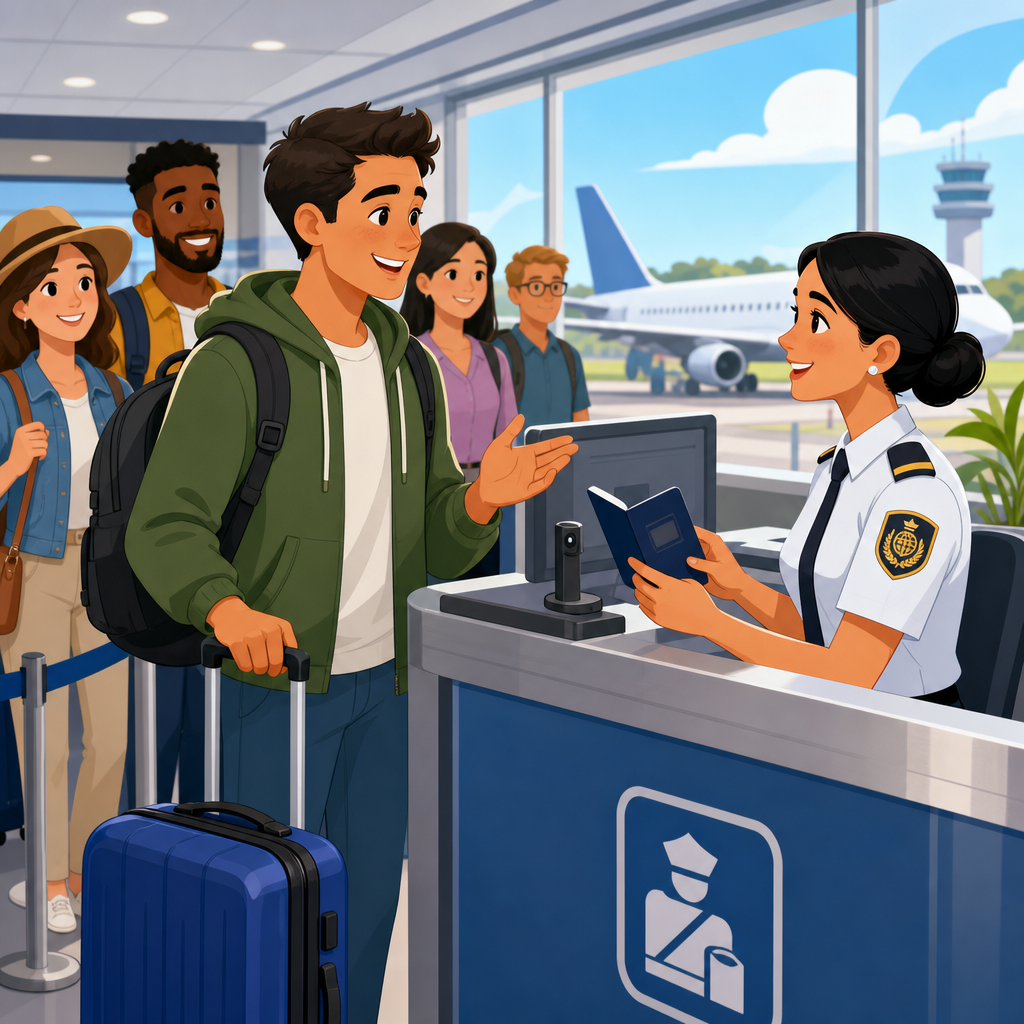
Travel English for immigration and customs is one of the most practical language skills an international traveler can build, because these checkpoints are where clear communication affects entry, timing, and stress levels immediately. In English for travel, immigration refers to the border control process where an officer checks identity, visa status, travel purpose, and eligibility to enter a country. Customs refers to the inspection of goods you bring across the border, including food, cash, gifts, medication, and items that may be taxed or restricted. I have coached adult English learners preparing for airports, visa interviews, business trips, and study abroad arrivals, and the same pattern appears every time: travelers rarely need advanced grammar, but they do need accurate answers, key vocabulary, and confidence under pressure.
This topic matters because immigration and customs conversations are short, formal, and high stakes. A misunderstanding about length of stay, accommodation, return tickets, or declared items can cause delays or secondary inspection. The language is also specialized. Words like declare, prohibited, connecting flight, accommodation, purpose of visit, and length of stay sound simple in class but become difficult when an officer speaks quickly behind glass in a noisy arrival hall. For that reason, English for travel should not be taught as random phrases alone. It works best as a system that combines listening, speaking, documents, and cultural expectations, especially for learners traveling for tourism, work, study, or family visits.
As a hub within ESL for Specific Goals, this guide covers the core of English for travel at the border and connects the larger subtopic. It explains the questions officers ask, the vocabulary travelers must recognize, the documents they should prepare, and the sentence patterns that help them answer briefly and truthfully. It also addresses customs declarations, common problems, and practice methods that improve performance fast. If a learner can handle immigration and customs in English, they gain a foundation for airport check-in, security, hotels, transportation, and emergency communication as well.
What officers usually ask at immigration
Immigration officers are trained to verify identity, legal entry conditions, and consistency. In plain terms, they want to know who you are, why you are entering, where you will stay, how long you will stay, and whether your documents support your answers. The most common questions are direct: “What is the purpose of your visit?” “How long will you stay?” “Where are you staying?” “Is this your first time here?” “Do you have a return ticket?” and “What do you do for work?” Learners should prepare short answers, not long stories. For example: “I’m here for tourism for ten days.” “I’m staying at the Riverside Hotel in Chicago.” “Yes, here is my return ticket.”
From experience, the biggest problem is not vocabulary but overexplaining. At border control, concise answers sound more credible than nervous speeches. If the officer needs more detail, they will ask. A strong response matches the document exactly. If your booking says twelve nights, do not say “about two weeks.” If you are visiting family, say “I’m visiting my sister in Toronto for one week,” not “I’m here for some personal reasons.” Precision reduces suspicion. Travelers should also know that officers may ask follow-up questions to test consistency, especially when a visitor carries little luggage, arrives on a one-way ticket, or cannot clearly explain accommodation.
Pronunciation also matters. Numbers, dates, addresses, and names cause frequent trouble. I advise learners to practice saying flight numbers, hotel names, and street addresses aloud before departure. Say dates in a standard format and be ready to repeat them slowly. If you do not understand a question, use a simple repair phrase: “Could you repeat that, please?” or “Could you speak a little more slowly?” These are better than guessing. Guessing can create contradictions, and contradictions are exactly what immigration officers notice.
Core travel English vocabulary for immigration and customs
Travel English for immigration and customs depends on a focused lexical set rather than broad conversational ability. The essential categories are identity, travel plans, accommodation, money, baggage, and restricted items. Identity vocabulary includes passport, visa, residence permit, citizenship, nationality, date of birth, surname, given name, and biometric scan. Travel-plan terms include itinerary, return ticket, boarding pass, final destination, connecting flight, layover, and length of stay. Accommodation words include hotel reservation, host, address, confirmation number, and check-in date. Customs language adds declaration form, duty-free allowance, prohibited items, restricted goods, cash, prescription medication, tobacco, alcohol, agricultural products, and inspection.
These words matter because officers often use formal terms that differ from classroom English. For instance, “occupation” means your job, “goods” means items you are bringing, and “funds” means available money for your trip. In many airports, forms and kiosk screens use the term “declare,” which means you officially report items such as large amounts of currency, food, plant products, commercial merchandise, or expensive gifts. The United States Customs and Border Protection, the UK Border Force, and the Canada Border Services Agency all publish guidance that uses this exact terminology. Learners who study those official words adapt faster than learners who memorize informal travel dialogues only.
Another high-value area is phrase recognition. Officers may say, “Please place your fingers on the scanner,” “Look at the camera,” “What is the address where you’ll be staying?” “Are you carrying any food?” or “Did you pack your bags yourself?” The final question is common because baggage security and border questioning overlap in many travelers’ minds. Understanding these phrases reduces panic. I also recommend learning opposites that appear on signs and forms: declared or undeclared, permitted or prohibited, resident or non-resident, arrival or departure, and single entry or multiple entry. At the border, one misunderstood adjective can change the meaning of the entire exchange.
Documents to prepare and the language attached to them
Good border communication starts before the flight. Travelers should organize documents in the order officers may request them: passport, visa or entry authorization, arrival form if required, hotel reservation or host address, return or onward ticket, and supporting documents such as invitation letters, conference registrations, school admission letters, or proof of funds. In my coaching sessions, travelers who build one clear document folder answer more smoothly because they are not searching through email while trying to listen. The language benefit is real: when you can see the exact hotel name, date, or address, you can say it correctly and confidently.
Each document supports a predictable sentence pattern. A tourist can say, “Here is my hotel confirmation.” A student can say, “I’m entering on a student visa, and here is my university acceptance letter.” A business traveler can say, “I’m attending meetings with our distributor, and here is the invitation letter.” Visiting-family travelers can say, “I’m staying with my aunt at this address.” These are stronger than vague answers because the language and paperwork reinforce each other. Border officers evaluate consistency across speech, documents, and behavior.
Digital records help, but paper backups still matter. Phone batteries fail, airport Wi-Fi is unreliable, and some officers prefer printed confirmations. Keep medication in original packaging with a prescription copy if needed, especially when carrying controlled substances or injectable medication. If you carry more than the allowed cash threshold, know the reporting requirement for the country you are entering. Reporting large sums is often legal; failing to report them is what creates serious problems. That distinction is important for learners because the word “declare” can sound threatening, even though it often simply means disclose accurately.
Model answers for common border situations
The most effective practice method is building model answers by travel purpose. A tourist should prepare four essentials: purpose, duration, accommodation, and return plan. For example: “I’m here for tourism.” “I’ll stay for eight days.” “I’m staying at the Central Park Hotel in Manhattan.” “Yes, my return flight is on May 18.” A business traveler needs employer and meeting language: “I work for Delta Tech in Brazil.” “I’m here for a trade conference and client meetings.” “I’ll stay for three nights.” A student needs institution language: “I’m enrolled at Northton University.” “Classes begin on September 3.” “I’m staying in campus housing.”
Travelers visiting friends or family often need the clearest answers because this category triggers more follow-up questions in many countries. A good answer is specific: “I’m visiting my brother, Daniel Kim, in Vancouver for six days.” Be ready for, “What does he do?” “What is his address?” and “When was the last time you visited?” If your host is paying for part of the trip, say so directly and truthfully. If you are between jobs, do not invent employment. Say, “I’m currently not working,” and support your trip with proof of funds if requested. Honest, simple English is safer than polished but false English.
| Situation | Likely Question | Strong Short Answer |
|---|---|---|
| Tourism | What is the purpose of your visit? | I’m here for tourism for ten days. |
| Business | Who are you meeting? | I’m meeting our regional partner, Apex Logistics. |
| Study | Where will you stay? | I’ll stay in university housing on campus. |
| Family visit | Who are you visiting? | I’m visiting my cousin in Mississauga. |
| Customs | Are you carrying any food? | Yes, I have packaged tea and declared it. |
Notice that each answer is factual, short, and easy to verify. That is the standard learners should aim for. I tell travelers to avoid jokes, slang, and unnecessary background information at the border. Humor often fails in a formal checkpoint. If an officer asks a yes-or-no question, start with yes or no, then add one line of clarification. This pattern is especially useful in customs interviews, where incomplete answers can sound evasive.
How to handle customs declarations correctly
Customs English focuses on what you are bringing into the country and whether anything must be declared, inspected, taxed, or prohibited. Many travelers assume customs is only about expensive shopping, but food, plants, animal products, medication, and cash are often more important. Countries protect agriculture and public health aggressively. Australia and New Zealand are famous for strict biosecurity enforcement, and the United States, Canada, the European Union, Singapore, and Japan also maintain detailed restrictions. If you are unsure whether an item is allowed, declare it. In practice, declaring an item does not automatically create a penalty; hiding an item creates the larger risk.
Key customs questions include, “Do you have anything to declare?” “Are you carrying food, plants, or animal products?” “How much cash are you carrying?” “Are these items for personal use?” and “Did you buy these goods abroad?” Learners should understand the difference between personal belongings and commercial goods. A laptop you use for work is usually personal property. Ten identical boxed electronics may look like merchandise. Prescription medication should stay in original containers, and some countries require a doctor’s letter for controlled drugs. Alcohol and tobacco often have quantity limits, while fresh fruit, meat, seeds, and soil-contaminated outdoor gear are heavily regulated.
I have seen travelers get into avoidable trouble because they answered the wrong question. When an officer asks, “Are you carrying any food?” they are not asking whether you plan to eat during the flight. They are asking whether food is physically in your baggage. A direct answer is best: “Yes, I have packaged snacks and tea.” Then let the officer decide whether to inspect them. The same applies to cash. Carrying reportable cash is not the same as laundering money, but failing to declare it can lead to seizure. Clear English protects the traveler as much as it helps the officer.
Listening, accent, and stress management at the checkpoint
Even advanced learners struggle at immigration and customs because the environment is noisy and tense. Officers may speak quickly, use local pronunciation, or ask questions through glass speakers. The solution is not more grammar drills. It is targeted listening practice and a stress routine. Use airport role-play audio, official arrival videos, and recordings from different English accents, especially American, British, Canadian, and Australian if those destinations matter to you. Practice hearing the same question in multiple forms: “Why are you here?” “What brings you here?” and “What’s the purpose of your visit?” all require the same answer.
Stress changes performance. Under pressure, learners forget familiar words, mishear numbers, and answer too fast. Before you reach the desk, put your passport and next document in hand, remove headphones, and stop looking at your phone. Listen fully, answer once, and pause. If you need clarification, ask politely. “I’m sorry, could you repeat that?” is normal and acceptable. In my experience, officers respond better to calm requests than to rapid guessing. Eye contact, clear volume, and steady pacing matter more than perfect grammar. Border English is operational communication, not a speaking exam.
For teachers and self-learners building a broader English for travel plan, immigration and customs should connect to airport check-in, security screening, hotel arrival, transportation, and emergency help. The same methods apply across the subtopic: build high-frequency vocabulary, prepare situation-specific scripts, rehearse with real documents, and practice listening under realistic noise conditions. Start with your next trip, write your own answers, and rehearse them aloud until they are automatic. That preparation turns a stressful checkpoint into a routine conversation and gives learners a practical foundation for confident travel in English.
Frequently Asked Questions
What kinds of questions do immigration officers usually ask, and how should I answer them in English?
Immigration officers usually ask short, direct questions to confirm your identity, the reason for your trip, how long you plan to stay, and where you will be staying. Common questions include: “What is the purpose of your visit?”, “How long will you stay?”, “Where are you staying?”, “Is this your first time here?”, and “Do you have a return ticket?” In some cases, they may also ask about your job, who you are traveling with, or whether you are visiting for tourism, business, study, or transit. These questions are routine, so the best approach is to stay calm and answer clearly, honestly, and briefly.
Useful answer patterns are simple and easy to remember. For example: “I’m here for tourism,” “I’m staying for seven days,” “I’m staying at a hotel in the city center,” or “I’m visiting my sister.” If you are traveling for business, you can say, “I’m here for a business meeting,” or “I’m attending a conference.” If you are in transit, say, “I’m in transit to Canada,” or whichever country is your final destination. Officers generally prefer straightforward answers rather than long explanations, so it helps to practice concise responses before you travel.
It is also smart to keep supporting documents easy to reach, such as your passport, visa, hotel reservation, return ticket, and any invitation letter if relevant. If you do not understand a question, it is completely acceptable to say, “Could you please repeat that?” or “Could you speak a little more slowly?” That is much better than guessing. Clear communication at immigration is less about advanced English and more about understanding common travel questions and responding with confidence and accuracy.
What is the difference between immigration and customs in travel English?
In travel English, immigration and customs are related but separate parts of entering a country. Immigration is about people. This is where officers check who you are, whether your passport and visa are valid, why you are entering the country, and whether you are allowed to enter. The focus is on identity, legal entry, and travel purpose. That is why immigration questions usually involve your trip, your stay, your documents, and sometimes your travel history.
Customs, on the other hand, is about the things you are bringing into the country. After immigration, customs officers may ask whether you have food, alcohol, tobacco, large amounts of cash, gifts, medication, or commercial goods in your luggage. They may also ask you to declare items that are restricted, taxed, or prohibited. Typical customs questions include: “Do you have anything to declare?”, “Are you carrying any food?”, “How much cash are you carrying?”, or “Did you pack your bags yourself?” The purpose is to protect public health, enforce import laws, and prevent illegal or undeclared goods from entering the country.
Understanding this difference helps travelers respond more accurately. If an officer asks about your hotel, length of stay, or visit purpose, that is generally immigration-related. If the questions are about items in your baggage, purchases, food, or cash, that is customs-related. In practical English terms, immigration is about your right to enter, while customs is about what you are bringing in. Knowing this distinction reduces confusion and makes the airport process much easier to follow.
How can I explain what I am carrying at customs without making mistakes?
The best way to explain what you are carrying at customs is to use plain, specific vocabulary and avoid vague answers. If a customs officer asks whether you have anything to declare, your answer depends on what you are carrying and the rules of the country. If you have nothing that needs to be declared, you can say, “No, I have nothing to declare.” If you do have items, be direct: “Yes, I have packaged snacks,” “I’m carrying prescription medicine,” “I have gifts for friends,” or “I’m carrying more than 10,000 dollars in cash.” Clear, honest descriptions are important because customs rules can be strict, especially regarding food, plants, animal products, and large sums of money.
It helps to learn common customs words before you travel. Important terms include “declare,” “duty-free,” “restricted items,” “prohibited items,” “prescription medication,” “personal belongings,” “souvenirs,” and “commercial goods.” For example, if you are carrying medicine, you might say, “This is prescription medication for personal use.” If you have food, say exactly what it is: “I have sealed chocolate,” “I have dried tea,” or “I have homemade food.” Specific wording is better than simply saying, “I have some stuff.” The more precise you are, the easier it is for officers to assess your items quickly.
You should also answer truthfully even if you are unsure whether an item must be declared. A good sentence in that situation is: “I’m not sure if this needs to be declared, so I wanted to mention it.” That shows responsibility and honesty. Customs officers are generally more concerned about undeclared or hidden items than about travelers asking questions. In other words, strong customs English is not about sounding perfect. It is about using simple, accurate language to describe your belongings and showing that you are cooperative.
What should I say if I do not understand an immigration or customs officer?
If you do not understand an officer, the most important thing is not to panic and not to pretend you understood. Misunderstanding a question can lead to wrong answers, delays, or unnecessary stress. Instead, use polite clarification phrases such as, “Sorry, I didn’t understand,” “Could you please repeat that?”, “Could you speak more slowly?”, or “Could you explain the question, please?” These are practical, respectful phrases that are widely understood and completely appropriate in airport and border situations.
You can also confirm what you think the officer means. For example, you might say, “Do you mean how long I will stay?” or “Are you asking about the food in my bag?” This technique is very useful because it shows you are trying to answer correctly. If you are asked for a document and are unsure, you can say, “Which document would you like to see?” or “Do you need my passport or boarding pass?” Small clarification questions like these help avoid confusion and keep the interaction moving smoothly.
Before traveling, it is useful to practice listening to common immigration and customs questions spoken at natural speed. Even if your English is intermediate, airport speech can feel fast because the setting is stressful. That is why memorizing a few survival phrases is so valuable. If necessary, you may also say, “English is not my first language,” to signal that you need a slower pace. Officers deal with international travelers every day, so asking for repetition is normal. In real travel situations, clear and honest communication matters much more than perfect grammar.
How can I prepare my English for immigration and customs before an international trip?
The most effective preparation is to focus on high-frequency questions, essential documents, and realistic spoken practice. Start by learning the vocabulary you are most likely to hear: passport, visa, arrival card, purpose of visit, return ticket, accommodation, declaration, baggage, cash, medication, and restricted items. Then prepare short answers about your own trip. You should be ready to say where you are going, why you are traveling, how long you will stay, where you will stay, and what you are carrying. Because these answers are personal, practicing with your real details makes them easier to remember under pressure.
It also helps to rehearse the sequence of the airport experience. For immigration, practice handing over your passport and answering simple questions such as, “I’m here on vacation,” “I’ll stay for ten days,” and “I’m staying at the Grand Hotel.” For customs, practice statements such as, “I have nothing to declare,” “I’m carrying prescription medicine,” or “I bought these gifts for personal use.” If you are carrying anything that could raise questions, such as medication, expensive electronics, or large amounts of cash, learn how to explain it in one or two simple sentences. Preparation reduces hesitation and gives you more confidence.
Finally, organize your documents so your English and your actions support each other. Keep your passport, visa, customs form, hotel booking, return flight information, and any supporting letters together and easy to access. When your paperwork is organized, communication becomes much easier because you can quickly show what the officer needs. The goal is not to memorize complicated travel language. The goal is to master the specific English needed for border control: short answers, key vocabulary, polite clarification phrases, and confident delivery. That practical preparation can make immigration and customs faster, smoother, and far less stressful.