False friends in English cause some of the most persistent errors I see in ESL grammar work because they look familiar, sound safe, and often seem easier than checking a dictionary. A false friend is a word that resembles a word in another language but carries a different meaning, usage, tone, or grammatical pattern in English. Learners transfer what they know from Spanish, French, German, Portuguese, Italian, Russian, Arabic, or other languages, then produce sentences that sound logical to them but unnatural or incorrect to native speakers. These mistakes matter because they affect clarity, exam performance, workplace credibility, and confidence in everyday conversation. They also sit at the center of common grammar mistakes more broadly, since false friends often trigger errors in word choice, article use, collocation, prepositions, countability, verb patterns, and register. In my own editing and teaching work, I have found that students improve faster when they stop treating false friends as isolated vocabulary problems and start seeing them as grammar signals. If a learner writes “I am sensible to cold,” the issue is not only vocabulary. It also involves adjective meaning, preposition choice, and how English encodes physical sensitivity. This hub article explains the most common types of false friends in English, shows where they overlap with grammar, and gives practical ways to avoid repeating them.
What false friends are and why they create grammar mistakes
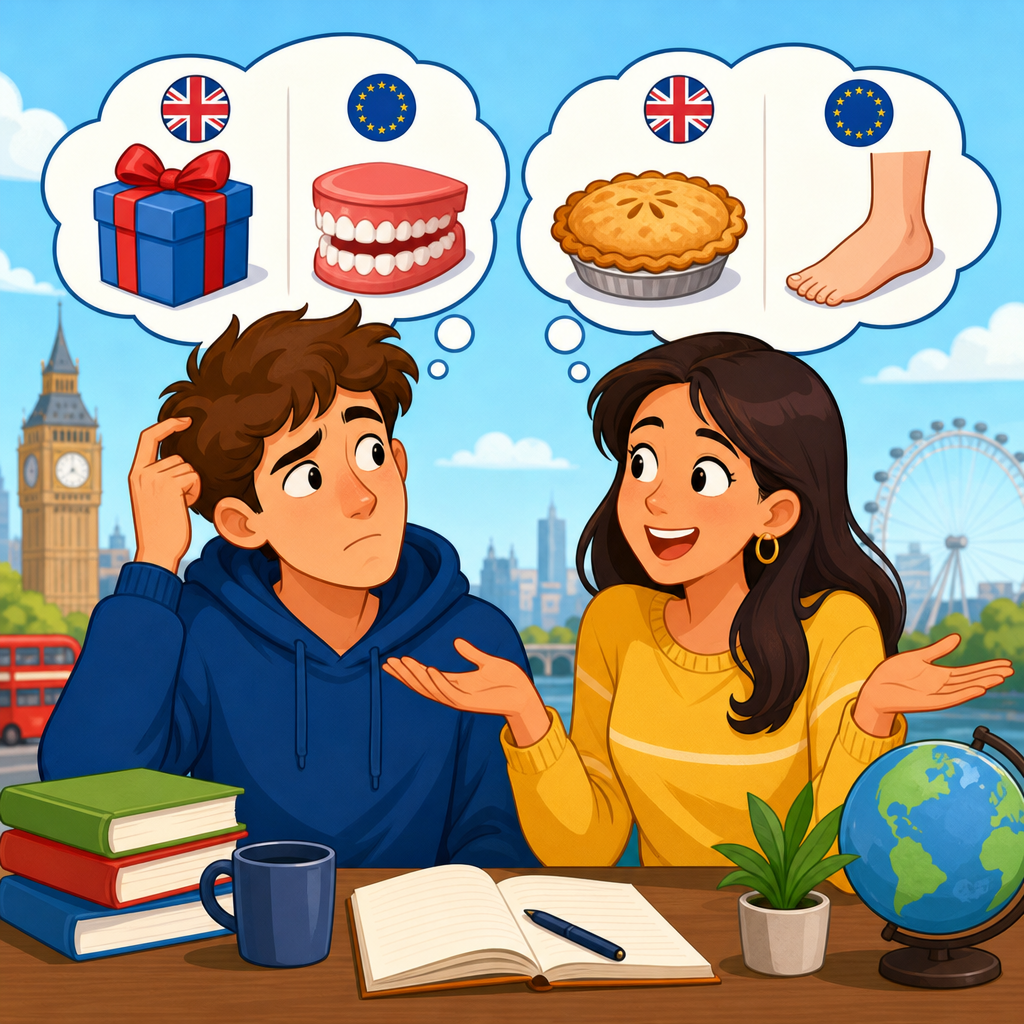
False friends are cross-language lookalikes that invite incorrect translation. Sometimes the meaning is completely different. More often, the core meaning overlaps only partially, which is more dangerous because the mistake is harder to notice. For example, Spanish actual means “current,” not “actual” in the English sense of “real.” French assister means “to attend,” not “to assist.” German bekommen means “to receive,” not “to become.” Each one can produce a grammatically correct sentence that communicates the wrong idea. That is why false friends deserve a central place in any guide to common grammar mistakes.
They create errors in several predictable ways. First, learners choose the wrong English word because of visual similarity. Second, they apply grammar patterns from the source language to the English lookalike. Third, they use a word in the wrong register, such as formal, casual, or academic contexts. Fourth, they mis-handle collocations, the word partnerships that make English sound natural. A student may write “make a photo” instead of “take a photo,” not because the grammar rule is unknown, but because a similar verb is used in another language. In real communication, these are not minor slips. They change meaning, confuse listeners, and weaken writing.
False friends also matter because English is full of near-synonyms with strict usage boundaries. Consider “library” and “bookstore.” In several languages, the local equivalent may resemble “library” while actually meaning a place that sells books. I have seen students confidently say, “I bought this novel in the library,” and the sentence is structurally fine, yet semantically wrong. When a mistake survives grammar checking software, it becomes harder to self-correct. Tools like Cambridge Dictionary, Merriam-Webster, Collins, and the Oxford Learner’s Dictionaries help because they show examples, collocations, and usage labels, not just translations.
High-frequency false friends that every ESL learner should master
The fastest way to reduce false friend errors is to learn the words that appear most often in everyday speech, exams, business email, and academic writing. Some cause direct meaning problems. Others cause broader grammar mistakes because they lead to wrong complements or prepositions. A practical starting point is to group them by communication context rather than alphabetically.
| False friend | Common source-language meaning | Incorrect English use | Correct English meaning or choice |
|---|---|---|---|
| actual | current, present | the actual government | the current government; actual = real |
| assist | attend | I assisted the meeting | I attended the meeting |
| sensible | sensitive | I am sensible to noise | I am sensitive to noise; sensible = practical |
| fabric | factory | He works in a fabric | He works in a factory; fabric = cloth |
| lecture | reading | I will lecture this book tonight | I will read this book; lecture = give a talk |
| pretend | intend, claim | I pretend to study law next year | I intend to study law; pretend = act as if |
| deception | disappointment | My exam result was a deception | It was a disappointment; deception = trickery |
| eventually | possibly | I will eventually come tomorrow | I might possibly come tomorrow; eventually = in the end |
These examples show a key point: false friends are rarely just vocabulary errors. “Pretend” requires a different logic from “intend.” “Assist” changes the whole action in a sentence. “Sensible” and “sensitive” shift both meaning and preposition patterns. When learners memorize them with sample sentences, accuracy improves quickly. I recommend keeping a personal list divided into work, travel, study, and social life, because retrieval is easier when words are tied to situations.
False friends that affect verb patterns, prepositions, and collocations
Many of the most stubborn common grammar mistakes come from false friends that look harmless but attach to different structures in English. Verb patterns are a major problem. A learner may choose the correct dictionary meaning but still build the sentence incorrectly. For instance, “discuss about” appears because some languages require a preposition equivalent to “about,” while English discuss takes a direct object: “We discussed the budget.” The false friend is not always a single word; sometimes it is a familiar translation pattern that drags the wrong grammar with it.
Prepositions are especially vulnerable. Students write “married with” instead of “married to,” “depend of” instead of “depend on,” or “explain me” instead of “explain to me.” In multilingual classrooms, I have noticed that learners often blame prepositions alone, but the deeper issue is lexical selection. English words come with fixed grammatical behavior. You do not learn “explain” fully unless you know that it follows “explain something to someone.” The same applies to “attend a class,” “apply for a job,” “participate in a project,” and “consist of several parts.”
Collocations make this even more important. A sentence can be technically understandable and still reveal nonnative phrasing because the wrong partner word was selected through a false friend. Common examples include “do a party” instead of “have a party,” “make a decision” confused with patterns from other languages, or “realize a dream” when “achieve a dream” or “fulfill a dream” fits better in context. Corpus-based tools such as the British National Corpus, COCA, Ludwig, and SkELL are useful because they show how words actually combine in authentic English. If you check usage rather than translation alone, false friend mistakes drop sharply.
How false friends differ across major language backgrounds
False friend patterns are not random. They often cluster by language family, and recognizing those clusters helps learners predict their own mistakes. Romance-language speakers frequently struggle with words like actual, sensible, pretend, and eventually because the forms are close to Spanish, Portuguese, French, or Italian equivalents. German speakers often meet traps such as become versus bekommen, chef versus Chef, and gift versus Gift, since the shared alphabet hides major semantic differences. Slavic-language speakers may overuse “sympathetic” when they mean “nice” or “likable,” depending on the language pair involved.
Arabic-speaking learners often face different pressure points. The issue may be less about identical spelling and more about broad translation zones, where one familiar word in the first language maps onto several narrower English choices. That can produce errors such as using “open” for a TV, light, or air conditioner when English may prefer “turn on,” or using “close” when English prefers “turn off.” East Asian learners may encounter another version of the problem through borrowed international vocabulary. A word that entered Japanese or Korean from English decades ago may have narrowed or shifted meaning, then returns to the learner as a misleading shortcut.
For teachers and self-learners, this means a generic correction strategy is inefficient. The best approach is contrastive: identify the top false friends for your first language and learn them in sets. When I worked with Spanish-speaking professionals, correcting actual, assist, and realize produced immediate gains in email clarity. With German-speaking learners, become and receive needed repeated attention because the error appeared in otherwise advanced writing. Tailored lists work better than broad warnings because they connect directly to the learner’s transfer patterns.
False friends in academic writing, exams, and professional English
False friends become more costly as the communication stakes rise. In academic writing, a small lexical error can undermine an argument because precise terms carry discipline-specific meaning. If a student writes “The actual literature shows” when meaning “current literature,” the sentence suggests something about authenticity rather than recency. In exam settings such as IELTS, TOEFL, Cambridge exams, or university placement tests, these mistakes affect lexical resource, grammatical range, and coherence at the same time. Examiners notice when a word choice error distorts meaning even if the sentence is otherwise well formed.
Professional English raises another level of risk. In business communication, “assist the meeting” may suggest helping organize it rather than attending it. “Eventually we can deliver on Monday” can sound like a weak long-term promise instead of a schedule commitment. “I am sensible to deadlines” may puzzle a manager who expects “sensitive to” or “aware of.” In legal, medical, financial, and technical fields, false friends can have serious consequences because terms are often standardized. A mistranslated adjective or verb can change responsibility, timeline, or compliance meaning.
The solution is to treat high-stakes writing as a separate practice zone. Before sending reports, applications, or proposals, check three things: whether the key terms mean exactly what you think they mean, whether the verbs take the correct pattern, and whether the phrase sounds natural in a trusted dictionary or corpus example. In my experience, this final verification step catches many errors that spellcheckers miss. Grammar tools such as Grammarly or LanguageTool are useful, but they are not enough on their own because false friends often produce sentences that are grammatically possible but semantically wrong.
Practical strategies to stop making the same mistakes
Most learners do not need more theory; they need a repeatable correction system. The first strategy is to collect false friends in sentence pairs. Write the wrong sentence you are likely to produce, then write the correct version beside it. “I assisted the conference” becomes “I attended the conference.” “This is the actual problem” stays correct only when you mean the real problem, not the current one. Contrast builds durable memory because it links the trap to the fix.
The second strategy is to learn words together with grammar. Do not memorize “sensitive” alone. Learn “sensitive to criticism,” “sensitive to light,” and “a sensitive issue.” Do not learn “explain” alone. Learn “explain the process to the client.” This approach prevents the familiar cycle where vocabulary seems known but sentences still come out wrong. The third strategy is spaced review. Revisit your list after one day, one week, and one month. Frequent short review works better than occasional long study because false friends are interference errors, and interference returns quickly.
Finally, use active production, not passive recognition. It is easy to identify a false friend in a quiz and still use it incorrectly in speech. Build short dialogues, email lines, and paragraph responses with your target words. Read them aloud. If possible, get feedback from a teacher, editor, or exchange partner who can explain why the correction matters. Over time, you will notice that your grammar improves along with your vocabulary because the same set of false friends often drives repeated errors across articles, prepositions, verb forms, and collocations. That is why false friends belong at the center of any serious study plan for common grammar mistakes.
False friends in English are not minor vocabulary accidents. They are a major source of common grammar mistakes because they distort meaning and pull wrong structures into otherwise solid sentences. When learners understand that a familiar-looking word may hide a different meaning, pattern, or register, they begin to correct errors at the source instead of patching them one by one. The most effective method is practical: identify the false friends linked to your first language, learn them in context, pair each word with its grammar pattern, and verify usage with trusted dictionaries or corpus examples.
This hub article should give you a framework for the whole common grammar mistakes topic. False friends connect directly to article use, prepositions, collocations, countability, verb complements, and formal versus informal style. If you improve this one area, your speaking becomes clearer, your writing becomes more precise, and your exam and workplace communication become more reliable. Start by making a list of ten false friends you have personally used, write the correct alternatives in full sentences, and review them this week. Small targeted corrections create lasting fluency.
Frequently Asked Questions
What are false friends in English, and why do learners make the same mistakes with them so often?
False friends are words that appear similar to words in another language but do not mean the same thing, do not work in the same grammatical structure, or carry a different tone in English. That similarity is exactly what makes them dangerous. Learners naturally rely on patterns they already know, so when an English word looks familiar, it feels trustworthy. The result is a very logical mistake from the learner’s point of view, even if it sounds unnatural or incorrect to a native speaker.
These errors are persistent because false friends are not random vocabulary mistakes. They are built on strong mental associations from a first language. A Spanish speaker may think “actually” means “currently,” a French speaker may assume “library” is related to “bookshop,” or a German speaker may overtrust a familiar-looking adjective or verb that behaves differently in English. In many cases, the learner is not guessing blindly. They are transferring a meaning that works perfectly well in their own language.
False friends also survive because they often produce sentences that are understandable. A teacher, friend, or colleague may still understand the speaker’s intention, so the mistake does not always get corrected immediately. That makes the form feel acceptable. Over time, the learner repeats it and the error becomes habitual. This is why false friends appear so often in advanced ESL writing and speaking: they are not caused by lack of intelligence or effort, but by deep cross-linguistic interference.
What are some of the most common false friends in English that ESL learners should watch out for?
Some false friends show up again and again because they involve very common everyday words. One classic example is “actually.” In English, “actually” usually means “in fact” or “really,” not “currently.” So “I actually live in London” means “in fact, I live in London,” not “I live in London now.” For “currently,” English uses “currently,” “at the moment,” or “right now.” Another frequent problem is “eventually,” which means “in the end” or “after some time,” not “possibly” or “maybe.”
Words connected to places and institutions also cause trouble. “Library” means a place where you borrow or read books, not a bookstore. A learner who says “I bought this novel at the library” is using a false friend. “College” can also be misleading because it does not always match the meaning of a similar word in another language. In English, especially in American usage, it often refers to higher education, not simply any school.
There are also important false friends in formal and academic English. “Sensible” in English means practical and reasonable, not sensitive or emotional. “Fabric” usually means cloth or material, not a factory. “Pretend” means to act as if something is true, not to intend. “Assist” often means to help, but not always to attend or be present. “Argument” in English is usually a disagreement, not just a neutral discussion. These mistakes matter because they can change the whole meaning of a sentence, not just make it sound slightly unnatural.
The best approach is to build a personal list of false friends based on your first language. Spanish speakers, French speakers, Portuguese speakers, Italian speakers, German speakers, Russian speakers, and Arabic speakers all tend to have different high-risk words. The more specific your list is, the faster you will notice patterns and stop repeating the same errors.
How can I tell whether a familiar-looking English word is a false friend before I use it?
The safest rule is simple: if a word looks almost too easy because it resembles a word from your language, pause and verify it. Familiar appearance is not proof of correct meaning. In fact, with false friends, that familiarity is the warning sign. Before using the word, check a reliable English dictionary and read more than the first definition. Look at example sentences, register labels such as “formal” or “informal,” and grammar notes showing whether the word is followed by a preposition, an infinitive, or a noun.
Context is also essential. A true understanding of a word includes meaning, usage, tone, and collocation. For example, two words may share a broad idea but still differ in natural usage. A learner may know the dictionary meaning, but still misuse the word because it sounds wrong in context. That is why it helps to search for the word in authentic sentences from newspapers, books, academic articles, or trusted learner corpora. If native speakers use it in ways you did not expect, that is a sign you should study it more carefully.
Another useful test is to ask yourself whether the English word behaves grammatically like the word in your language. False friends often fail this test. They may require different prepositions, work in different sentence patterns, or belong to a different part of speech. A word may look equivalent but function differently. If you train yourself to check meaning and structure together, you will catch far more mistakes before they become habits.
Finally, keep a correction notebook. Every time you discover a false friend, write the incorrect version, the correct English meaning, and one or two example sentences. That simple habit turns passive correction into active learning. Over time, you stop trusting visual similarity and start trusting evidence.
Are false friends only vocabulary problems, or can they affect grammar and tone too?
False friends are often introduced as vocabulary mistakes, but in practice they affect much more than word meaning. They can create grammar problems, awkward collocations, and tone issues that make writing sound strange, too direct, too formal, or simply inaccurate. That is why they are so important in ESL grammar work. A learner may choose a word that seems correct at first glance, then build the whole sentence around it in a way that does not work in English.
For example, some words look equivalent across languages but take different prepositions. Others may be countable in one language and uncountable in English. Some may be used naturally in formal writing but sound odd in everyday conversation. A learner may also choose a word that is technically understandable but emotionally stronger, weaker, or more negative than intended. In that case, the false friend is not just a vocabulary error; it changes the social effect of the message.
This is especially important in professional and academic settings. A student writing an essay or an employee sending an email may unintentionally sound imprecise, overconfident, or unnatural because of a false friend. Native speakers may understand the general meaning, but they may still notice that something feels off. That can affect clarity and credibility. So when you study false friends, do not stop at translation. Study how the word behaves in real English sentences, what words commonly go with it, and whether it fits the tone you want.
What is the best way to stop making false friend mistakes in speaking and writing?
The most effective strategy is repeated, deliberate noticing. You will not eliminate false friends just by reading one list of examples. You need to train yourself to recognize your personal risk words and replace automatic transfer with accurate English usage. Start by identifying the false friends that come from your own language. A generic list is useful, but a targeted list is much more powerful because it matches the exact mistakes you are likely to make.
Next, learn words in contrast, not isolation. Do not just memorize that one word is wrong. Learn the wrong-looking option and the correct English option side by side. For example, if you confuse “actually” and “currently,” write both with clear example sentences. If you confuse “pretend” and “intend,” practice both in short, realistic contexts. This contrast-based method helps your brain separate forms that previously felt identical.
Production practice matters too. Use the corrected words in your own sentences, short paragraphs, and speaking exercises. If possible, ask a teacher, tutor, or language partner to listen specifically for false-friend errors. In writing, leave time for a final editing pass focused only on familiar-looking words. Many learners proofread for articles, verb tenses, and spelling, but forget to check meaning transfer from their first language. That final review can catch some of the most damaging errors.
Most importantly, be patient. False friends are persistent because they come from habits, not from lack of study. The goal is not to become afraid of familiar words, but to become more precise with them. With consistent exposure, correction, and review, you can retrain those instincts and make your English sound more natural, accurate, and confident.