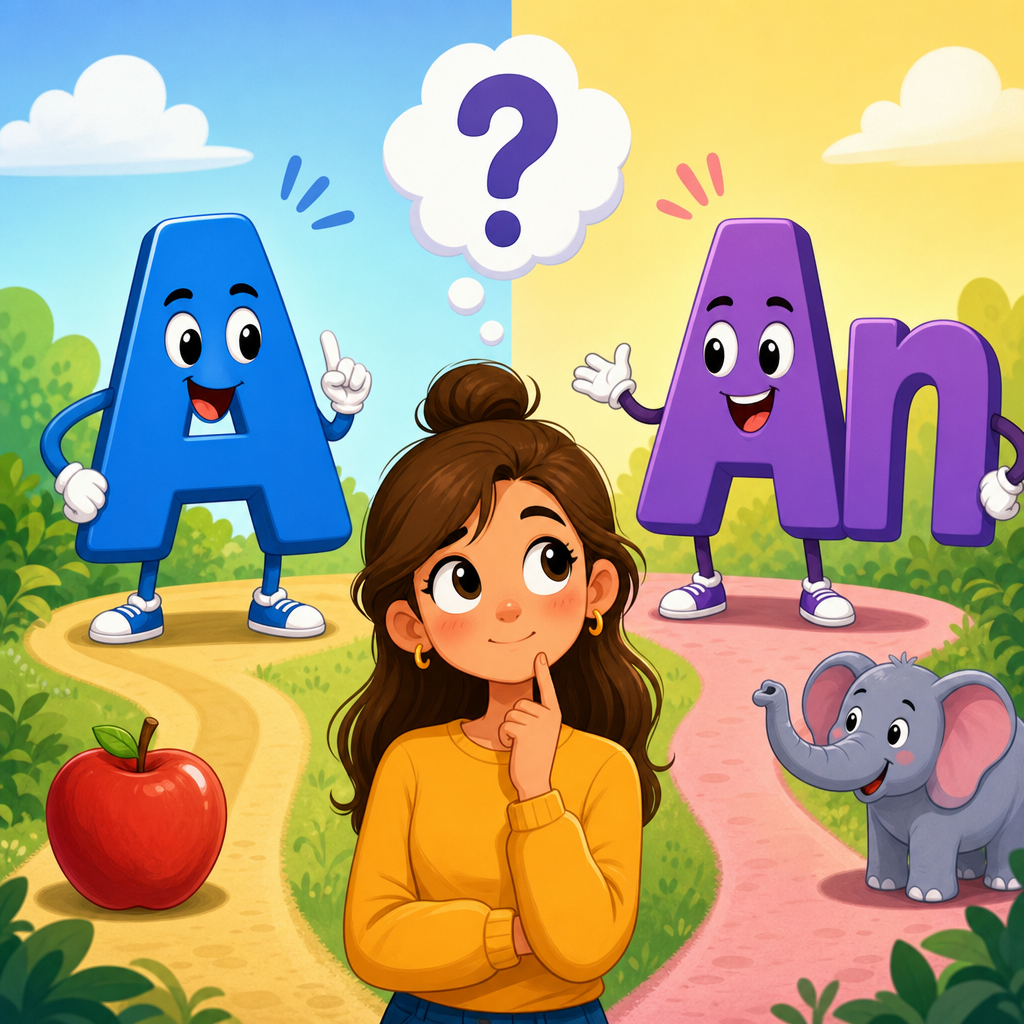
Articles are small words, but in ESL grammar they cause outsized problems, and few topics create more recurring confusion than using articles incorrectly in everyday speech and writing. In English, articles are determiners placed before nouns to signal whether the noun is specific, general, known, unknown, singular, or uncountable. The three article forms are a, an, and the; in many cases, English also requires the zero article, meaning no article at all. I have taught article usage to learners from language backgrounds that have no article system, reduced article systems, or completely different rules, and the same pattern appears repeatedly: students often know the vocabulary and the tense, yet a missing or incorrect article makes the sentence sound unnatural, vague, or wrong. That is why this topic belongs at the center of any ESL grammar hub on common grammar mistakes.
Using articles incorrectly matters because articles affect meaning, not just style. Compare “I bought book,” “I bought a book,” and “I bought the book.” The first is ungrammatical in standard English, the second introduces one non-specific book, and the third points to a particular book already identified by context. Article errors can also create misunderstanding in academic writing, workplace emails, customer service, test preparation, and conversation. A learner who writes “manager approved proposal” may still be understood, but the sentence lacks the structure expected in professional English. In high-stakes contexts such as IELTS, TOEFL, university assignments, or business reports, article mistakes are among the most noticeable signs that a writer is still developing control of English grammar.
This hub article explains the most common grammar mistakes involving articles, how to correct them, and where article usage overlaps with broader ESL grammar topics such as countable and uncountable nouns, noun phrases, modifiers, and general versus specific reference. It is designed to answer the questions learners usually ask: When do I use a or an? When do I use the? When should I use no article? Why do native speakers say “go to school” but “go to the school”? Why is “the information” sometimes wrong while “the advice” may be correct? By treating article errors as part of a larger pattern of common grammar mistakes, learners can move beyond memorizing isolated rules and start making reliable choices in real communication.
At a practical level, article control improves fluency because it helps speakers package information the way English expects. Articles work together with noun countability, adjective order, prepositional phrases, and context. If you understand article logic, many other grammar decisions become easier. This article serves as a hub for that larger grammar area by covering the full landscape: missing articles, unnecessary articles, confusion between definite and indefinite reference, article problems with uncountable and plural nouns, fixed expressions, pronunciation-based choices between a and an, and editing strategies that catch mistakes before they become habits.
The core system: what articles actually do
The fastest way to improve article usage is to stop thinking of articles as decoration and start thinking of them as meaning markers. A and an introduce singular countable nouns that are one of many and not yet identified: “I saw a dog,” “She needs an umbrella.” The marks a noun as specific, identifiable, unique, or already known: “I saw the dog that bit the mail carrier,” “Please close the door.” Zero article is used with many plural and uncountable nouns when speaking generally: “Dogs are loyal,” “Water is essential,” “Students need feedback.”
In the classroom, I often explain article choice through two questions. First, is the noun countable and singular? If yes, it usually needs an article or another determiner, such as my, this, or each. Second, is the noun specific to the listener or reader? If not, use a or an; if yes, use the. This simple framework does not solve every case, but it correctly handles a large share of common grammar mistakes. It also prevents the most frequent learner error: writing a singular countable noun with no article at all, as in “I bought car,” “Teacher gave homework,” or “She is engineer.”
The most common article errors ESL learners make
The biggest article mistakes fall into predictable groups. Missing articles are common before singular countable nouns: “He has car” should be “He has a car.” Unnecessary articles appear before general plural or uncountable nouns: “The life is hard” is usually “Life is hard,” and “She gave me an advice” should be “She gave me advice” or “She gave me a piece of advice.” Learners also confuse specific and general meaning. “I like the music” means particular music, perhaps the song now playing, while “I like music” refers to music in general.
Another frequent problem is overusing the because learners assume it sounds more formal or complete. In fact, many institutional and abstract nouns take no article in general statements: “Education is important,” “Health matters,” “Technology changes quickly.” Yet those same nouns can take the when narrowed by context: “The education he received in Finland shaped his career,” “The health of the patient improved,” “The technology used in modern MRI systems is highly specialized.” This is where article usage becomes a hub topic inside common grammar mistakes. It is not enough to memorize lists; learners must connect noun type, context, and intended meaning.
| Error pattern | Incorrect | Correct | Why |
|---|---|---|---|
| Missing article with singular count noun | She bought car. | She bought a car. | Singular countable nouns usually need an article or determiner. |
| Using the for a general plural noun | The dogs are friendly. | Dogs are friendly. | General plural nouns usually take zero article. |
| Using a with uncountable noun | He gave me an information. | He gave me information. | Uncountable nouns do not take a/an. |
| Wrong definite reference | I need the pen. | I need a pen. | Use a when any pen is acceptable. |
| Wrong sound choice | a hour | an hour | Article choice follows sound, not spelling. |
Countable, uncountable, and plural nouns: where article mistakes multiply
Most persistent article problems are really noun problems. If a learner does not know whether a noun is countable, uncountable, or flexible, article mistakes will keep repeating. Countable nouns can be counted individually: book, chair, idea. Singular countable nouns need an article or another determiner. Uncountable nouns refer to mass, substance, or abstract concepts: water, furniture, equipment, advice, information. These usually do not take a or an. Plural nouns can often appear with zero article when speaking generally: “Teachers need planning time,” “Computers require updates.”
English also has nouns that change according to meaning. “Chicken” is uncountable when it means the food, but countable when it means the animal. “Paper” can mean a material, an academic article, or a newspaper. “Experience” is uncountable in “She has experience,” but countable in “She had a strange experience.” Learners who study article rules without studying noun behavior usually plateau quickly. In editing sessions, I often see the same sentence corrected twice because the writer focuses on the article and ignores the noun category underneath it. For that reason, any serious review of common grammar mistakes should connect article usage to countability every time.
Specific versus general meaning: the decision behind the
The most important question behind the is not “Is this noun important?” but “Can the reader identify it?” Use the when both speaker and listener know which person, thing, place, or idea is meant, either because it was mentioned earlier, because only one exists in context, or because a defining phrase makes it specific. “I saw a movie last night. The movie was too long.” The first mention is non-specific; the second is specific because the noun is now known. “Please pass the salt” works because the dining context identifies the item. “The president of the club resigned” works because the phrase after the noun specifies which president.
General meaning usually takes zero article with plural and uncountable nouns and a/an with singular countable nouns used as one example of a class. “Books can change lives,” “Honesty matters,” and “A teacher needs patience” are all general statements. Many learners misuse the in broad statements because their first language marks general nouns differently. That leads to errors such as “The happiness is important in the life” or “The society needs the empathy.” More natural English is “Happiness is important in life” and “Society needs empathy.” When learners grasp the specific-versus-general distinction, a large set of common grammar mistakes begins to disappear across articles, noun phrases, and even pronoun reference.
A, an, and pronunciation-based mistakes
The choice between a and an depends on pronunciation, not spelling. Use an before a vowel sound: “an apple,” “an hour,” “an MBA.” Use a before a consonant sound: “a university,” “a European city,” “a one-time fee.” These examples matter because spelling can mislead learners. Hour begins with a silent h, so it starts with a vowel sound. University begins with the /juː/ sound, which behaves like a consonant sound. Acronyms follow the same principle. “An FBI agent” is correct because F begins with an /ɛ/ sound, while “a NASA engineer” is correct because NASA begins with /n/.
This looks like a small detail, but pronunciation-based article choice is one of the easiest ways to sound more natural immediately. It is also highly visible in writing. In professional documents, forms, résumés, and presentations, “an user” or “a honest person” stands out. Learners often ask whether regional accents change the rule. The answer is yes, but only when pronunciation truly changes. For example, some speakers pronounce the h in words others do not. Still, for standard international ESL instruction, the reliable rule is sound first, spelling second.
Fixed expressions, place names, and institutional nouns
Some article errors persist because English uses articles idiomatically in fixed expressions. We say “go to school,” “be at work,” “go to bed,” “be in prison,” and “go to church” when referring to the institution or primary purpose. But we say “go to the school,” “be at the worksite,” or “visit the church” when referring to a specific building. This contrast confuses learners because both forms are grammatically correct, but the meaning changes. “The child is at school” means attending school as a student. “The parent is at the school” means physically at that building.
Geographic names create another cluster of common grammar mistakes. Most countries take no article: “Canada,” “Brazil,” “Japan.” Some require the: “the United States,” “the Netherlands,” “the Philippines.” Rivers, seas, oceans, deserts, and mountain ranges usually take the: “the Nile,” “the Pacific,” “the Sahara,” “the Alps.” Most streets, cities, lakes, and single mountains do not: “Oxford Street,” “Paris,” “Lake Victoria,” “Mount Fuji.” Because there is no single shortcut for all place names, learners improve fastest by noticing patterns and checking reliable dictionaries such as Cambridge, Oxford, or Merriam-Webster when uncertain.
How to correct article mistakes consistently
The most effective correction method is not to hunt randomly for a, an, and the. Instead, edit noun phrase by noun phrase. First, underline every singular countable noun and ask whether it has an article or another determiner. Second, check whether the noun is general or specific. Third, test whether the noun is actually uncountable. Fourth, listen for the sound if choosing between a and an. I use this sequence with advanced learners because article mistakes often survive even after years of study; what changes performance is a repeatable diagnostic process.
Targeted practice works better than broad exposure alone. Sentence transformation drills, dictation, reading aloud, and focused rewriting all help, especially when learners compare meaning before and after the correction. Corpus tools such as the Corpus of Contemporary American English and the British National Corpus can also show real usage patterns. In longer writing, grammar checkers like Grammarly or LanguageTool can flag some article problems, but they miss nuance and sometimes suggest incorrect changes. The best habit is deliberate review with examples from authentic English. If article errors appear often in your speaking or writing, build a personal error log and revisit the same noun types until the pattern becomes automatic.
Using articles incorrectly is one of the most common grammar mistakes in ESL because articles compress several decisions into one short word: countability, specificity, shared knowledge, and pronunciation. Once learners understand that system, article choice stops feeling random. The key points are clear. Singular countable nouns usually need an article or determiner. A and an introduce non-specific singular count nouns, with the choice based on sound. The marks specific, identifiable reference. Zero article is common with general plural and uncountable nouns. Fixed expressions and place names require pattern awareness, not guesswork.
As a hub within ESL grammar, this topic connects directly to countable and uncountable nouns, determiners, noun phrases, prepositions, and editing skills. Learners who improve article control usually become clearer in every kind of English, from conversation to academic writing. Review your recent sentences, identify the nouns, and test each article choice against the rules in this guide. That simple habit will reduce common grammar mistakes quickly and make your English sound more accurate, natural, and confident.
Frequently Asked Questions
What are the most common article mistakes ESL learners make?
The most common mistakes usually fall into a few predictable patterns: using the when no article is needed, leaving out a or an before singular countable nouns, confusing a and the, and adding articles before uncountable or plural nouns in a general meaning. For example, learners often say “I bought book” instead of “I bought a book,” because singular countable nouns normally need a determiner. Another frequent error is saying “The life is hard” when speaking generally; in that case, English usually prefers no article: “Life is hard.”
Many of these mistakes happen because article systems vary widely across languages. Some languages do not use articles at all, while others use them differently from English. As a result, learners may rely on direct translation rather than English noun patterns. A very useful way to think about articles is to ask two questions: Is the noun countable and singular? Is the noun specific or general? If the noun is singular and countable, it usually needs a, an, or the. If it is specific and both speaker and listener can identify it, the is often correct. If it is general or mentioned for the first time, a or an may be better. Building this decision-making habit is one of the fastest ways to reduce repeated article errors.
How do I know when to use “a” or “an” instead of “the”?
Use a or an when you are introducing a singular countable noun that is not specific to the listener, or when it is one example of a larger group. For instance, “I saw a dog outside” tells the listener that the dog is not yet identified. Use an before a vowel sound, as in “an apple” or “an hour,” and use a before a consonant sound, as in “a car” or “a university.” The key is sound, not spelling. That is why “an honest person” is correct, but “a European country” is also correct.
Use the when the noun is specific, known, or already identified in context. For example, “I saw a dog outside. The dog was barking loudly.” In the first sentence, the dog is new information. In the second, it has become specific. You also use the when there is only one clear thing meant in that situation, such as “the sun,” “the kitchen,” or “the teacher” if both people know which teacher is being discussed. In practice, the difference is not just grammatical; it affects meaning. Saying “I need a pen” means any pen is fine. Saying “I need the pen” means a particular pen is needed. That distinction is at the heart of correct article use.
Why is it sometimes correct to use no article at all?
English often uses the zero article, meaning no article, with plural nouns and uncountable nouns when speaking in a general sense. For example, “Dogs are loyal” refers to dogs generally, not specific dogs. “Water is essential” refers to water as a substance in general. This is one of the most important patterns learners need to master, because many article errors come from adding the where English prefers no article. A sentence like “The happiness is important” usually sounds unnatural unless a very specific kind of happiness is being discussed. In most general statements, “Happiness is important” is the natural form.
No article is also common with many proper nouns, such as names of people, cities, and most countries: “Maria,” “Tokyo,” “Brazil.” However, there are exceptions, including names like “the United States,” “the Netherlands,” and “the Philippines.” Zero article also appears in fixed expressions and institutional uses, such as “go to school,” “be in prison,” or “at work,” when the focus is on the function of the place rather than the building itself. Compare “She is in school” with “Her mother is at the school.” In the first case, school is treated as an institution; in the second, a specific building is meant. Recognizing these patterns helps learners understand that no article is not the absence of grammar, but a meaningful grammatical choice.
What makes article use especially difficult with uncountable and abstract nouns?
Uncountable and abstract nouns are difficult because learners cannot always tell whether the noun is being used in a general, specific, or limited sense. Words like information, advice, furniture, knowledge, and progress are uncountable in English, so they do not usually take a or an. That is why “an advice” and “a furniture” are incorrect. Instead, English says “some advice,” “a piece of advice,” “some furniture,” or “an item of furniture.” Abstract nouns such as love, education, freedom, and life also often appear with no article when discussed generally: “Education matters,” “Freedom is valuable,” “Life can be unpredictable.”
At the same time, both uncountable and abstract nouns can take the when the meaning becomes specific. For example, “The information you sent was helpful” refers to particular information, and “The education she received abroad shaped her career” refers to a specific educational experience. In some cases, an uncountable noun can even become countable when the meaning changes. For example, “coffee” is usually uncountable in “Coffee is popular,” but countable in a café setting: “We ordered two coffees.” This is why article use cannot be learned only as a list of rules. Learners need to notice how meaning changes with context. When teaching or practicing articles, it is especially useful to examine the noun first, then decide whether the speaker means something general, specific, or one unit of something.
What is the best way to improve article accuracy in everyday speaking and writing?
The best approach is to stop treating articles as tiny optional words and start treating them as part of the noun pattern. Instead of memorizing isolated rules, practice nouns in full phrases: “a meeting,” “the meeting,” “meetings,” “information,” “the information.” This helps you connect article choice to meaning. A strong editing habit is to check every noun and ask: Is it singular or plural? Countable or uncountable? General or specific? New information or known information? Those four questions solve a large percentage of article problems. In writing, article errors are often easier to catch during revision than during first drafting, so build a second-pass review specifically for noun phrases.
In speaking, repetition and exposure matter. Read short texts aloud and notice why the writer chose a, an, the, or no article. Compare pairs such as “I need a doctor” and “I need the doctor,” or “Children need sleep” and “The children need sleep.” Keeping a personal error list is also highly effective. If you often omit articles before singular countable nouns, focus on that one issue until it becomes automatic. If you overuse the with general nouns, train yourself to recognize generic statements. Improvement comes faster when practice is specific, consistent, and based on real examples. Articles may be small, but mastering them has a major effect on clarity, naturalness, and overall fluency.