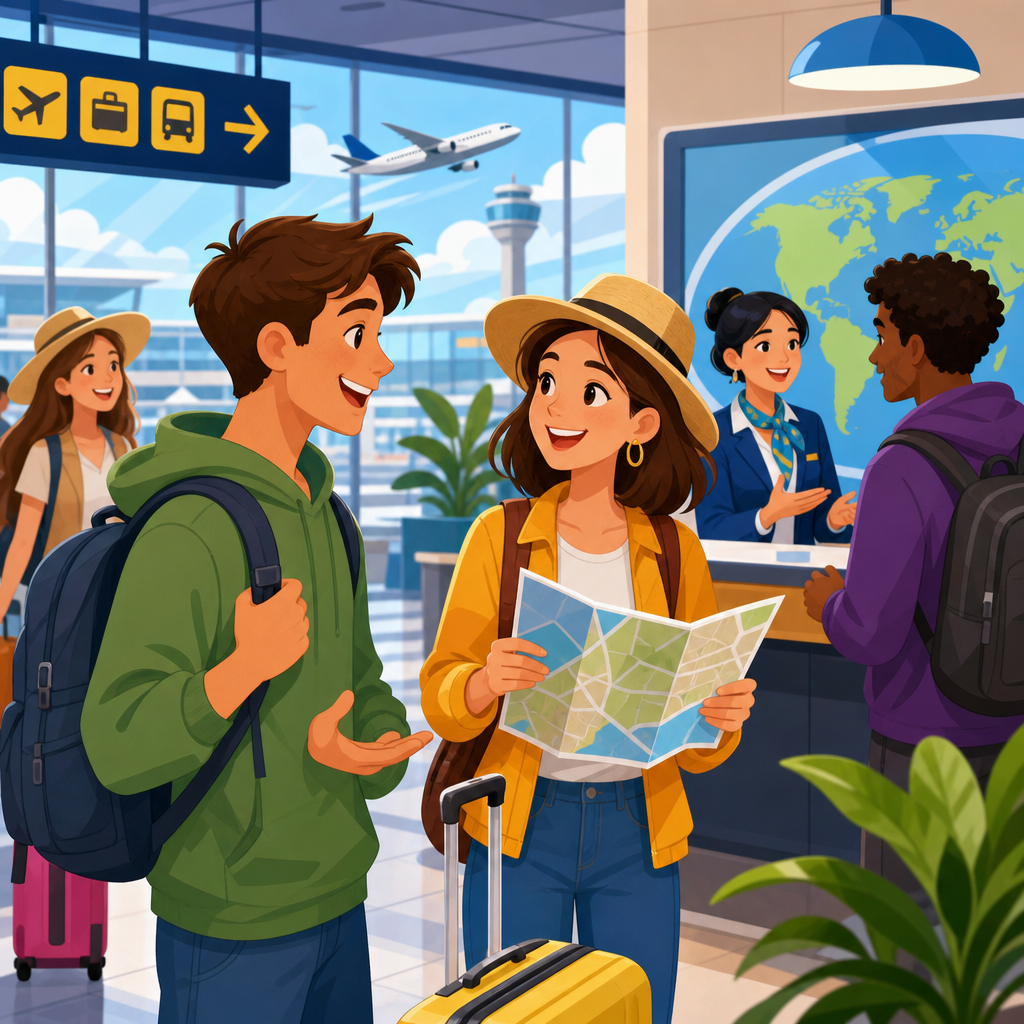
Common travel conversations in English help learners handle the real situations that shape a trip: booking a room, asking for directions, checking in for a flight, ordering food, solving problems, and speaking politely with strangers. In English for travel, the goal is not perfect grammar or a large academic vocabulary. The goal is successful communication in airports, hotels, train stations, restaurants, shops, and emergency situations. A traveler needs practical phrases, clear pronunciation, listening strategies, and enough cultural awareness to avoid confusion. I have taught travel English to adult learners preparing for business trips, family vacations, and migration interviews, and the same pattern always appears: students do not need every rule first; they need the most common travel conversations in English organized by situation.
This topic matters because travel creates pressure. People are tired, there is background noise, signs move quickly, and staff often speak fast. In those moments, memorized school dialogues are rarely enough. Useful English for travel includes fixed expressions such as “Could you repeat that?” “Where is platform three?” and “I have a reservation under Kim.” It also includes functional skills like confirming details, understanding prices, spelling names, reading times, and asking for help without sounding abrupt. As a hub article under ESL for Specific Goals, this guide introduces the core conversations every traveler should master and explains how they connect. If you can manage these situations confidently, you can travel more independently, avoid costly mistakes, and turn simple interactions into smooth, respectful exchanges.
What common travel conversations in English include
Common travel conversations in English are short, purpose-driven exchanges built around a clear task. The traveler usually needs information, service, permission, or problem resolution. The language is therefore highly functional. Typical conversation types include airport check-in, immigration questions, transportation requests, hotel check-in, restaurant ordering, shopping, sightseeing, medical help, and casual small talk. Each type has predictable questions and answers. For example, at immigration, officers commonly ask, “What is the purpose of your visit?” “How long will you stay?” and “Where are you staying?” In a hotel, front desk staff ask for identification, payment, and booking confirmation. In a taxi, drivers ask for the destination and sometimes the preferred route.
The key terms in travel English are function, register, and repair. Function means what the language does, such as requesting, clarifying, apologizing, or confirming. Register means the level of formality. Travelers should usually choose polite neutral English: “Could you help me?” works better than “Help me.” Repair means fixing communication when something breaks down. In real travel, repair language is essential: “Sorry, I didn’t catch that,” “Do you mean terminal two?” and “Could you say that more slowly?” Learners who master repair strategies communicate better than learners who only memorize perfect dialogues. Travel English is not one long conversation; it is a set of repeatable micro-conversations, each with common sentence patterns and expected responses.
Airport and immigration conversations
Airport English is often the first high-stakes interaction on an international trip. At check-in, airline staff usually need your passport, destination, baggage details, and seating preference. A typical exchange sounds like this: “Good morning. May I see your passport?” “Sure. Here it is.” “Are you checking any bags?” “Yes, one suitcase.” “Would you like an aisle or window seat?” “An aisle seat, please.” Travelers should also know problem phrases such as “My flight was changed,” “My bag is overweight,” “Where is the gate?” and “Is this flight boarding now?” In my classes, learners improve fastest when they practice numbers, dates, and letters because agents often confirm names, booking codes, and departure times under noisy conditions.
Immigration and security conversations are more direct. Officers may ask, “Why are you visiting?” “Is this your first trip here?” “How much cash are you carrying?” or “Do you have anything to declare?” The best answers are short, truthful, and specific: “I’m here for tourism for eight days,” or “I’m visiting my sister in Toronto.” Long, nervous explanations often create confusion. Security staff use imperative language such as “Please remove your laptop,” “Take off your belt,” or “Step aside for additional screening.” Travelers should not panic when the tone is brief; brevity in these contexts is normal. What matters is understanding instructions quickly and asking for clarification if needed: “Sorry, should I take out my charger too?” That one sentence can prevent delay and stress.
Transportation conversations: taxis, trains, buses, and directions
After the airport, travelers usually need local transportation. Taxi and rideshare conversations are practical and repetitive. You need to state the destination, confirm the price or meter, and sometimes explain route preferences. Useful phrases include “Please take me to this address,” “How long will it take?” “Do you accept card?” and “Could you drop me off near the main entrance?” In some cities, drivers may ask, “Do you want the fastest route or the cheapest route?” Travelers should also know location phrases such as “next to,” “across from,” “on the corner,” and “between.” These are critical when confirming pickup points, especially at large stations, airports, or hotels where one wrong entrance can waste thirty minutes.
Train and bus conversations focus on schedules, platforms, tickets, and transfers. Staff may say, “The 10:45 service is delayed,” “You need to change at Central Station,” or “Platform six has changed to platform nine.” Direction conversations with strangers often begin with “Excuse me, could you tell me how to get to the museum?” Clear follow-up questions matter: “Is it within walking distance?” “Which line should I take?” “Do I need to transfer?” A common learner mistake is asking only “Where is it?” when the real need is a sequence of steps. Good travel English is procedural. It gets from point A to point B with minimal ambiguity. Navigation apps help, but spoken confirmation from staff or locals is still valuable when signs, line closures, or local accents complicate the situation.
Hotel check-in, check-out, and solving room problems
Hotel conversations are among the most predictable in travel English, which makes them ideal for practice. At check-in, the guest usually says, “I have a reservation under Silva,” or “I’d like to check in.” Staff commonly ask for ID, a credit card, and arrival details. They may say, “Breakfast is served from 6:30 to 10:00,” “Your room is on the fifth floor,” or “Wi-Fi is included.” Important follow-up questions include “What time is check-out?” “Is there a late check-out option?” “Can you store my luggage?” and “How do I call reception from my room?” These are standard, high-frequency interactions, and handling them well creates immediate confidence because the traveler gains a stable base for the trip.
Problems at a hotel require polite but precise language. Instead of saying “Room bad,” a traveler should describe the issue clearly: “The air conditioning isn’t working,” “There’s no hot water,” “The room hasn’t been cleaned,” or “I requested a non-smoking room.” Effective complaint language is calm and specific: state the problem, request a solution, and confirm the timeline. For example, “The shower is leaking. Could someone take a look today?” If the answer is unclear, ask, “When do you think maintenance can come?” In hospitality, specificity leads to action. I encourage learners to carry photo evidence for billing or room condition disputes, but spoken English still matters because front desk teams need concise explanations before they can respond. Good hotel English reduces friction and protects the traveler’s money, comfort, and time.
Restaurant, shopping, and sightseeing conversations
Restaurant English goes beyond ordering food. Travelers need to ask about ingredients, portion sizes, allergies, payment methods, and service customs. Core phrases include “Could I see the menu, please?” “What do you recommend?” “Does this contain nuts?” “Can I have this without cheese?” and “Could we have the bill, please?” In countries where tipping customs differ, travelers may also ask, “Is service included?” Misunderstandings often happen around cooking preferences, sides, and drinks. A learner who can ask one extra question avoids disappointment: “Does this come with rice or salad?” The conversation is usually short, but it directly affects health, spending, and overall satisfaction, especially for vegetarians, families with children, and anyone managing allergies.
Shopping and sightseeing conversations are equally useful because they combine transaction language with social interaction. In shops, staff ask, “Can I help you?” “What size are you looking for?” or “Would you like a receipt?” Travelers may need “I’m just looking,” “Do you have this in a smaller size?” “How much is this?” and “Can I pay by card?” At museums and attractions, common questions include “What time is the last entry?” “Is there an audio guide?” “Are there discounts for students?” and “How long does the tour last?” These exchanges are easy to underestimate, yet they create many opportunities for confusion because prices, schedules, and policies vary widely. Practical tourism English means asking direct questions early instead of making assumptions and discovering limits too late.
Useful phrases by situation
The fastest way to improve common travel conversations in English is to learn phrases in clusters by situation. Individual words are less powerful than complete expressions because travel interactions move quickly. When a traveler can produce a full phrase automatically, response time improves and stress drops. The table below groups common situations with the most useful language patterns and the reason each pattern works in real conversation.
| Situation | Useful phrase | Why it helps |
|---|---|---|
| Airport check-in | I have one checked bag. | Gives clear baggage information fast. |
| Immigration | I’m here for tourism for one week. | Answers purpose and duration directly. |
| Directions | Could you show me on the map? | Reduces misunderstanding from accents. |
| Taxi | Please take me to this address. | Works even with pronunciation differences. |
| Hotel | I have a reservation under Patel. | Uses the standard check-in formula. |
| Restaurant | Does this dish contain shellfish? | Protects health and clarifies ingredients. |
| Shopping | Do you have this in a medium? | Supports efficient size requests. |
| Emergency | I need a doctor. It’s urgent. | Signals seriousness immediately. |
| Clarification | Could you repeat that more slowly? | Repairs communication politely. |
| Payment | Can I pay by card? | Confirms method before checkout. |
Emergency conversations, small talk, and how to practice travel English
Emergency travel conversations require simple, immediate language. If you lose a passport, need medical care, or report theft, complexity is the enemy. Say what happened, where you are, and what you need: “My passport has been stolen,” “I need the police,” “My child is missing,” or “I’m having trouble breathing.” At pharmacies or clinics, useful phrases include “I have a fever,” “I’m allergic to penicillin,” “Where is the nearest hospital?” and “I need an interpreter if possible.” Travelers should also learn local emergency numbers before arrival; for example, 112 works across much of Europe, while 911 is standard in the United States and Canada. Clear emergency English saves time, and in urgent situations, minutes matter.
Not every travel conversation is transactional. Small talk helps with host families, tour guides, seatmates, and local residents. Safe topics include the weather, food, the city, travel plans, and cultural recommendations. “Is this your first time here?” “What would you recommend seeing?” and “The old town is beautiful” are natural openings. Still, effective travel English is built through practice, not reading alone. I advise learners to role-play full sequences: airport to hotel, hotel to restaurant, restaurant to pharmacy. Use shadowing to copy rhythm and intonation, record your voice, and practice with maps, menus, and booking confirmations. Focus on listening for key words rather than every word. When learners train by situation, common travel conversations in English become automatic, and automatic language is what keeps real trips moving smoothly.
English for travel is most useful when it is organized around the conversations travelers actually face. Across airports, immigration counters, train stations, taxis, hotels, restaurants, shops, attractions, and emergencies, the same principle applies: successful communication depends on clear purpose, polite phrasing, and the ability to repair misunderstandings quickly. You do not need advanced grammar to travel well. You need the right expressions for common travel conversations in English, confidence with numbers and details, and enough listening practice to follow short instructions in noisy places.
As the hub page for English for Travel within ESL for Specific Goals, this article gives the foundation that supports every deeper lesson in the topic. Each subskill can become its own study path: airport English, hotel complaints, restaurant ordering, asking for directions, emergency help, and travel small talk. Start by choosing the situations you are most likely to face on your next trip, then practice those dialogues aloud until they feel natural. Build phrase clusters, not isolated vocabulary lists. If you want better trips, fewer misunderstandings, and more independence abroad, begin with these travel conversations and practice them before you pack.
Frequently Asked Questions
1. What are the most important English conversations travelers should learn first?
The most useful travel conversations are the ones tied to situations you are most likely to face during a trip. For most learners, that means airport check-in, passport control, finding transportation, checking into a hotel, asking for directions, ordering food, shopping, and handling simple problems. These are high-frequency situations where a few clear phrases can make a major difference. You do not need advanced grammar to manage them well. You need practical language such as “I have a reservation,” “Where is platform 4?”, “Could you help me?”, “How much is this?”, “I’d like to order,” and “Can you say that again, please?”
A smart way to start is to organize your study by travel stage. Before departure, focus on booking and airport language. After arrival, learn transportation and hotel phrases. During the trip, practice restaurant, shopping, and sightseeing conversations. Also include emergency language such as “I need a doctor,” “I lost my bag,” or “I need to call the police.” This approach helps you remember language in context instead of memorizing random vocabulary lists. Travel English works best when it is connected to real actions, real places, and real needs.
It is also important to learn common question patterns because travel often requires short exchanges. Staff may ask, “Can I see your passport?”, “Do you have any bags to check?”, “Single or return?”, or “Would you like anything to drink?” If you can understand these routine questions and give direct answers, communication becomes much easier. In short, the best conversations to learn first are not the most complex ones. They are the ones that help you move, eat, sleep, pay, and solve problems with confidence.
2. Do I need perfect grammar to communicate successfully while traveling in English?
No, perfect grammar is not necessary for successful travel communication. In fact, one of the biggest mistakes learners make is waiting until their English feels “correct enough” before they speak. Travel English is about being understood in real time, often in noisy, fast-moving environments such as airports, train stations, hotel lobbies, and busy restaurants. In those moments, clear meaning matters much more than grammatical perfection. A simple sentence like “I need taxi to airport” may not be grammatically complete, but most people will understand it immediately.
That said, basic structure still helps. Short, direct sentences are usually the most effective. For example, “I have a reservation,” “I am looking for gate 12,” “Can I pay by card?”, and “I need help with my luggage” are all easy to remember and easy for others to understand. If your grammar is not perfect but your pronunciation is clear and your message is direct, you can communicate very successfully. Many native speakers also simplify their language when helping travelers, so the goal is not to sound academic. The goal is to exchange useful information politely and quickly.
A better priority than perfect grammar is clarity. Practice key verbs such as need, want, have, go, pay, book, order, and help. Learn useful time phrases like today, tomorrow, at 7 p.m., and two nights. Learn numbers, dates, room types, food items, and transportation vocabulary. If you can combine these basic building blocks, you can handle most situations. Confidence also grows when you stop worrying about small errors. People in travel settings are usually focused on helping you complete a task, not judging your sentence structure. Speak simply, listen carefully, and ask follow-up questions when needed.
3. How can I improve my English listening and speaking for real travel situations?
The best way to improve for travel is to practice with realistic, situation-based English. Instead of only studying isolated words, use full dialogues connected to common travel moments. Practice conversations for checking in at a hotel, ordering at a restaurant, buying a train ticket, asking for directions, and going through airport security. Repeat the same dialogues out loud until the language feels automatic. This is important because travel conversations often happen quickly, and you may not have time to mentally translate from your first language.
Listening practice should include different accents, speeds, and settings. Airport announcements, hotel front desk conversations, and restaurant interactions often sound different from classroom English. Try listening to short travel dialogues, travel videos, or role-play recordings and focus on catching key words rather than understanding every single word. In real life, you usually do not need to understand everything. You need to recognize the important information: gate number, departure time, total price, room number, street name, or menu choice. This skill is far more practical than trying to follow every detail perfectly.
For speaking, repetition is essential. Practice useful phrases aloud, not just silently. Record yourself saying things like “Excuse me, where is the nearest station?”, “I’d like to check in,” or “Could I have the bill, please?” Then listen to your pronunciation and make adjustments. Role-play with a teacher, language partner, or even by yourself. One highly effective method is to prepare “mini scripts” for likely situations. For example, if you know you will check into a hotel, practice the exact exchange in advance. This reduces anxiety and increases speed when the real conversation happens. Over time, these scripts become flexible speaking tools you can adapt naturally.
4. What polite English phrases should travelers use when speaking with strangers or service staff?
Politeness is one of the most valuable parts of travel English because it helps conversations go smoothly, even when there is confusion or stress. Simple expressions such as “Excuse me,” “Please,” “Thank you,” “Could you help me?”, and “I’m sorry, I didn’t understand” can completely change the tone of an interaction. Whether you are asking a stranger for directions, speaking with hotel staff, ordering in a restaurant, or requesting help at an airport, polite language shows respect and often leads to better assistance.
Some of the most useful polite travel phrases include “Excuse me, could you tell me how to get to…?”, “Could I have…?”, “Would it be possible to…?”, “Can you please repeat that?”, and “Thank you for your help.” These phrases are especially helpful because they sound natural without being too formal. If there is a problem, polite language becomes even more important. Instead of saying “This is wrong,” a better approach is “I think there may be a mistake with my order” or “I’m sorry, but my room doesn’t seem to be ready yet.” This keeps the conversation calm and cooperative.
Travelers should also learn how to soften requests and buy time. Phrases like “Just a moment, please,” “Let me check,” “I’m not sure,” and “Could you speak a little more slowly?” are very practical. If you do not understand someone, do not pretend to understand. Ask politely for clarification: “Could you repeat that?”, “Could you write it down?”, or “Do you mean this street?” Clear, respectful communication is often more effective than using advanced vocabulary. In travel settings, kindness, patience, and a polite tone are just as important as the words themselves.
5. What should I say in English if I have a travel problem or emergency?
Every traveler should prepare a small set of emergency phrases before a trip. Problems can happen even on well-planned journeys, and having the right English ready can save time and reduce stress. Start with direct, high-priority expressions such as “I need help,” “I lost my passport,” “My bag is missing,” “I missed my flight,” “I need a doctor,” “Please call the police,” and “There is a problem with my reservation.” These phrases are simple, urgent, and easy for others to understand quickly. In emergencies, short and clear language is usually best.
It is also useful to learn problem-solving language for less serious issues. For example, in a hotel you may need to say, “The air conditioning isn’t working,” “There is no hot water,” or “I think I was charged twice.” At the airport, you might need “My luggage did not arrive,” “Where is the lost baggage office?”, or “Can you help me rebook my ticket?” In a restaurant, common problem phrases include “I ordered something different,” “This isn’t what I asked for,” or “I have a food allergy.” These are everyday travel problems, and knowing how to explain them calmly can make them easier to fix.
Beyond memorizing phrases, travelers should practice giving key personal information clearly. Be ready to say your full name, hotel name, phone number, room number, flight number, and destination. Know how to explain location: “I am at Terminal 2,” “I’m near the train station,” or “I’m at the front entrance of the hotel.” If possible, keep important details written in your phone or on paper. In stressful situations, even confident speakers can forget words. The strongest preparation is a combination of practical emergency phrases, clear pronunciation, and the confidence to ask directly for help when you need it.