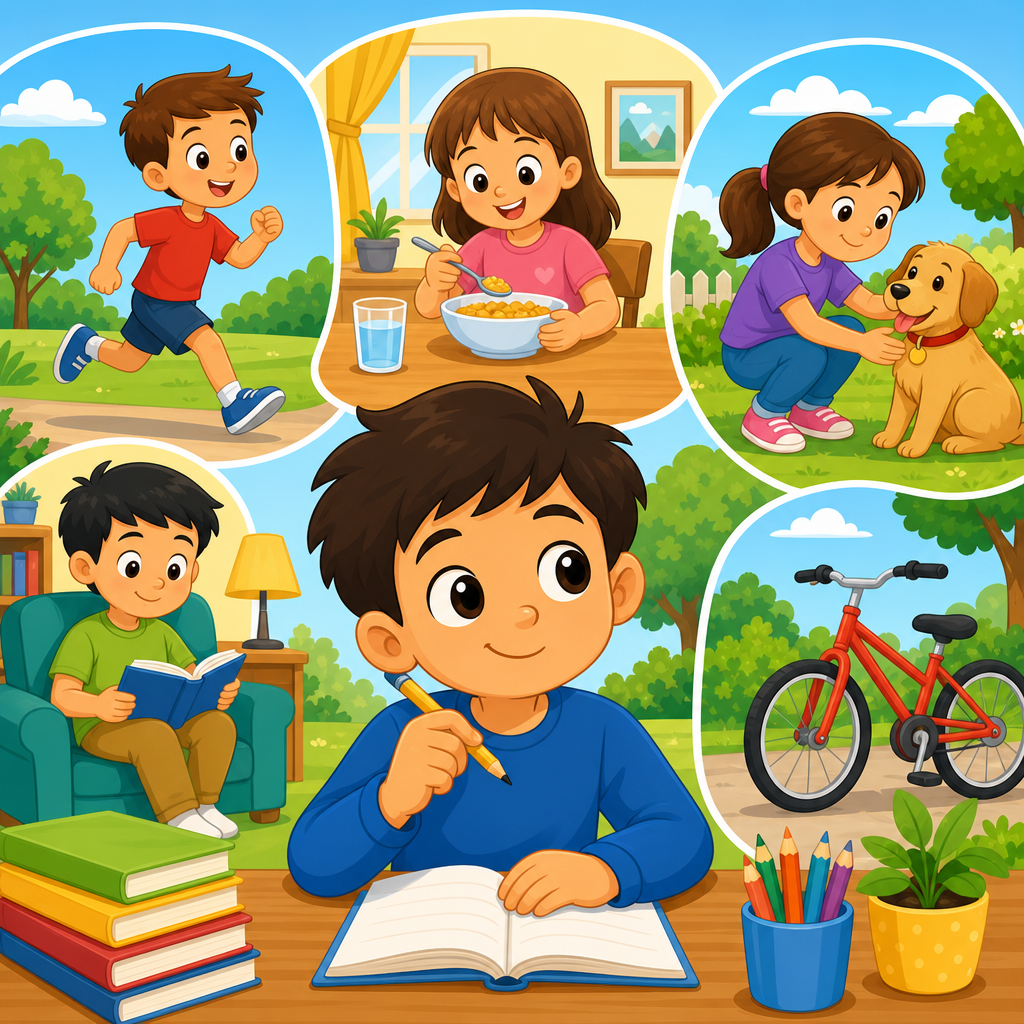
Simple sentences are the foundation of clear English, and for beginners they are the fastest way to start speaking, writing, and understanding the language with confidence. In ESL Basics, a simple sentence means one independent clause that expresses a complete thought, usually with a subject and a verb, such as “I read” or “The baby sleeps.” It is called simple not because the idea is childish, but because the structure is direct and complete. In beginner classrooms, I have seen simple sentences unlock progress faster than long grammar lectures, because learners can immediately use them in daily life: “I am tired,” “We need water,” “She likes music.” These patterns appear in conversations, textbooks, signs, emails, and tests, so mastering them matters early.
Many new learners confuse a simple sentence with a short sentence. That is a mistake. A simple sentence can be very short, like “Birds fly,” but it can also be longer, like “My older brother walks to the train station every morning before work.” The key is not length. The key is that the sentence has one main clause and does not join two full ideas with a coordinating conjunction such as and, but, or so. A simple sentence may include adjectives, adverbs, prepositional phrases, compound subjects, or compound verbs. For example, “Tom and Ana study at the library after class” is still a simple sentence because it contains one complete clause.
Why does this topic matter so much for beginners? Because simple sentences build accuracy, fluency, and confidence at the same time. When students try to produce complex structures too early, they often freeze, translate word by word, or make avoidable errors with tense, agreement, and word order. In contrast, simple sentences let them practice the essentials: subject-verb agreement, basic verb tenses, articles, pronouns, and common vocabulary. They also support listening comprehension. If a learner can quickly identify who did what, when, and where, everyday English becomes less intimidating. This hub page covers what simple sentences are, the main patterns beginners need, examples of simple sentences for beginners, common mistakes, and practical ways to practice them well.
What a Simple Sentence Is and How It Works
A simple sentence contains one independent clause. That clause can stand alone as a complete sentence because it includes a subject, a verb, and a complete meaning. In “The dog barked,” the subject is “the dog,” the verb is “barked,” and the idea is complete. In “After dinner,” there is useful information, but no complete thought, so it is only a phrase. This difference is essential for ESL learners. A sentence must communicate a full message, not just a group of words.
The most common beginner pattern is subject plus verb: “I smile,” “They work,” “Rain falls.” Another frequent pattern is subject plus be verb plus complement: “She is happy,” “The room is cold,” “We are ready.” English also allows simple sentences with objects, as in “He plays soccer,” and with adverbials, as in “She sings in the shower.” In classroom practice, I usually introduce these patterns in that order because learners first need control of basic word order before adding extra information. English is less flexible than some languages. The standard pattern is subject-verb-object, and beginners benefit from treating that as the default.
Punctuation also supports meaning. A simple sentence starts with a capital letter and ends with a period, question mark, or exclamation mark. “You are here.” “Are you ready?” “Watch out!” These are all simple sentences because each one contains a single complete clause. Questions deserve special attention because English changes word order with auxiliary verbs: “Do you live here?” “Is she your teacher?” Even though the structure changes, the sentence is still simple because it contains one independent clause.
Core Patterns with Examples of Simple Sentences for Beginners
Beginners need high-frequency sentence frames they can adapt quickly. The first is subject plus verb: “Cats sleep.” “Children laugh.” “The sun rises.” These work well because they show agreement clearly. Singular subjects usually take a singular verb in the present simple, often with -s in the third person, while plural subjects do not: “He works,” but “They work.” The second pattern is subject plus be verb plus noun or adjective: “I am a student.” “The soup is hot.” “They are late.” This pattern is central because it helps learners describe identity, condition, age, location, and feelings.
The third pattern is subject plus verb plus object: “Mina drinks tea.” “We watch movies.” “My father drives a bus.” These examples introduce transitive verbs, which need objects to complete the meaning. The fourth pattern adds place or time: “The class starts at nine.” “My friend lives in Seoul.” “I study after dinner.” These additions make simple sentences more useful in real situations. When learners can answer basic questions like who, what, where, and when, they can manage everyday communication much more effectively.
| Pattern | Structure | Example | Use |
|---|---|---|---|
| SV | Subject + Verb | Birds sing. | Basic actions and facts |
| SVC | Subject + Be + Complement | The baby is sleepy. | Descriptions and identity |
| SVO | Subject + Verb + Object | She reads books. | Actions affecting something |
| SVA | Subject + Verb + Adverbial | We eat at home. | Time and place details |
| SVOO | Subject + Verb + Indirect Object + Direct Object | He gave me advice. | Giving and sending |
It helps beginners memorize useful examples of simple sentences for beginners by topic. For daily routines: “I wake up at six.” “She brushes her teeth.” “We eat breakfast together.” For the classroom: “The teacher explains the lesson.” “I need a pencil.” “Our test is tomorrow.” For feelings and health: “I am nervous.” “My head hurts.” “He feels better today.” For travel and directions: “The bus stops here.” “The bank is across the street.” “We leave at noon.” These examples are simple, but they are not trivial. They cover the functions learners need most in real life.
How to Build Better Simple Sentences Step by Step
The easiest way to build a simple sentence is to begin with a subject and choose one verb that matches it. If the subject is “she,” a present simple verb usually takes -s: “She works.” Then add the most important extra information: “She works at a hospital.” This step-by-step method prevents overload. In my experience, learners make fewer errors when they first create the core sentence and then expand it carefully. If they try to build long sentences immediately, they often lose control of word order or verb form.
Beginners should also learn how modifiers fit into a simple sentence. Adjectives usually come before nouns: “a small bag,” “an interesting book.” Adverbs of frequency often come before the main verb but after be: “I always study early,” but “She is always friendly.” Prepositional phrases add context: “on the table,” “after school,” “with my sister.” A sentence like “My younger sister always does her homework at the kitchen table” is still simple because it has one independent clause, even though it contains several details. This is an important insight for learners who wrongly assume that any long sentence must be complex.
Questions and negatives are another essential area. To make a negative in the present simple, use do or does: “I do not like coffee.” “He does not drive.” With be, add not directly: “She is not busy.” For questions, invert the auxiliary: “Do they work here?” “Is the store open?” These patterns appear constantly in beginner communication. A learner who can ask “Where do you live?” and answer “I live near the station” already has practical control of simple sentence structure.
Common Mistakes Beginners Make with Simple Sentences
The most frequent mistake is leaving out the subject or the verb. Some languages allow sentences like “Is raining,” but standard English requires “It is raining.” Another common problem is subject-verb agreement: “She go to school” instead of “She goes to school.” This error is understandable because the third-person singular -s is small in form but important in grammar. Teachers should correct it consistently, but learners should not let it block communication. Accuracy grows through repetition and noticing.
Articles also cause trouble. Beginners often say “I have book” when English requires “I have a book.” Word order is another issue, especially in questions: “Where you live?” instead of “Where do you live?” I often see learners overgeneralize from short spoken forms, then reproduce incorrect patterns in writing. That is why reading correct examples matters. Exposure helps students internalize sentence shape, not just vocabulary.
Run-on sentences appear when learners connect multiple ideas without proper punctuation or conjunction control: “I like tea I drink it every morning.” For beginners, it is usually better to split ideas into separate simple sentences: “I like tea. I drink it every morning.” This approach improves clarity and reduces grammatical strain. Fragments are the opposite problem. “Because I was late” is not a complete sentence by itself. A beginner should first master “I was late” before adding dependent clauses. Simple sentence practice is not a limitation; it is a training ground for everything that comes next.
Practice Methods, Teaching Uses, and Next Steps in ESL Basics
The best way to practice simple sentences is through short, controlled activities followed by meaningful use. Sentence substitution drills still work when they are focused and brief: “I live in ___,” “She lives in ___,” “They live in ___.” Picture description is also effective because it forces learners to connect grammar with real meaning: “The boy is running.” “A woman carries a bag.” “Two children play in the park.” In beginner lessons I have taught, five minutes of daily sentence building produced better retention than occasional long grammar sessions. Consistency beats intensity.
Writing journals with a strict limit of five to eight simple sentences can also help. For example: “I woke up late today. I missed the bus. My brother drove me to school. The class was easy. I felt better after lunch.” This type of task develops tense control and sequencing without pushing learners into structures they cannot yet manage. Speaking practice should follow the same principle. Role-plays about shopping, introductions, family, or routines naturally encourage clear simple sentences. A beginner who says “I need two tickets” or “My mother works downtown” is using English successfully.
As a hub within ESL Basics, this topic connects directly to subject pronouns, the be verb, present simple tense, articles, prepositions, question forms, punctuation, and basic writing. Those areas should be learned alongside simple sentences, not separately. The goal is not to memorize isolated grammar labels. The goal is to produce accurate, useful English in everyday situations. Start with short patterns, expand them with details, and practice them until they feel automatic. If you want faster progress, review ten model sentences daily, write five of your own, and say them aloud. Simple sentences are the starting point of fluent communication, and mastering them gives every beginner a strong, reliable base for the rest of English learning.
Frequently Asked Questions
What is a simple sentence in English?
A simple sentence is a sentence with one independent clause, which means it expresses one complete thought and can stand on its own. In most cases, it includes a subject and a verb, such as “I read,” “She runs,” or “The baby sleeps.” The subject tells who or what the sentence is about, and the verb shows the action or state. Some simple sentences are very short, while others can be a little longer, such as “The little boy plays in the park.” Even though that example has more words, it is still a simple sentence because it has only one complete idea.
For beginners, simple sentences are important because they form the base of everyday English. They help learners understand sentence order, build confidence, and communicate clearly without getting lost in complicated grammar. A sentence does not need to be long to be correct or useful. In fact, short and direct simple sentences are often the best place to start when learning how to speak and write English accurately.
Can a simple sentence be long, or does it always have to be short?
A simple sentence can absolutely be long. The word “simple” refers to the sentence structure, not the number of words. If the sentence contains just one independent clause, it is still simple, even if it has adjectives, adverbs, prepositional phrases, or compound subjects and verbs. For example, “The friendly teacher with the blue bag speaks clearly to the new students every morning” is a simple sentence. It is longer than “The teacher speaks,” but it still expresses one complete thought with one main clause.
This is a helpful point for beginners because many learners think “simple” means “very short” or “easy vocabulary only.” That is not always true. A simple sentence can grow step by step as your English improves. You might begin with “The dog runs,” then expand it to “The small brown dog runs across the yard every afternoon.” Both are simple sentences. This makes simple sentences a great learning tool because they let you practice adding detail without changing the basic structure.
What are some examples of simple sentences for beginners?
Some clear and useful examples of simple sentences for beginners include: “I eat breakfast.” “She is happy.” “We go to school.” “The sun is hot.” “My brother plays soccer.” “They live in a big city.” “The baby is sleeping.” “I like coffee.” “He reads every night.” “The cat sits on the chair.” These examples are effective because they use common subjects, everyday verbs, and familiar vocabulary. They also show the usual word order in English, which is subject plus verb, and often an object or extra detail.
Beginners should practice a variety of simple sentence patterns. For example, you can use subject + verb: “Birds fly.” You can use subject + verb + object: “I drink water.” You can also use subject + be verb + complement: “She is tired.” Working with these patterns helps learners see how English sentences are built. Once these forms feel natural, it becomes much easier to ask questions, write short paragraphs, and understand spoken English in real situations.
Why are simple sentences so important for English beginners?
Simple sentences are important because they give beginners a strong foundation. Before learners can comfortably use longer or more complex sentences, they need to understand how a complete English thought is formed. Simple sentences teach the core skills of grammar, including subject-verb agreement, basic verb forms, sentence order, and punctuation. When students master these essentials, they make fewer mistakes and feel more confident speaking and writing.
They are also practical. In real communication, many everyday messages are simple sentences: “I need help.” “We are ready.” “The bus is late.” “I don’t understand.” These kinds of sentences are extremely useful in classrooms, at work, while traveling, and in daily conversation. From a teaching perspective, simple sentences allow beginners to focus on meaning without being overwhelmed by advanced structures. That is why they are often the first type of sentence introduced in ESL lessons. They are not just beginner exercises; they are the building blocks of fluent communication.
How can beginners practice writing simple sentences correctly?
Beginners can practice writing simple sentences correctly by starting with basic patterns and repeating them often. A strong method is to begin with a subject and a verb, then expand little by little. For example, start with “I walk,” then try “I walk to school,” and then “I walk to school every day.” This kind of practice helps learners understand how to create a complete thought while adding useful details. It is also helpful to use familiar topics such as family, food, school, hobbies, weather, and daily routines, because known vocabulary makes sentence building easier.
Another effective strategy is to read simple sentence examples and then create your own. Beginners can keep a notebook and write five to ten simple sentences each day, checking that each one has a clear subject and verb. Reading the sentences aloud is also valuable because it connects writing with speaking practice. Teachers and self-learners should pay attention to common mistakes, such as missing verbs, incorrect word order, or sentence fragments. With regular practice, simple sentences become automatic, and that fluency prepares learners for more advanced grammar later on. The key is consistency: short, clear, correct sentences practiced every day lead to real progress.