Grammar mistakes are rarely a sign of low intelligence; they are usually a sign of interference, speed, habit, or incomplete exposure. In ESL learning, common grammar mistakes appear when a speaker transfers patterns from a first language, memorizes a rule without seeing enough exceptions, or writes quickly without editing for agreement, tense, or word order. I have edited essays, emails, reports, and classroom assignments from learners at beginner through advanced levels, and the same issues appear again and again: subject-verb agreement errors, article confusion, incorrect prepositions, tense shifts, missing plural markers, and sentence fragments. A useful grammar hub must do more than list errors. It should explain what the mistake is, why it happens, how to correct it, and what pattern the learner should watch for next time. That is exactly what this guide does.
Common grammar mistakes matter because grammar affects clarity, credibility, and comprehension. In academic writing, a small error can weaken an argument by making the sentence harder to parse. In workplace communication, grammar mistakes can obscure deadlines, responsibilities, or tone. In conversation, repeated errors may not block understanding, but they can cause listeners to work harder than necessary. For ESL learners, grammar is not only about correctness; it is about control. When you can choose the right tense, article, pronoun, or clause structure on purpose, you communicate with more precision. This article serves as a sub-pillar hub for ESL grammar by covering the most frequent error categories, showing real-life examples with corrections, and pointing to the logic behind each rule so you can apply it beyond a single sentence.
The term grammar mistakes refers to errors in the structure of language rather than spelling alone. If someone writes “She go to work every day,” the problem is grammar because the verb form does not match the subject in the present simple. If someone writes “definately,” the problem is spelling. The distinction matters because learners often try to fix grammar by memorizing vocabulary lists, when what they actually need is pattern recognition. Throughout this article, you will see corrected examples in plain English, along with practical explanations based on real usage. The goal is not perfectionism. The goal is to help you notice the highest-frequency errors, understand the correction, and build habits that carry over into speaking and writing.
Subject-Verb Agreement Errors That Change the Sentence
Subject-verb agreement means the verb form must match the subject in number and person. This sounds simple, yet it causes constant problems because English marks agreement in limited but important ways, especially in the present simple. A classic error is “He go to school by bus.” The correct sentence is “He goes to school by bus.” Many learners know the rule but drop the -s in fast writing or speech. Another common example is “The students studies hard,” which should be “The students study hard.” The subject is plural, so the verb must be the base form.
Agreement becomes harder when a phrase sits between the subject and the verb. Consider “The list of items are on the desk.” The head noun is “list,” not “items,” so the correct version is “The list of items is on the desk.” I often see this error in business emails and student reports because writers are drawn toward the nearest noun. Collective nouns add another layer. In American English, “The team is winning” is standard when the team acts as one unit. Pronouns also trigger mistakes: “Everybody have a ticket” should be “Everybody has a ticket.” Indefinite pronouns such as everybody, someone, and each usually take singular verbs.
Verb Tense Mistakes in Daily Communication
Verb tense errors are among the most noticeable common grammar mistakes because they affect time reference immediately. One frequent issue is mixing present simple and present continuous. Learners write “I am knowing the answer” instead of “I know the answer.” Stative verbs such as know, believe, understand, and belong are usually not used in continuous forms. Another common sentence is “Yesterday I go to the market,” which must be “Yesterday I went to the market.” Time markers like yesterday, last week, and in 2023 usually require a past form.
Present perfect and past simple cause trouble even for advanced learners. “I have seen him yesterday” is incorrect in standard English because present perfect does not normally combine with a finished past time marker. The correct form is “I saw him yesterday.” By contrast, “I have seen that movie before” is correct because the time is unspecified. In workplace English, I often correct lines such as “We didn’t received your file” to “We didn’t receive your file.” After did or didn’t, the main verb returns to the base form. Small tense corrections like this make messages sound immediately more professional and easier to trust.
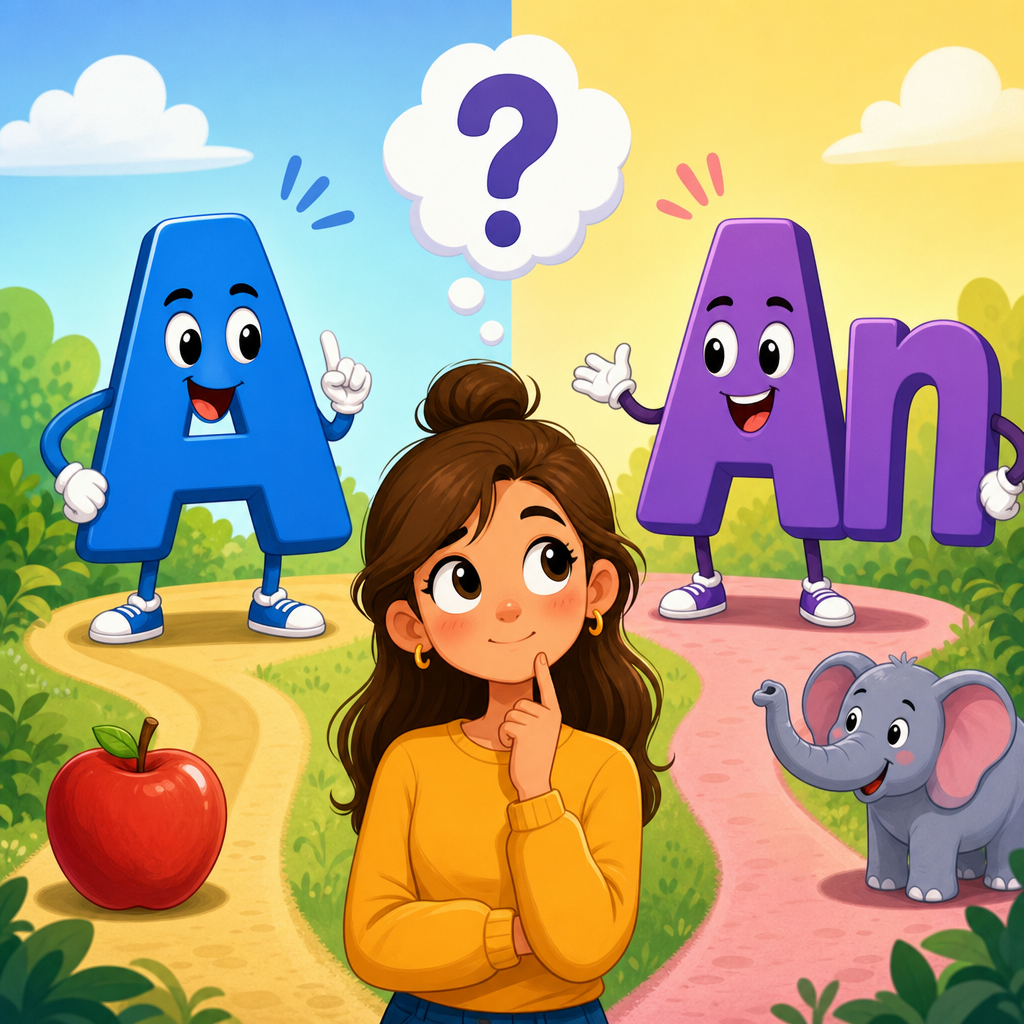
Article Mistakes with A, An, and The
Articles are difficult because many languages either use them differently or do not use them at all. The difference between a, an, the, and zero article can completely change meaning. A learner may write “I bought car yesterday,” but English requires “I bought a car yesterday” because the noun is singular and countable. Another typical sentence is “Sun is hot.” The correct version is “The sun is hot” because there is only one sun in our everyday frame of reference, making it specific.
Article choice depends on whether the noun is specific, general, countable, singular, or already known to the reader. Compare “I need a pen” and “I need the pen on your desk.” The first means any pen; the second means one specific pen. I regularly see overcorrection too: “The life is difficult” should usually be “Life is difficult” when speaking generally. Country names, meal names, and abstract nouns often take no article in broad statements, but there are exceptions, such as “the Netherlands” and “the United States.” Learning articles improves quickly when students stop chasing isolated rules and start asking one practical question: am I talking about any one, one specific one, or things in general?
Preposition Errors Learners Make Most Often
Prepositions are small words with large consequences. They show relationships involving time, place, direction, method, and connection, but their logic does not map neatly across languages. The sentence “She is married with a doctor” is a very common transfer error; standard English uses “married to,” so the correction is “She is married to a doctor.” Another example is “We discussed about the problem.” Because discuss already includes the idea of about, the correct version is “We discussed the problem.”
Time prepositions are especially unstable for learners. We say “on Monday,” “in July,” and “at 6:00.” Place prepositions follow their own patterns: “at school,” “in a room,” “on the table.” I often correct “depend of” to “depend on,” “good in math” to “good at math,” and “arrive to the airport” to “arrive at the airport” or “arrive in London,” depending on scale. The best way to master prepositions is not to memorize long random lists. Learn them in chunks attached to nouns, verbs, and adjectives: interested in, responsible for, afraid of, apply for, focus on. Chunks are easier to retrieve accurately in real communication.
Countable, Uncountable, and Plural Noun Problems
Noun errors often involve countability, plural marking, and quantifiers. A learner writes “I need many information,” but information is uncountable, so the correction is “I need a lot of information” or “I need much more information” in formal style. Another very common example is “She gave me an advice.” Since advice is uncountable, standard English uses “She gave me some advice” or “She gave me a piece of advice.” These are not minor preferences; they are fixed grammatical patterns.
Plural markers also disappear easily in ESL writing. “There are three cat in the garden” should be “There are three cats in the garden.” The same issue appears after quantifiers: many books, several ideas, a few minutes. Some nouns are irregular, including children, men, women, feet, and mice. Others stay the same in singular and plural, such as sheep and deer. In classroom writing, I also see confusion with one of the most common noun pairs in English: work and job. We say “I have a job,” but “I have a lot of work.” Knowing which nouns are countable helps learners choose correct articles, quantifiers, and verb agreement at the same time.
Sentence Structure, Word Order, and Fragments
English relies heavily on word order because it has fewer inflections than many languages. The default pattern is subject, verb, object: “The manager approved the budget.” Learners may produce “Approved the manager the budget” under first-language influence, but standard English requires the subject before the verb in statements. Questions reverse the auxiliary and subject: “Did the manager approve the budget?” Adverbs can also move, but not freely in every position. “I only saw him yesterday” and “I saw him only yesterday” can carry slightly different emphasis.
Fragments and run-on sentences are equally common. A fragment is an incomplete sentence, such as “Because I was late.” It needs an independent clause: “Because I was late, I took a taxi.” A run-on joins full sentences without proper punctuation or conjunctions: “I finished the report I sent it at midnight.” Correct versions include “I finished the report, and I sent it at midnight” or “I finished the report. I sent it at midnight.” In real business writing, these sentence structure problems often matter more than rare advanced grammar points because they directly affect readability and tone.
Pronouns, Possessives, and Reference Clarity
Pronoun mistakes create confusion when the reader cannot tell who or what the pronoun refers to. A basic example is “My brother said that he need help.” The verb should agree with the pronoun: “My brother said that he needs help” in reported present context, or “needed help” in a past narrative. Possessives also cause trouble: “Its” means possession, while “it’s” means “it is.” The sentence “The company changed it’s policy” is wrong; the correct version is “The company changed its policy.”
Another frequent issue is ambiguous reference. “When Ana met Maria, she was tired” leaves the reader asking who was tired. A clearer sentence is “When Ana met Maria, Ana was tired” or “Maria was tired when Ana met her,” depending on meaning. Learners also mix subject and object pronouns: “Me and him went to the store” is informal and nonstandard in careful writing; “He and I went to the store” is the standard form. Clear pronoun reference is not an advanced stylistic luxury. It is basic reader support.
Quick Reference Table of Real-Life Grammar Mistakes
| Mistake | Correction | Why it is wrong |
|---|---|---|
| She go every day. | She goes every day. | Third-person singular present needs -s. |
| I have seen him yesterday. | I saw him yesterday. | Finished past time takes past simple. |
| I bought car. | I bought a car. | Singular countable nouns need an article. |
| Married with a teacher | Married to a teacher | Correct preposition is to. |
| Many information | A lot of information | Information is uncountable. |
| Because I was sick. | Because I was sick, I stayed home. | Subordinate clauses cannot stand alone. |
How to Correct Grammar Mistakes Efficiently
The fastest way to improve grammar is to correct by pattern, not by isolated sentence. If you notice three errors with articles in one paragraph, stop and review singular countable nouns across the whole text. If your recurring issue is tense after did, search specifically for did plus past verb forms. In my editing workflow, I mark repeated error types first because repetition reveals the underlying habit. This approach is more effective than correcting twenty unrelated lines without seeing the system behind them.
Use reliable tools carefully. Grammar checkers such as Grammarly, LanguageTool, and Microsoft Editor can catch agreement, punctuation, and article issues, but they are not final authorities. They sometimes misread meaning, especially in complex sentences or discipline-specific writing. A better process is three-step review: read once for sentence completeness, once for verb forms and agreement, and once for articles, plurals, and prepositions. Reading aloud helps because your ear often catches missing words and unnatural phrasing. For long-term improvement, keep a personal error log with the sentence, the correction, and the rule in your own words. That turns every mistake into reusable evidence.
Real-life grammar mistakes with corrections are most useful when they teach a repeatable principle, not just a one-time fix. Across ESL grammar, the highest-value areas are subject-verb agreement, verb tense, articles, prepositions, noun countability, sentence structure, and pronoun clarity. These categories appear constantly in emails, assignments, presentations, and conversations because they sit at the core of English sentence building. If you can recognize them quickly, your writing becomes clearer, your speech becomes more controlled, and your editing becomes faster.
The main benefit of studying common grammar mistakes is not simply producing cleaner sentences. It is gaining confidence that your meaning will arrive intact. When grammar works, readers stop noticing form and focus on ideas. That is the real goal for any ESL learner, whether you are writing to a teacher, manager, client, or friend. Use this hub as a starting point, review the error patterns that appear most often in your own communication, and practice corrections in full sentences. Then revisit your recent writing today and fix the mistakes you now know how to spot.
Frequently Asked Questions
Why do smart people still make grammar mistakes in real life?
Grammar mistakes are not reliable signs of intelligence. In most real-life situations, they happen because people are moving fast, multitasking, translating ideas from another language, or relying on patterns they have used for years. A person can understand a complex topic and still write, “She go to work every day” or “The information are useful” simply because their attention is focused on meaning rather than form. This is especially common in ESL learning, where first-language interference plays a major role. If a learner’s native language does not mark verb tense the same way English does, or does not use articles like “a” and “the,” those features are much more likely to be missed in writing and speech.
Another reason grammar errors persist is that many learners are taught rules in isolation but do not get enough repeated exposure to natural exceptions and real-world usage. Someone may memorize “add -s for third person singular” and still forget it during conversation because spontaneous production is different from controlled practice. The same thing happens with native speakers who type quickly and skip editing. In emails, reports, essays, and messages, mistakes often come from habit, speed, and incomplete proofreading rather than lack of knowledge. That is why the most useful response is not embarrassment, but correction with context. When learners see the mistake, the correction, and the reason behind it, accuracy improves much faster.
What are some common real-life grammar mistakes and how should they be corrected?
Some of the most frequent grammar mistakes appear in subject-verb agreement, verb tense, articles, prepositions, and word order. For example, a learner may write, “He go to school every day,” when the correct version is, “He goes to school every day.” This is a subject-verb agreement issue because third person singular subjects in the simple present usually require the verb to end in -s or -es. Another common example is “Yesterday I go to the store,” which should be corrected to “Yesterday I went to the store,” because the time marker “yesterday” requires a past tense verb.
Article mistakes are also extremely common. A sentence like “I bought new phone” should be “I bought a new phone,” because singular countable nouns usually need an article or another determiner. Word order errors often appear when learners transfer sentence structure from their first language. For instance, “I only know not the answer” sounds unnatural in English; a more natural correction is “I just don’t know the answer” or “I only know that I don’t know the answer,” depending on the intended meaning. Prepositions create another major problem because they often do not translate directly. “Married with someone” should be “married to someone,” and “depend of” should be “depend on.” These mistakes are common because English grammar is full of patterns that seem simple at first but become more complex in actual use. The best approach is to study them through examples, not isolated rules alone.
Why do the same grammar mistakes keep repeating even after correction?
Repeated grammar mistakes usually mean the error is not random. It is often connected to a deep habit, a first-language pattern, or a gap between recognition and production. Many learners can identify the correct sentence when they see two options on a page, but still produce the wrong version while speaking or writing quickly. That happens because passive knowledge develops before active control. In other words, understanding the rule is only the first step; using it accurately in real time takes much more repetition.
Another reason errors repeat is that one correction by itself is rarely enough to change a language habit. If a student writes “people is” and the teacher changes it to “people are,” the learner may accept the correction in that moment without fully noticing the pattern. But if the learner sees and practices several examples such as “people are busy,” “my parents are here,” and “the police are investigating,” the correction becomes more memorable. Repetition with attention is what turns a correction into long-term improvement. It also helps to identify personal error patterns. Some learners consistently drop articles, some confuse past and present tense, and others struggle with sentence order. Once those patterns are tracked, editing becomes more focused and much more effective. The goal is not just to fix one sentence, but to train the learner to catch the same type of mistake independently next time.
How can ESL learners correct grammar mistakes more effectively in writing and speaking?
The most effective method is to combine targeted study with slow, consistent practice. In writing, learners should first draft freely so they can express ideas without fear, then edit in stages instead of trying to fix everything at once. One editing pass can focus only on verbs, another on articles, and another on sentence structure. This is far more practical than checking every grammar point at the same time. Reading the text aloud also helps, because many mistakes become easier to notice when the sentence is heard instead of silently read. For example, “She have two brothers” often sounds wrong more quickly than it looks wrong on the page.
In speaking, self-correction improves when learners practice shorter patterns repeatedly until they become automatic. Rather than memorizing abstract grammar definitions, it is often more useful to drill real phrases such as “He works,” “They were waiting,” “I have never seen that,” or “She is interested in music.” Listening to high-quality English input also matters because it strengthens instinct for natural grammar and word order. Learners should pay attention to how native and proficient speakers form common structures in context, especially in conversations, interviews, and professional communication. Finally, feedback should be selective. If every mistake is corrected immediately, the learner can become overwhelmed. It is usually better to focus on the most frequent or most important error types first, especially those that affect clarity. Gradual correction leads to stronger progress than trying to eliminate every grammar problem at once.
Which grammar mistakes matter most, and which ones are less serious?
The most important grammar mistakes are the ones that affect meaning, clarity, credibility, or professionalism. Errors with verb tense, negation, subject-verb agreement, pronouns, and word order can confuse the reader or listener. For example, “I didn’t went” is problematic because it combines two past markers incorrectly, and “She told me he was ready” can become confusing if the pronoun does not clearly refer to the right person. In academic and professional settings, these errors matter because they can distract the audience and reduce confidence in the message, even when the main idea is understandable.
Less serious mistakes are usually the ones that do not block comprehension. A missing article, an awkward preposition, or slightly unnatural phrasing may still sound nonnative, but the meaning often remains clear. For instance, “I am in the office since morning” should be corrected to “I have been in the office since morning,” yet many readers will still understand the intended meaning. That does not mean such mistakes should be ignored, but it does mean they should be prioritized sensibly. In real-life communication, grammar correction is most useful when it supports clearer meaning and more natural expression, not when it creates anxiety over every tiny imperfection. Strong communication is the main goal. Accuracy matters, but it grows best through awareness, practice, and revision rather than shame.