English punctuation gives structure to written language. It tells readers where ideas begin, pause, connect, and end. For ESL learners, punctuation is not decoration. It changes meaning, tone, and clarity. A missing comma can confuse a sentence, a misplaced apostrophe can signal the wrong grammar, and an incorrect period can make polished writing look careless. In every grammar course I have taught, punctuation errors often caused more misunderstanding than vocabulary mistakes because readers rely on marks to process sentences quickly.
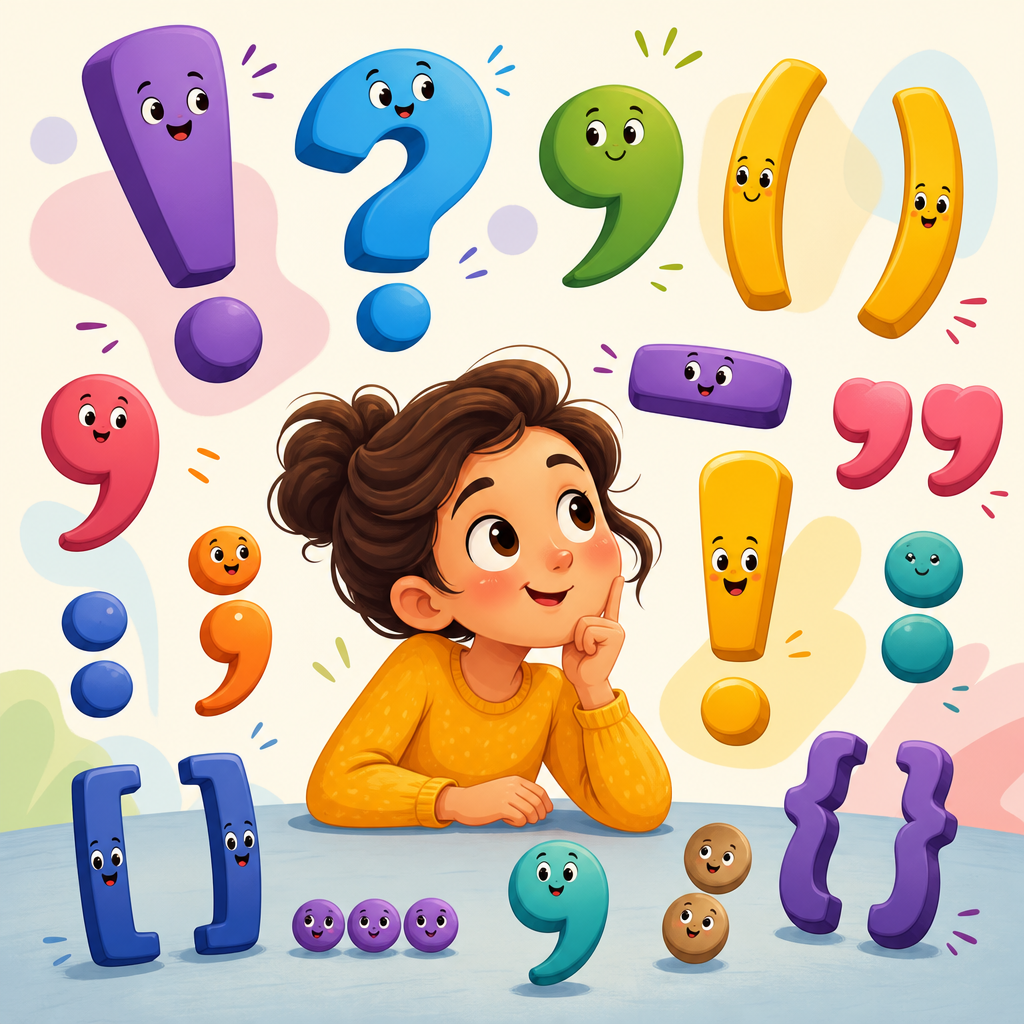
This simple guide to all English punctuation marks explains what punctuation is, why it matters, and how each mark works in real writing. In English, punctuation marks are symbols such as the period, comma, question mark, colon, semicolon, and quotation marks. They organize sentences, show relationships between ideas, mark possession, signal emotion, and help readers identify direct speech, lists, abbreviations, and parenthetical information. Good punctuation supports grammar, but it also supports rhythm. It helps writing sound natural, even when the reader never hears the writer’s voice.
This page serves as a hub for punctuation within ESL grammar. That means it gives a complete overview while also pointing you toward the main patterns you need to master: sentence endings, pauses, joining ideas, showing ownership, and handling titles, numbers, and dialogue. If you understand the function of each mark instead of memorizing random rules, you will write more accurately in emails, essays, tests, and workplace documents. The goal is practical control. By the end, you should know what each punctuation mark does, when to use it, and which mistakes ESL learners make most often.
Sentence-ending punctuation: period, question mark, and exclamation mark
The first punctuation marks learners need are the sentence-ending marks. The period ends a statement: “The meeting starts at nine.” It also appears in many abbreviations, although modern style guides vary. American English often uses periods in abbreviations like “U.S.” or “Dr.” while some British styles prefer fewer periods. In ESL writing, the main rule is simple: use a period to close a complete statement. Do not replace it with a comma or leave it out entirely. Run-on sentences often begin as punctuation problems before they become grammar problems.
The question mark ends a direct question: “Where are you going?” It should not be used after an indirect question such as “I asked where she was going.” That sentence reports a question, so it ends with a period. This distinction matters because many learners place question marks anywhere they see question words like what, why, or how. Focus on structure, not vocabulary. If the sentence itself asks something directly, use a question mark. If it only reports information, use a period. In formal writing, one question mark is enough. Multiple question marks look informal and weaken credibility.
The exclamation mark shows strong feeling, surprise, urgency, or emphasis: “Watch out!” or “That’s amazing!” In professional writing, use it sparingly. Too many exclamation marks make serious writing seem emotional or unpolished. I often advise learners to treat the exclamation mark as a high-impact tool rather than a default ending. It works well in dialogue, instructions, marketing copy, and personal messages, but most academic and business statements should end with a period instead. Good writers create emphasis through precise word choice first, then punctuation when needed.
The comma: the most common mark and the most misused
The comma is the most flexible punctuation mark in English, and that is why it causes so many errors. A comma signals a small pause or separation, but “pause” alone is not a reliable rule. Commas follow grammatical patterns. They separate items in a list, join independent clauses with coordinating conjunctions, set off introductory elements, and mark nonessential information. For example: “We bought apples, oranges, and pears.” “She finished the report, and she sent it before noon.” “After dinner, we went for a walk.” “My brother, who lives in Seoul, is visiting next week.”
One important issue is the serial comma, also called the Oxford comma, used before the final item in a list. Many publishers require it because it prevents ambiguity. Compare “I thanked my parents, Oprah Winfrey and my teacher” with “I thanked my parents, Oprah Winfrey, and my teacher.” The second version is clearer. Major style guides differ, but consistency matters. For ESL learners, using the serial comma is usually the safest choice because it reduces confusion. Another key rule: never join two complete sentences with only a comma. That error is called a comma splice.
Commas also appear after transition words and with direct address. Write “However, the results were different” and “Maria, could you help me?” They are also used with dates and locations in standard American punctuation: “June 14, 2026,” and “Austin, Texas, is growing quickly.” In restrictive versus nonrestrictive clauses, commas change meaning. “Students who studied passed” suggests only some students studied. “Students, who studied, passed” suggests all of them did. Because that distinction can be subtle, learners should review relative clauses carefully. Commas are not optional decoration; they signal whether information is essential.
Apostrophes, quotation marks, and capital partners in meaning
The apostrophe has two main jobs in English: showing possession and marking contractions. Possession means ownership or relationship: “the teacher’s book,” “the company’s policy,” “the students’ classroom.” Singular nouns usually take apostrophe plus s. Regular plural nouns ending in s usually take only an apostrophe. Irregular plurals such as “children” take apostrophe plus s: “children’s games.” Contractions combine words by omitting letters: “don’t,” “it’s,” “we’re.” A classic ESL problem is confusing “its” and “it’s.” “Its” shows possession; “it’s” means “it is” or “it has.”
Quotation marks show direct speech, exact words, or titles of shorter works, depending on the style guide. “She said, ‘I’ll call you tomorrow.’” In American English, periods and commas usually go inside quotation marks, while question marks depend on meaning. If the quoted words form the question, write: She asked, “Are you ready?” If the whole sentence asks about quoted words, write: Did she say “Are you ready”? Single and double quotation marks also vary by national style. American usage generally prefers double quotation marks first; British usage often prefers single marks first.
Capitalization is not a punctuation mark, but it works so closely with punctuation that learners should study them together. A new sentence begins with a capital letter after a period, question mark, or exclamation mark. Direct quotations often begin with capitals when they are complete sentences. This is especially important in dialogue writing. Another related mark is the ellipsis, three dots showing omitted words, hesitation, or trailing thought. In formal writing, use ellipses carefully because they can distort quotations if context is removed. In casual writing, they often signal uncertainty or unfinished meaning.
Semicolons, colons, dashes, parentheses, and brackets
Semicolons and colons help writers connect ideas with precision. A semicolon links closely related independent clauses without a conjunction: “The forecast looked terrible; the event continued anyway.” It can also separate complex list items that already contain commas. A colon introduces something that explains, lists, or expands on what came before: “She brought three things: a laptop, a notebook, and a charger.” The clause before a colon must usually be complete. Many learners misuse colons after verbs or prepositions, as in “The items are: pens and paper.” In most contexts, that colon is unnecessary.
Dashes and hyphens are different marks with different jobs. A hyphen joins words, especially in compound adjectives before nouns: “well-known author,” “full-time job,” “two-year contract.” An en dash often shows ranges such as 2019–2024, though many keyboards make it harder to type. An em dash creates a strong break in thought—stronger than a comma, less formal than parentheses. Good writers use it for emphasis or interruption. Parentheses add extra information that is not essential to the main sentence. Brackets usually appear inside quotations to add clarification or show editorial changes, such as “[the manager] approved it.”
| Mark | Main use | Example | Common ESL mistake |
|---|---|---|---|
| Semicolon ; | Join related independent clauses | The test was hard; everyone finished. | Using it where a comma or period is needed |
| Colon : | Introduce a list or explanation | You need three items: ID, cash, and water. | Placing it after incomplete phrases |
| Hyphen – | Form compound words or modifiers | a high-speed train | Confusing it with a dash |
| Em dash — | Create emphasis or interruption | He finally answered—two hours later. | Overusing it in formal writing |
| Parentheses () | Add nonessential information | The fee ($20) is nonrefundable. | Forgetting punctuation around the sentence |
Slashes, brackets, braces, and lesser-used marks
Some punctuation marks appear less often in everyday ESL writing, but learners still need to recognize them. The slash can mean “or,” mark fractions, or appear in dates and web addresses: “and/or,” “1/2,” “06/14/2026.” Because slashes can look informal or vague, many editors prefer rewriting instead of using them in formal prose. Braces are mostly used in mathematics, music, linguistics, and programming rather than ordinary writing. Angle brackets appear in technical documentation, markup languages, and dictionaries. You may not use these often in essays, but seeing them without confusion is useful.
Another overlooked area is punctuation with numbers, initials, and abbreviations. Decimal points, commas in large numbers, currency symbols, and percent signs all follow style conventions. For example, American English writes “1,500” while many European systems use a period or space. That difference matters in international business writing. Initials may appear as “J. K. Rowling” or without spaces depending on house style. Abbreviations such as “e.g.,” “i.e.,” and “etc.” are common but often misused. “E.g.” means “for example,” while “i.e.” means “that is.” They are not interchangeable.
Punctuation also changes across varieties of English and across style guides such as The Chicago Manual of Style, APA, MLA, and Associated Press style. For instance, quotation punctuation differs between American and British English, and headline punctuation varies in journalism. ESL learners do not need to memorize every publishing rule at once, but they should understand that punctuation is partly standard grammar and partly style convention. The practical strategy is to learn the core functions first, then apply the style expected by your school, exam, company, or client. Consistency is more important than copying every possible convention.
Common punctuation mistakes ESL learners make and how to fix them
The most frequent punctuation mistakes in ESL writing are sentence fragments, run-on sentences, comma splices, missing apostrophes, and incorrect quotation punctuation. I see these patterns repeatedly in exam preparation and business writing reviews. A run-on sentence happens when two independent clauses are joined with no proper punctuation: “I finished the task I sent the email.” Fix it with a period, semicolon, or comma plus conjunction. A fragment lacks a complete clause: “Because the train was late.” Fix it by adding the main clause. Punctuation is often the visible signal of a deeper sentence-structure issue.
Another common problem is transferring punctuation rules from a first language. Some languages use fewer commas, different quotation marks, spaces before punctuation, or different capitalization rules. French, for example, traditionally uses a space before some marks; English usually does not. Spanish uses inverted question marks and exclamation marks; English does not. Learners who understand these differences improve faster because they stop treating punctuation errors as random. The best method is comparative practice: take a short paragraph, punctuate it in English, then explain why each mark is there. That process builds control instead of guesswork.
To improve punctuation, read edited English every day and notice patterns in context. Use tools such as Grammarly, Microsoft Editor, or the Hemingway Editor carefully; they can catch surface errors, but they do not replace grammar knowledge. For higher-stakes writing, consult a reliable style guide and read your work aloud to hear unnatural joins or missing pauses. Most importantly, revise in layers. First check sentence boundaries, then commas, then apostrophes, then quotation and formatting details. Punctuation mastery comes from repeated correction. Start with the marks you use daily, and your writing will become clearer, more confident, and easier to trust.
English punctuation is a system, not a list of isolated symbols. Each mark helps readers understand structure, meaning, emphasis, and tone. The core marks every ESL learner must control are the period, comma, question mark, exclamation mark, apostrophe, quotation marks, colon, semicolon, and hyphen. From there, dashes, parentheses, brackets, slashes, and ellipses become easier because you already understand the larger logic: punctuation shows relationships between words and ideas. When you know the purpose of a mark, you can usually choose it correctly even in unfamiliar sentences.
The biggest benefit of learning punctuation well is clarity. Clear punctuation improves essays, emails, presentations, applications, and everyday messages. It also helps grammar, because punctuation reveals whether a sentence is complete, connected properly, or overloaded. If you treat this page as your hub for punctuation, return to each section as you practice sentence endings, commas, possession, dialogue, and complex sentence linking. Then apply the rules in your own writing immediately. Pick one recent paragraph you wrote, edit every punctuation mark with intention, and turn correct punctuation into a lasting ESL habit today.
Frequently Asked Questions
Why is punctuation so important in English writing?
Punctuation is important because it gives writing structure, rhythm, and clear meaning. In English, words alone do not always show where one idea ends and another begins. Punctuation marks guide the reader through a sentence by showing where to pause, stop, connect ideas, ask a question, or express emotion. Without punctuation, even simple sentences can become confusing or misleading.
For ESL learners especially, punctuation is not a minor detail. It directly affects clarity and grammar. A comma can separate ideas and prevent misreading. A period shows that a thought is complete. A question mark tells the reader that the sentence is asking for information. An apostrophe can change the meaning of a word by showing possession or contraction. For example, the teachers room and the teacher’s room do not mean the same thing.
Good punctuation also affects tone. Compare Come in., Come in!, and Come in? Each sentence uses the same words, but the punctuation changes how the message sounds. One feels neutral, one enthusiastic or forceful, and one uncertain. That is why punctuation is not decoration. It helps readers understand your intent, your grammar, and your meaning with much less effort.
What are the main English punctuation marks, and what does each one do?
The main English punctuation marks each serve a specific purpose in written communication. The period ends a complete statement. The question mark ends a direct question. The exclamation mark adds strong feeling, surprise, or emphasis. The comma creates small pauses, separates items in a list, and helps organize sentence structure. The semicolon links closely related independent clauses or separates complex items in a list. The colon introduces lists, explanations, or examples.
Quotation marks show direct speech, quoted material, or sometimes titles of shorter works, depending on style. Apostrophes show possession or indicate missing letters in contractions such as don’t or it’s. Parentheses add extra, nonessential information. Dashes, especially the em dash, create emphasis, interruption, or an added thought. Hyphens join words in compound terms such as well-known or part-time. Ellipses show omitted words in a quotation or suggest a pause or trailing thought in informal writing.
Less common marks also matter. Brackets are used to add editorial information inside quoted text. The slash can show alternatives such as and/or, though it should be used carefully. Understanding what each mark does helps you write with more control. Instead of guessing, you can choose punctuation based on function: ending a thought, linking ideas, clarifying meaning, or shaping tone.
What punctuation mistakes do ESL learners make most often?
One of the most common mistakes is using commas incorrectly. Some learners add too many commas because they write where they would naturally pause while speaking. Others use too few, which can make sentences run together. A comma should not simply mark any pause in speech. It should follow grammar rules, such as separating items in a list, joining clauses with a coordinating conjunction, or setting off introductory elements when needed.
Apostrophes are another major problem area. Many learners confuse plural forms and possessive forms. For example, books is a plural noun, while book’s shows possession. Another frequent error is mixing up its and it’s. It’s means it is or it has, while its shows possession. This small mark changes grammar completely.
Learners also often struggle with sentence endings. They may forget periods, overuse exclamation marks, or use question marks with indirect questions. For instance, I wonder where he is. is a statement, so it ends with a period, not a question mark. Run-on sentences are also very common, especially when writers try to connect too many ideas with commas alone. In that case, they need a period, semicolon, or conjunction. These mistakes are common because punctuation rules do not always work the same way across languages, so careful practice is essential.
How can I know whether to use a comma, semicolon, or period?
A useful way to decide is to ask how closely your ideas are related and whether each part can stand alone as a complete sentence. Use a period when you want a full stop between two complete thoughts. This is the safest and clearest choice, especially if you are unsure. For example: The meeting ended late. Everyone went home tired. Each sentence is complete on its own.
Use a semicolon when two complete sentences are very closely connected in meaning and you want to keep them linked more smoothly than a period would. For example: The meeting ended late; everyone went home tired. A semicolon should connect independent clauses, not random sentence fragments. It can also separate items in a complex list when those items already contain commas.
Use a comma when grammar allows a lighter connection. For example, a comma can join two complete sentences only if there is also a coordinating conjunction such as and, but, or so: The meeting ended late, so everyone went home tired. A comma alone cannot correctly join two full sentences. That mistake is called a comma splice. If you remember this rule, your writing will become much clearer and more professional very quickly.
How can I improve my punctuation in everyday English writing?
The best way to improve punctuation is to combine rule learning with regular reading and editing practice. Start by mastering the most common marks first: periods, commas, question marks, apostrophes, and quotation marks. These appear constantly in everyday writing, so gaining confidence with them will immediately improve your emails, essays, messages, and assignments. Do not try to memorize every advanced rule at once. Build accuracy step by step.
Reading well-edited English is extremely helpful because it trains your eye to notice patterns. Pay attention to how newspapers, books, and quality websites use punctuation in real sentences. Notice where commas appear, how dialogue is punctuated, and how longer sentences are organized. Then compare that with your own writing. If a sentence feels confusing, check whether the problem is actually punctuation rather than vocabulary.
Finally, revise slowly. During editing, look at one type of punctuation at a time. First check sentence endings. Then check commas. Then check apostrophes. Reading your work aloud can help you find awkward places, but do not rely only on sound. Always confirm with grammar rules. Over time, punctuation becomes less about memorizing symbols and more about understanding sentence structure. Once you can see how ideas connect, choosing the right punctuation mark becomes much easier.