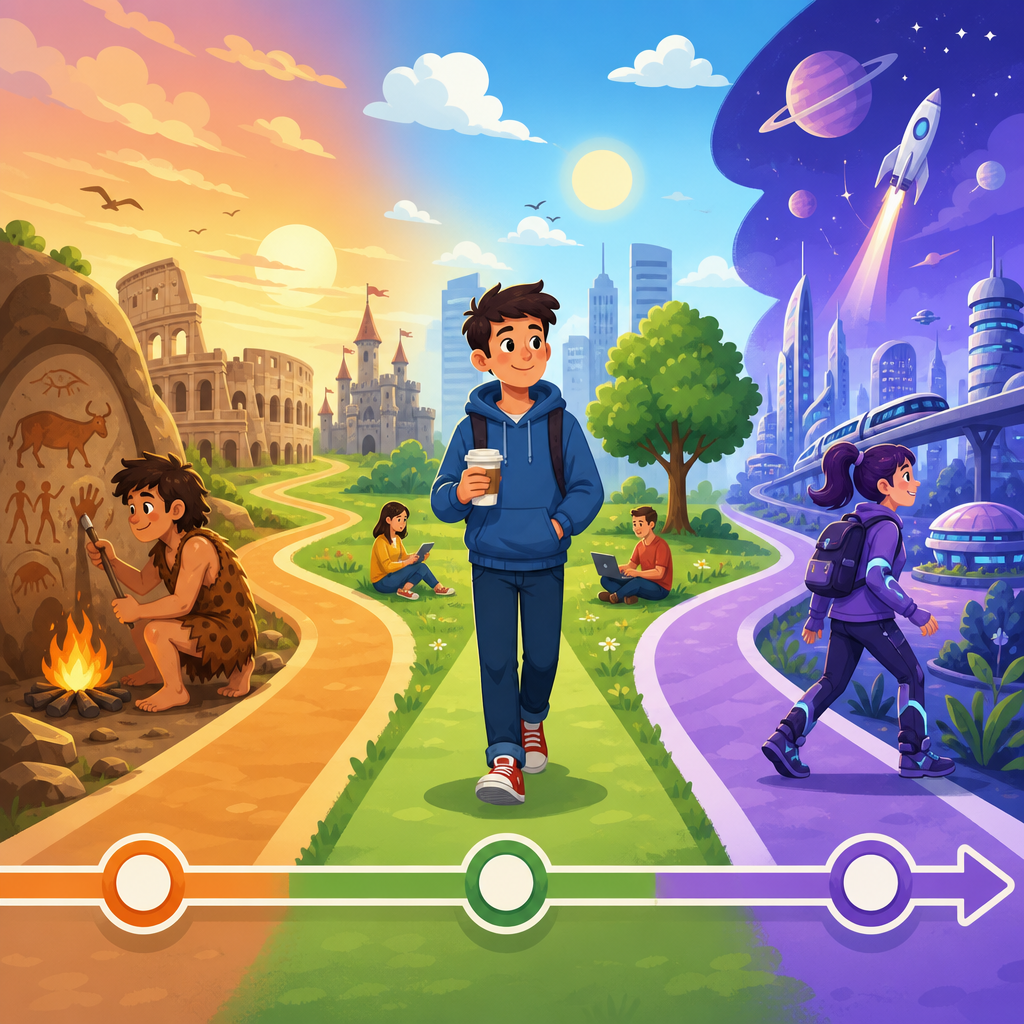
Understanding the timeline of English tenses is the fastest way to make verb forms feel logical instead of random. In ESL teaching, I have seen learners improve much faster once they stop memorizing isolated rules and start seeing tenses as a system that places actions in time, shows whether an action is complete or ongoing, and signals its relationship to another event. That is what a timeline of English tenses explained clearly should do: map meaning, not just endings.
English verb tenses combine time and aspect. Time places an event in the past, present, or future. Aspect shows whether the event is simple, ongoing, completed, or connected to another point in time. This is why English has more than three useful tense forms in practice. The core set usually taught in ESL grammar includes twelve patterns: simple, continuous, perfect, and perfect continuous across present, past, and future. Modal verbs, conditionals, and the passive voice matter too, but they build on this central tense framework.
Why does this topic matter so much? Because tense errors affect clarity immediately. If a learner says, “I lived here for five years,” the meaning differs from “I have lived here for five years.” The first often suggests the situation is finished; the second connects the past to now and usually means the person still lives there. In professional email, academic writing, interviews, and everyday conversation, these distinctions shape how accurate, polite, and credible a speaker sounds. A strong grasp of the English tense timeline also helps with reading because published English constantly shifts between time frames to show background, sequence, duration, and result.
This hub article covers verb tenses comprehensively by organizing them on a clear timeline, explaining how each tense works, and showing the practical choices native speakers make. If you have ever asked, “When do I use present perfect instead of past simple?” or “Why do we say will be doing?” this guide answers those questions directly. Treat it as your foundation for all ESL grammar work on verb tenses.
The big picture: how the English tense timeline works
The simplest way to understand English tenses is to imagine three anchor points: past, present, and future. Then add four views of the action: simple, continuous, perfect, and perfect continuous. Simple forms present an action as a fact, habit, event, or completed whole. Continuous forms focus on an action in progress around a time. Perfect forms show that one action happened before another reference point or has a present result. Perfect continuous forms emphasize duration leading up to a reference point.
For example, compare these four present forms. “I work” can describe a routine or general truth. “I am working” describes an activity happening now or around now. “I have worked” is uncommon alone but can report life experience or completed action with current relevance. “I have been working” emphasizes duration and suggests the activity started earlier and continues now or has just recently stopped. Once learners see these meaning patterns repeated across the timeline, the system becomes much easier.
Signal words can help, but they are not rules by themselves. Words like always, now, since, for, already, yesterday, while, by the time, and next week often point toward certain tenses. Still, context decides the final choice. I regularly tell students to ask three questions before choosing a tense: When is the action located? Is it finished or in progress? Is it connected to another time or result?
Present tenses: habits, current actions, and present results
The present simple is used for routines, facts, states, and scheduled events. “She teaches math.” “Water boils at 100 degrees Celsius.” “The train leaves at 6:10.” It also appears in instructions and headlines. Learners often overuse the present continuous because in many languages the present simple can sound too basic, but in English it is the default for habits and facts. Stative verbs such as know, believe, belong, need, and understand usually stay in the simple form, so “I know the answer” is correct, while “I am knowing” is not standard.
The present continuous shows an action happening now, around now, or as a temporary situation. “He is studying for his exams.” “We are staying with friends this month.” It also expresses changing situations, as in “Prices are rising,” and future arrangements, as in “I am meeting the dentist on Thursday.” In classroom correction, one common issue is forgetting that the continuous requires a form of be plus the -ing form: am working, is going, are learning.
The present perfect connects the past with the present. Use it for life experience, unfinished time periods, recent events with present importance, and situations that started in the past and continue now. “I have visited Seoul twice.” “She has lost her keys.” “We have lived here since 2021.” American and British usage differ slightly in some everyday contexts, but the core meaning is the same: the past event matters now. This tense often contrasts with past simple. “I lost my keys yesterday” gives a finished past time. “I have lost my keys” focuses on the current result: I do not have them now.
The present perfect continuous highlights duration or repeated activity leading up to the present. “They have been waiting for an hour.” “I have been working on this report all morning.” It is especially useful when the activity itself matters more than the finished result. If the result matters more, present perfect may be better: “I have written the report” means it is done; “I have been writing the report” means the process has occupied my time.
Past tenses: completed events, background actions, and earlier past
The past simple is the main tense for finished actions at a definite past time. “We launched the product in May.” “I called her last night.” It is the backbone of storytelling because it moves events forward in sequence. Learners should pay attention to irregular verbs such as went, saw, made, and took, since these forms carry a large share of everyday communication. Time expressions like yesterday, in 2019, two hours ago, and last week strongly align with past simple because they define a completed past frame.
The past continuous describes an action in progress at a past moment or a background scene interrupted by another event. “At 8 p.m., I was cooking.” “She was walking home when it started to rain.” In narratives, the past continuous paints the setting while the past simple delivers the main event. This division is one of the clearest timeline uses in English. “The crowd was cheering, the lights were flashing, and then the singer appeared.”
The past perfect places one past action before another past reference point. “By the time we arrived, the film had started.” “He had never flown before he moved abroad.” This tense prevents confusion when sequence matters. Without it, a sentence may still be understandable, but the order can become less precise. In professional writing, legal summaries, and academic case descriptions, the past perfect is essential because chronology must be exact.
The past perfect continuous emphasizes duration before a past point. “She had been studying for three hours before the test began.” “They had been living in Dubai before they relocated to Toronto.” In real usage, speakers choose this tense when they want to stress how long an earlier activity continued. It is less common than past simple and past continuous, but it is valuable in nuanced writing and advanced speaking.
Future forms: predictions, plans, and actions in progress later
English does not mark the future with a single verb ending the way some languages do, so learners need to understand future meaning through several forms. The most common is will plus base verb. Use it for predictions, spontaneous decisions, promises, and offers. “It will rain later.” “I will answer the door.” “We will send the invoice today.” This form is flexible and extremely common, but it is not the only way to talk about the future.
Be going to is often used for plans, intentions, or predictions based on current evidence. “I am going to start a new course next month.” “Look at those clouds. It is going to storm.” In spoken English, this frequently contracts to gonna, though learners should write the full form in formal contexts. The difference between will and going to is sometimes subtle, but one reliable guideline is this: use going to when the plan or evidence already exists before the moment of speaking.
The future continuous, formed with will be plus -ing, shows an action that will be in progress at a future time. “This time tomorrow, I will be flying to Madrid.” It can also soften questions politely: “Will you be using the conference room at 2?” The future perfect, will have plus past participle, marks completion before a future point. “By next June, she will have completed her residency.” The future perfect continuous emphasizes duration before that point: “By December, they will have been operating for ten years.” These forms appear less often in beginner materials, but they are common in business forecasts, project planning, and formal writing.
| Tense | Main use on the timeline | Example |
|---|---|---|
| Present simple | habit, fact, schedule | She works every Saturday. |
| Present continuous | action in progress now | She is working right now. |
| Present perfect | past connected to now | She has worked here since 2020. |
| Past simple | finished past event | She worked yesterday. |
| Past continuous | ongoing past background | She was working at 9 p.m. |
| Past perfect | earlier than another past event | She had worked there before she moved. |
| Will future | prediction, decision, promise | She will work tomorrow. |
| Future continuous | action in progress in the future | She will be working at noon. |
| Future perfect | completed before a future point | She will have worked ten hours by 6. |
The hardest contrasts learners must master
The most common problem area in verb tenses is the contrast between present perfect and past simple. The decision depends on whether the time is finished and stated. “I saw that movie last weekend” is correct because the time is definite and over. “I have seen that movie” is correct when the experience matters, not the exact time. Another high-frequency contrast is present simple versus present continuous: “He works from home” describes a routine, while “He is working from home this week” describes a temporary arrangement.
Past simple and past continuous also cause confusion. Use past continuous for the longer background action and past simple for the shorter interrupting event: “I was driving when my phone rang.” If both actions are short and sequential, use past simple for both: “I parked the car, locked the door, and ran inside.” Learners also struggle with stative verbs, which usually resist continuous forms. “I am loving it” works as advertising style, but standard grammar still prefers “I love it” in ordinary usage.
Future forms create another challenge because several options can be correct with slightly different meanings. “I will call you tonight” can be a promise or decision made now. “I am going to call you tonight” suggests an existing plan. “I am calling you tonight” often implies a fixed arrangement. Advanced fluency comes from choosing the form that matches intention, evidence, and context, not from forcing one future formula onto every sentence.
How to choose the correct tense in real communication
In real speaking and writing, tense choice is not about finding a single magic keyword. It is about reading the situation. I advise learners to build a three-step habit. First, identify the reference time: past, present, or future. Second, decide whether the action is complete, ongoing, repeated, or earlier than another event. Third, check whether the result matters now or at another reference point. This method works far better than memorizing lists.
Consider workplace examples. In a status meeting, “We completed phase one last Friday” uses past simple because the action is finished at a known time. “We have completed phase one” is useful when the result matters now and leads to the next step. “We are testing the software” shows current progress. “By the end of the quarter, we will have launched the platform” places completion before a future deadline. The same logic applies in academic essays, customer service, and daily conversation.
To improve quickly, study tenses in connected texts rather than isolated sentences. Notice how news articles use present simple in headlines, past simple for reported events, and present perfect for recent developments. Notice how stories alternate between past simple and past continuous. Keep a tense journal: each day, write one sentence for a habit, one for something happening now, one for a completed past event, and one for a future plan. If you want a practical next step in your ESL grammar study, review each tense with timeline diagrams and then practice choosing between close alternatives in realistic examples.
The timeline of English tenses explained well gives learners a map for every major verb choice. Instead of treating verb tenses as twelve unrelated rules, see them as repeated meaning patterns across past, present, and future. Simple forms show facts and completed events. Continuous forms show actions in progress. Perfect forms connect one time to another. Perfect continuous forms emphasize duration. Once those ideas are clear, tense selection becomes a matter of meaning, not guesswork.
As a hub for verb tenses in ESL grammar, this guide should help you recognize what each tense does, why certain contrasts matter, and how native-level clarity depends on timeline control. Start by mastering the high-frequency forms—present simple, present continuous, past simple, and present perfect—then add the others through reading, listening, and deliberate practice. Revisit this page whenever you need a clear overview, and use it as your base for deeper study of each individual tense.
Frequently Asked Questions
What does a timeline of English tenses actually show?
A timeline of English tenses shows where an action happens in relation to time: past, present, or future. More importantly, it also shows how the speaker sees that action. Is it finished? Is it still happening? Did it happen before another event? This is why a good tense timeline is so useful. It helps learners understand that tense is not only about when something happens, but also about duration, completion, and connection to other actions.
For example, “I ate,” “I was eating,” and “I had eaten” all refer to the past, but they do not mean the same thing. “I ate” presents the action as a completed fact. “I was eating” shows the action in progress at a particular moment in the past. “I had eaten” places the action before another past event. On a timeline, these differences become much easier to see than if students only memorize grammar formulas. That is why teachers often use timelines to turn abstract rules into something visual, logical, and easier to remember.
Why is learning tenses through a timeline better than memorizing rules one by one?
Learning tenses through a timeline is often faster and more effective because it gives structure to the whole tense system. Many learners struggle when they study tenses as isolated grammar topics: present simple this week, present perfect next week, past continuous later. The result is usually confusion, because the learner knows the form but not the underlying logic. A timeline changes that by showing how the tenses relate to each other.
When learners see that the present simple is often used for routines and general truths, the present continuous for actions happening around now, the past simple for finished past events, and the present perfect for past actions connected to the present, the system starts to feel meaningful. Instead of asking, “Which rule do I memorize?” they begin asking, “How does this action sit in time?” That shift is powerful. It makes tense choice more intuitive and helps students use grammar actively in speaking and writing rather than just recognize it in exercises.
How do simple, continuous, perfect, and perfect continuous tenses fit on a timeline?
These four aspects are the key to understanding the full timeline of English tenses. The simple aspect usually presents an action as a fact, habit, or complete event. The continuous aspect shows an action in progress. The perfect aspect connects one time to an earlier action, often emphasizing completion or result. The perfect continuous aspect combines both ideas, highlighting duration over time and often continuing relevance.
For example, compare these present forms: “I work” suggests a routine or general fact, “I am working” shows an action happening now or around now, “I have worked” links a past action to the present, and “I have been working” emphasizes ongoing activity or duration up to the present. The same logic carries into past and future forms. “I was working” means the action was in progress in the past, “I had worked” means it happened before another past point, and “I will have been working” looks ahead to a future moment and measures duration up to that time. Once learners understand aspect on the timeline, the tense system becomes much more organized and far less intimidating.
Which English tenses are usually the most difficult for ESL learners, and why?
The tenses that cause the most difficulty are usually the present perfect, present perfect continuous, past perfect, and future perfect. The reason is simple: these tenses do not only locate actions in time, they also express relationships between different time points. That extra layer makes them harder than straightforward forms like the past simple or present continuous.
The present perfect is especially challenging because many learners want to attach it to a specific finished past time, which English usually does not allow. For example, “I visited London last year” is correct, but “I have visited London last year” is not. The present perfect needs a connection to now, not a finished time marker. The past perfect can also be confusing because it requires two points in the past: one earlier and one later. In “By the time she arrived, I had left,” the leaving happened first, and the arrival happened second. A timeline makes these relationships visible. That is exactly why it is such a practical teaching tool for difficult tenses: it reduces confusion by showing sequence, overlap, completion, and duration clearly.
How can I use a timeline to choose the correct tense when speaking or writing?
The best way to use a timeline is to ask a few simple questions before choosing the verb form. First, when does the action happen: past, present, or future? Second, is the action complete or still in progress? Third, is it connected to another event or time point? These questions guide you toward the right tense much more reliably than trying to remember a long list of disconnected rules.
For example, if you want to describe a routine, the timeline points you toward the present simple: “I study every morning.” If you want to describe something happening now, the present continuous fits: “I am studying right now.” If you want to explain that an earlier past action happened before another past event, the timeline leads you to the past perfect: “I had studied before the test started.” If you want to show duration from the past up to the present, the present perfect continuous may be best: “I have been studying for three hours.” With practice, this timeline-based thinking becomes automatic. Instead of guessing, you begin matching meaning to form, which is the real goal of mastering English tenses.