Parts of speech are the categories that describe how words function in a sentence, and mastering them is one of the fastest ways to make English grammar clearer, more predictable, and easier to use. For ESL learners, teachers, and writers, the parts of speech provide a practical map of the language: they show which words name people or things, which words describe them, which words express action, and which words connect ideas. When I teach grammar, I do not start with abstract rules about “correctness.” I start with function. If a learner can identify whether a word is acting as a noun, verb, adjective, adverb, pronoun, preposition, conjunction, interjection, or determiner, sentence structure begins to make sense.
In English, the term “parts of speech” refers to traditional word classes. Some grammar books list eight parts of speech, while modern reference grammars often separate determiners from adjectives, making nine major categories. Both systems are useful, but for a complete guide, it is best to include determiners as their own group because words like the, this, and some behave differently from descriptive adjectives like blue or careful. Understanding this distinction helps learners answer common questions such as: Why can we say the red car but not usually red the car? Why can one word belong to more than one category? And why do dictionary labels matter?
This topic matters because parts of speech sit underneath every core grammar skill in ESL: sentence building, word order, punctuation, verb tenses, agreement, clause formation, and vocabulary development. They also support reading comprehension. If you can spot the subject noun, the main verb, and the connecting preposition in a sentence, you can decode meaning faster. On exams such as IELTS, TOEFL, and Cambridge English assessments, learners are constantly tested on these patterns, even when the test does not ask about them directly. In real communication, strong control of word classes helps speakers choose natural phrasing, avoid common errors, and expand simple sentences into more precise ones.
This complete guide explains each major part of speech in plain terms, shows how they work in context, and highlights important exceptions. It is designed as a hub page for ESL grammar, so each section gives the foundation you need before moving into deeper topics such as countable and uncountable nouns, auxiliary verbs, adjective order, phrasal verbs, relative pronouns, articles, prepositions of time, coordinating conjunctions, and sentence adverbs.
Nouns, pronouns, and determiners: the words that identify people, things, and reference
Nouns are words that name people, places, things, ideas, or events. Examples include teacher, London, table, freedom, and meeting. In sentences, nouns commonly act as subjects, objects, and complements: The teacher explained the lesson; We visited London; Her goal is freedom. Nouns can be common or proper, countable or uncountable, concrete or abstract. These distinctions matter because they control article use, plural forms, and verb agreement. For example, advice is uncountable, so learners say some advice, not an advice.
Pronouns replace nouns or noun phrases to avoid repetition and make sentences more natural. Personal pronouns include I, you, he, she, it, we, and they. English also uses object pronouns such as me, him, and them; possessive forms such as my, your, and their; reflexive pronouns such as myself and themselves; and relative pronouns such as who, which, and that. One practical rule I stress with learners is that pronoun choice depends on grammatical role, not just meaning. We say She called him, not Her called he, because English distinguishes subject and object forms.
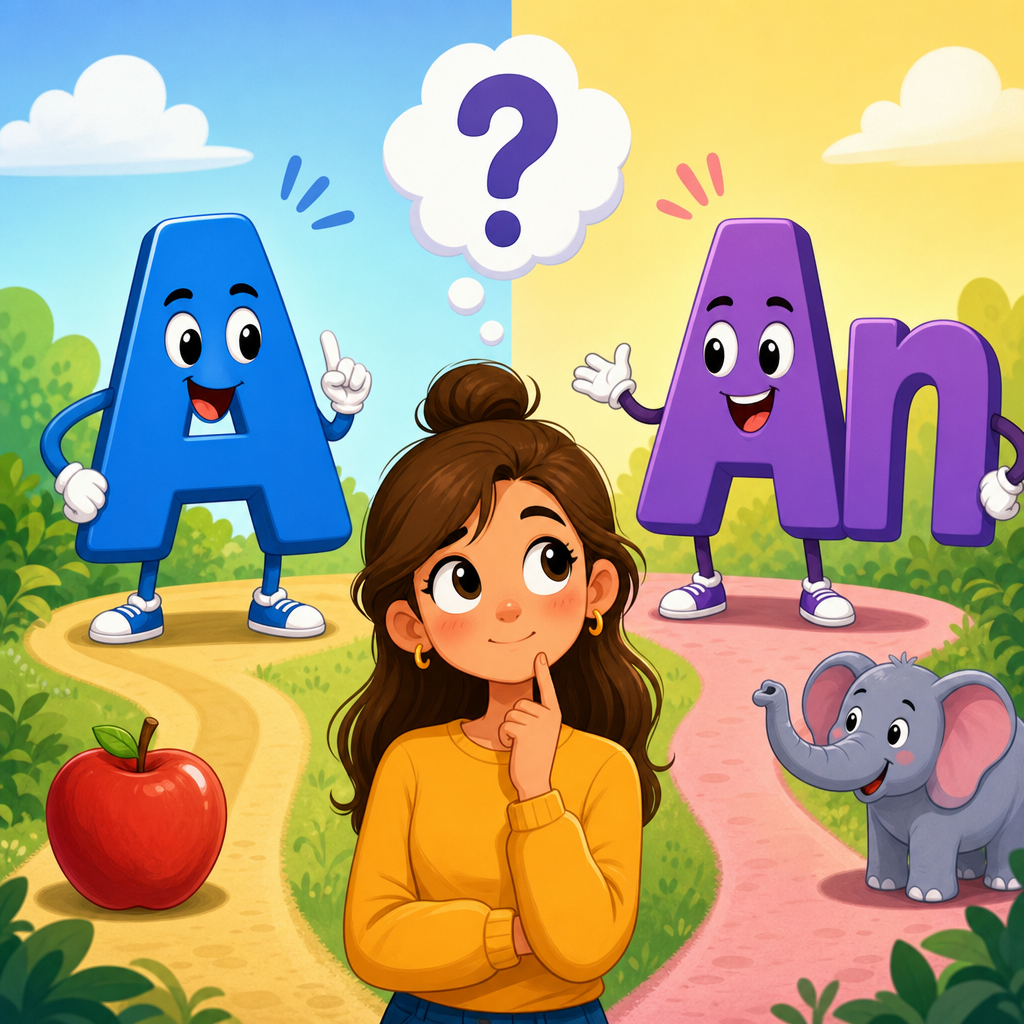
Determiners come before nouns and specify reference, quantity, possession, or definiteness. Articles are determiners: a, an, and the. Demonstratives such as this, that, these, and those also belong here, along with possessives like my and their, quantifiers like some, many, few, and numbers like three. In standard English, determiners usually appear at the beginning of a noun phrase: the book, my new laptop, those two large boxes. This is why determiners are central to article errors in ESL. Learners often know the noun but not whether it needs a determiner.
A useful way to analyze noun phrases is to start with the noun head and work outward. In those three excellent restaurants, the head is restaurants, excellent is an adjective, three is a numeral determiner, and those is a demonstrative determiner. Seeing these layers helps learners produce accurate word order and understand how reference is built.
Verbs: the engine of the sentence
Verbs express actions, processes, states, or events, and every complete English clause needs a verb. Main verbs carry lexical meaning, as in run, think, build, and exist. Auxiliary verbs support grammar. The primary auxiliaries are be, have, and do; modal auxiliaries include can, could, may, might, must, shall, should, will, and would. In She has finished her work, has is an auxiliary and finished is the main verb. In They can swim, can expresses ability and swim carries the core meaning.
English verbs change form for tense and aspect, though less heavily than in many languages. Common forms include the base form, third-person singular present, past tense, present participle, and past participle: write, writes, wrote, writing, written. These forms combine into major patterns such as simple, progressive, perfect, and perfect progressive. Learners often improve quickly once they see that verb systems are built from a small set of recurring structures rather than isolated rules. The Common European Framework of Reference encourages this functional approach because learners need to connect form with communicative purpose.
Another essential distinction is between transitive and intransitive verbs. A transitive verb takes a direct object: She opened the window. An intransitive verb does not: The baby slept. Some verbs can be both, depending on context, such as run in He runs every morning and She runs a company. Linking verbs such as be, seem, and become connect the subject to a complement: The soup smells good. This explains why we say good, an adjective, after smells, not well, unless we mean the manner of smelling.
| Part of speech | Main function | Example words | Example in a sentence |
|---|---|---|---|
| Noun | Names a person, place, thing, or idea | student, city, music | The student loves music. |
| Pronoun | Replaces a noun phrase | she, they, which | She arrived early. |
| Verb | Shows action, state, or process | write, is, have | They are writing now. |
| Adjective | Describes a noun | small, useful, tired | We bought a useful guide. |
| Adverb | Modifies a verb, adjective, or clause | quickly, very, fortunately | Fortunately, we arrived on time. |
| Preposition | Shows relationship in time, place, or logic | in, on, with | The keys are on the desk. |
| Conjunction | Connects words or clauses | and, but, because | I stayed because it rained. |
| Interjection | Expresses emotion or reaction | oh, wow, ouch | Wow, that was fast. |
| Determiner | Introduces and limits a noun | the, some, those | Those apples are fresh. |
One challenge for ESL learners is that English often uses multi-word verbs. Phrasal verbs such as give up, turn on, and look after combine a verb with a particle or preposition, sometimes creating meanings that are not predictable from the individual words. That is why verb study cannot stop at single-word definitions. Real fluency depends on recognizing pattern, valency, and collocation.
Adjectives and adverbs: the words that add detail
Adjectives describe or classify nouns. They can express qualities, size, age, color, origin, material, or purpose: a smart student, an old building, a French film, a wooden chair. In English, adjectives usually appear before nouns or after linking verbs: a difficult exam, The exam was difficult. Unlike many languages, English adjectives do not change for gender or number, which simplifies agreement but makes word order more important. The standard sequence, often taught as opinion, size, age, shape, color, origin, material, purpose, noun, explains why a lovely small old round brown Italian wooden coffee table sounds natural while other orders do not.
Adverbs modify verbs, adjectives, other adverbs, or entire clauses. Manner adverbs answer how: She spoke clearly. Degree adverbs answer to what extent: very difficult, extremely slowly. Frequency adverbs answer how often: always, usually, rarely. Sentence adverbs comment on the whole statement: Fortunately, nobody was hurt. A common ESL mistake is assuming that all adverbs end in -ly. Many do, but important adverbs do not, including well, fast, hard, late, and often. Some -ly words are adjectives, such as friendly and likely.
Placement matters. Frequency adverbs often come before the main verb but after be: She usually walks to work, but She is usually on time. Degree adverbs typically come before the word they modify: quite interesting, really slowly. Sentence adverbs usually appear at the beginning, though they can move: Honestly, I forgot. Precise placement affects tone and emphasis, so learners benefit from studying complete sentence patterns rather than single words in isolation.
Prepositions, conjunctions, and interjections: the words that connect ideas and express reaction
Prepositions show relationships involving time, place, direction, cause, means, or association. Common examples include in, on, at, by, for, with, from, and between. In We met at the station on Friday, the prepositions mark place and time. In The report was written by Maria, by shows agency. Prepositions are notoriously difficult because usage depends on convention as much as logic. We say interested in, depend on, and good at because these are established patterns. Corpus-based tools such as the Cambridge Dictionary, Collins COBUILD, and the British National Corpus are valuable because they show authentic combinations.
Conjunctions connect words, phrases, or clauses. Coordinating conjunctions join equal elements: and, but, or, nor, for, so, and yet. Subordinating conjunctions introduce dependent clauses: because, although, if, when, while, and since. Correlative conjunctions work in pairs, such as either…or and not only…but also. These words are central to sentence variety. Compare I stayed home. It was raining with I stayed home because it was raining. The conjunction makes the relationship explicit.
Interjections express sudden feeling, reaction, or discourse management. Examples include oh, wow, oops, hey, and ouch. In conversation analysis, many of these items do more than show emotion; they help manage interaction, signal surprise, attract attention, or soften responses. Although interjections receive less space in textbooks, they matter for natural spoken English and pragmatic competence.
Why parts of speech can be confusing in English
The hardest truth for learners is that a word’s part of speech depends on how it functions in a specific sentence, not only on its dictionary meaning. English allows conversion, also called zero derivation, where one form shifts category without a visible ending. Email can be a noun or a verb. Fast can be an adjective or an adverb. Before can function as a preposition, conjunction, or adverb depending on structure. This flexibility is normal English, not an exception to be ignored.
Another source of confusion is that school grammar and modern linguistic grammar sometimes use different labels. For practical ESL instruction, the best approach is functional and evidence-based: identify what the word is doing in the sentence, look at its position, and test which words can replace it. If a word can take tense or follow a modal, it is functioning as a verb. If it introduces a noun, it is likely a determiner. If it links clauses, it is functioning as a conjunction. This method works better than memorizing isolated lists.
The most reliable way to learn parts of speech is through repeated analysis of real sentences. Use graded readers, news articles, and listening transcripts. Underline nouns, circle verbs, and label connectors. Then build your own examples. Over time, patterns become automatic. If you are studying ESL grammar seriously, use this hub as your starting point and move next into detailed lessons on nouns, verbs, articles, pronouns, modifiers, and sentence structure.
Parts of speech are not just grammar terminology; they are the framework that makes English understandable and usable. Once you know how each category works, you can read with more confidence, write with greater accuracy, and speak in clearer, more natural sentences. The key points are simple: nouns name, pronouns replace, determiners specify, verbs drive the clause, adjectives describe, adverbs modify, prepositions relate, conjunctions connect, and interjections react. English becomes easier when you focus on function instead of memorizing random rules.
For ESL learners, this knowledge pays off immediately. It improves article choice, verb forms, word order, sentence variety, and error correction. It also gives you a structure for expanding vocabulary, because every new word can be learned together with its category, pattern, and common collocations. That is how grammar moves from theory into practical skill.
Use this guide as your hub for the wider ESL grammar topic, then continue with focused study on each word class in context. Review examples, analyze authentic sentences, and practice building your own. When you can identify the parts of speech quickly, you unlock the rest of English grammar.
Frequently Asked Questions
What are the parts of speech in English, and why do they matter?
The parts of speech are the main categories that explain how words function in a sentence. In traditional English grammar, these categories usually include nouns, pronouns, verbs, adjectives, adverbs, prepositions, conjunctions, interjections, and, in many modern explanations, articles or determiners. Each group does a different job. Nouns name people, places, things, or ideas. Verbs express actions, events, or states of being. Adjectives describe nouns. Adverbs modify verbs, adjectives, or other adverbs. Prepositions show relationships such as time, place, direction, or cause. Conjunctions connect words and ideas. Pronouns stand in for nouns, and interjections express emotion or reaction.
They matter because they make grammar easier to understand in practical terms. Instead of memorizing rules in isolation, learners can look at a sentence and ask what each word is doing. That simple shift makes English feel more organized and predictable. For ESL learners, this is especially helpful because it builds sentence awareness. For teachers, it offers a clear framework for explaining grammar. For writers, it improves accuracy, variety, and style. Once you understand the parts of speech, it becomes much easier to identify sentence patterns, avoid common mistakes, and build clearer, more natural English.
How many parts of speech are there in English?
The most common answer is eight, but many modern grammar resources teach nine. The traditional list includes noun, pronoun, verb, adjective, adverb, preposition, conjunction, and interjection. However, many teachers and textbooks separate articles and determiners into their own category because words like a, an, the, this, those, and my play a very specific role in introducing and identifying nouns. That is why you may see slightly different counts depending on the grammar system being used.
This difference does not mean grammar is inconsistent; it simply reflects different teaching approaches. The important point is not the number itself but the function of each category. If a learner understands how words behave in real sentences, they can work successfully with either system. In a practical classroom or writing context, it is often best to focus on the core question: what job is this word doing here? That approach is more useful than worrying too much about whether a source lists eight parts of speech or nine.
Can a word belong to more than one part of speech?
Yes, and this is one of the most important ideas to understand. In English, many words can function as more than one part of speech depending on how they are used in a sentence. For example, book can be a noun in “The book is on the table,” but it can also be a verb in “I need to book a ticket.” The word fast can be an adjective in “a fast car” and an adverb in “She runs fast.” The word light can be a noun, an adjective, or a verb in different contexts.
This is why strong grammar teaching focuses on function, not just word lists. A dictionary may give several possible labels for a word, but the sentence determines which one is active. That is also why learners sometimes feel confused when trying to memorize vocabulary in isolation. The better strategy is to study words inside complete examples. When you ask how a word is working in a sentence, the part of speech usually becomes much clearer. This habit improves reading comprehension, sentence building, and editing because it trains you to notice structure instead of guessing based on appearance alone.
What is the easiest way to identify the part of speech of a word in a sentence?
The easiest and most reliable method is to look at the word’s job, position, and relationship to the words around it. Start by identifying the sentence core: who or what the sentence is about, and what is happening. That usually helps you find the noun or subject and the verb first. Then look for words that describe the noun, which are often adjectives, and words that modify the verb, adjective, or another adverb, which are often adverbs. Next, notice words that show relationships such as in, on, after, or between; these are typically prepositions. Words that connect ideas, such as and, but, and because, are conjunctions.
It also helps to use a few test questions. Is the word naming something? It may be a noun. Is it replacing a noun? It may be a pronoun. Is it showing action or a state? It is likely a verb. Is it describing a noun? It is probably an adjective. Is it modifying how, when, where, or to what degree something happens? It may be an adverb. Over time, repeated practice with short sentences builds confidence very quickly. The key is not to identify words by intuition alone, but to examine how each word contributes to meaning and structure. That process turns grammar from a list of labels into a practical reading and writing skill.
How does learning the parts of speech improve speaking and writing?
Learning the parts of speech improves speaking and writing because it gives you a clear framework for building sentences that are accurate, varied, and easy to understand. When you know how word categories work, you can create stronger sentence patterns on purpose rather than by trial and error. For example, if you understand verbs well, you can choose more precise actions. If you understand adjectives and adverbs, you can add detail without creating confusion. If you understand conjunctions and prepositions, you can connect ideas more smoothly and show relationships more clearly.
This knowledge also makes editing much easier. Writers who understand parts of speech are better at spotting missing verbs, vague pronoun references, weak modifiers, and awkward sentence structure. Speakers benefit too, especially ESL learners, because grammar becomes less abstract and more usable in real conversation. Instead of trying to remember isolated correction rules, they can build sentences from functional pieces. That leads to greater fluency, better self-correction, and more confidence. In short, mastering the parts of speech does not just help you label words; it helps you control how English works, which is one of the fastest ways to make your grammar clearer and more effective.